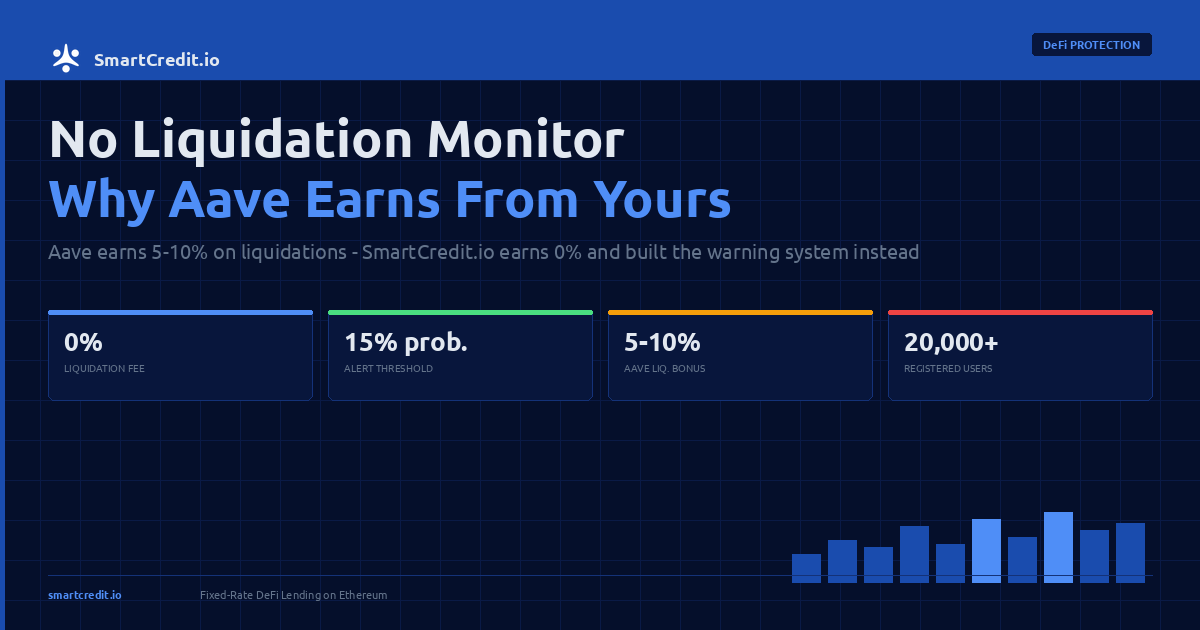
Aave V3 is the largest DeFi lending protocol by total value locked. Its engineering team is well-resourced, its smart contracts are audited, and its governance is active. Yet Aave has never built a tool that warns borrowers before their positions are liquidated. This is not an oversight. The absence of a DeFi liquidation monitor on Aave, Compound and MakerDAO reflects a structural conflict of interest – these protocols earn 5-10% on every liquidation event, run their own liquidation bots, and have no financial incentive to reduce the number of liquidations. SmartCredit.io earns 0% on liquidations. That is why SmartCredit.io built the Protection Agent.
Last Updated: November 2026
The Feature That Does Not Exist on Aave or Compound
Log into Aave V3. Navigate to your borrowing position. You will find a health factor – a ratio that tells you how close your position is to the liquidation threshold at this exact moment. What you will not find is a notification system that alerts you before that health factor reaches 1.0, a probability calculation that estimates how quickly market volatility might push you there, or a Telegram message that fires in time for you to act.
These features are absent from Aave. They are absent from Compound Finance. They are absent from MakerDAO. All three protocols offer sophisticated borrowing products used by hundreds of thousands of users. All three have the engineering capability to build a DeFi liquidation monitor. None have done so.
The standard explanation offered in community discussions is that liquidation bots are “open to anyone” and that the market provides this service. However, this framing sidesteps the question. The issue is not whether anyone can run a liquidation bot – it is whether the protocol should warn borrowers before the bots arrive. Those are entirely different functions, and the protocols have built one but not the other.
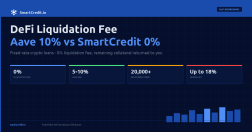
Understanding why requires understanding how liquidation revenue works in DeFi – and whose interests it serves. As covered in our detailed comparison of DeFi liquidation fees, Aave charges 5-10% of collateral as a liquidation bonus. That bonus is paid to whoever repays the borrower’s debt first – and in practice, the fastest actors are well-capitalised bots with direct protocol knowledge. The revenue flows somewhere. Following that flow explains the missing feature.
How DeFi Liquidations Work – and Where the Warning Should Come
When you borrow on Aave V3, your position is tracked by a health factor – the ratio of your collateral value to your outstanding debt, adjusted for each asset’s liquidation threshold. A health factor above 1.0 means your position is safe. A health factor below 1.0 means your position is eligible for liquidation immediately.
The transition from safe to liquidatable can happen rapidly during market volatility. ETH, for example, has historically experienced intraday price drops of 15-25% during significant market events. If your ETH health factor is 1.2 when such a move begins, you may cross the liquidation threshold before you have time to add collateral or repay – especially if you are not monitoring your position in real time.
A well-designed DeFi liquidation monitor would not simply check the current health factor. It would model the probability of reaching the liquidation threshold given the current collateral asset’s historical volatility and the remaining loan term. A position with a health factor of 1.4 backed by a highly volatile token is genuinely riskier than a position at 1.3 backed by ETH – but a snapshot of the health factor alone does not reveal this. Probability-based monitoring is therefore more actionable than ratio-based monitoring.
The Health Factor Snapshot Problem
Aave’s health factor is a snapshot: it reflects the current state of your position at the moment you check it. It does not tell you how quickly your collateral could move to the liquidation threshold, how likely that move is over your loan’s remaining term, or what market conditions would need to occur to trigger liquidation.
Consequently, borrowers using the health factor alone as their risk signal are relying on a lagging indicator. By the time the health factor reaches a critical level, the market move that caused it may already be accelerating. Acting on a health factor of 1.1 is significantly harder than acting on an alert that your liquidation probability has risen above 15% when your health factor was still 1.4.
This is precisely the gap that a DeFi liquidation monitor – built on volatility-based probability modelling rather than ratio snapshots – could fill. Aave has not built this. The question is why.
What a Genuine Liquidation Warning System Would Include
A well-designed borrower protection system for a lending protocol would include at minimum: persistent monitoring of collateral values relative to liquidation thresholds, probability calculation derived from collateral volatility, real-time alerts delivered through a channel the borrower actively uses (such as Telegram or email), and enough lead time for the borrower to respond before liquidation occurs.
None of these features are technically complex. They require an off-chain monitoring service, access to on-chain position data (which is public), a volatility model (standard financial mathematics), and an alert delivery mechanism. For a protocol with Aave’s engineering resources and revenue, the build cost would be negligible compared to the value delivered to users.
Yet the feature has not been built. The complete guide to avoiding crypto loan liquidation covers in detail what tools and strategies are currently available to borrowers – and notably, none of them come from Aave or Compound directly.
SmartCredit.io
The DeFi liquidation monitor Aave never built
Protection Agent monitors Aave V3 and Compound V3 positions and sends Telegram alerts before liquidation – based on probability, not just the health factor. Free to use, no wallet connection required.
Set up Protection Agent →Why Aave Earns Revenue From Liquidating Its Own Users
When an Aave V3 position is liquidated, the liquidator – whoever repays the borrower’s debt – receives the repaid amount plus a liquidation bonus. This bonus is set per asset in Aave’s risk parameters: typically 4.5-5% for stablecoins, 5-10% for ETH and wBTC, and up to 15% for more volatile assets.
The liquidation bonus does not go to lenders. It does not go to the protocol treasury directly. It goes to the liquidator – the entity that executes the transaction. This creates a competitive market for liquidation execution, which Aave presents as a feature: open, permissionless and efficient.
In practice, however, the liquidation market is not equally accessible. Profitable liquidation requires capital, speed, low-latency connections to the blockchain, and sophisticated tooling to identify liquidatable positions before other actors. These requirements mean that the liquidation market is dominated by well-resourced, technically sophisticated actors – not ordinary DeFi participants.
Liquidation Bots: Open to Anyone in Theory
Aave’s governance documentation notes that the liquidation system is open to any third party. This is technically correct. The smart contracts are permissionless. Any wallet can repay a borrower’s debt and claim the liquidation bonus, provided it has sufficient capital and executes the transaction before competing actors.
However, “open to anyone” in a smart contract context means open to whoever can win a mempool race with capital and technology advantages. In this environment, protocol-connected entities – those with direct knowledge of risk parameters, early access to protocol updates and significant capital reserves – consistently outperform independent actors in capturing liquidation revenue.
The result is that liquidation revenue, while theoretically distributed across all liquidators, flows primarily to a small number of sophisticated actors with structural advantages. DeFi Llama’s protocol data shows that Aave has processed hundreds of millions of dollars in liquidations over its lifetime. The revenue from those events – the 5-10% bonus on each liquidated amount – represents a substantial income stream for whoever captures it consistently.
MakerDAO Publishes Liquidation Revenue as Protocol Income
MakerDAO provides the clearest illustration of how liquidation revenue integrates into protocol economics. MakerDAO charges a liquidation penalty – historically around 13% – on vaults that reach the liquidation threshold. This penalty is split between the liquidator (who receives a bonus for executing the liquidation) and the Maker protocol treasury (which retains a portion as income).
MakerDAO governance forums and financial reports have included liquidation income as a line item in protocol revenue analysis. This confirms that liquidation events are not simply a mechanism to protect lenders – they are a revenue source for the protocol ecosystem. When you are liquidated on MakerDAO, part of the penalty accrues to MakerDAO itself.
The implications of this structure are significant. A protocol that earns revenue from liquidations has a financial interest in liquidations occurring. Building a system that significantly reduces liquidations – by warning borrowers in advance and enabling them to avoid the threshold – would directly reduce this revenue stream. The incentive to build such a system therefore works against the protocol’s financial interests.
The Conflict of Interest That Explains the Missing Monitor
The argument is straightforward. Aave earns liquidation revenue. A DeFi liquidation monitor would reduce liquidations. Therefore, Aave has a financial disincentive to build a liquidation monitor. This is a structural conflict of interest, and it explains a feature absence that would otherwise be puzzling for a well-resourced, borrower-facing protocol.
It is worth being precise about what this argument does and does not claim. It does not claim that Aave is acting in bad faith or that its team has explicitly decided not to build a warning system in order to maximise liquidation revenue. The conflict of interest operates at an incentive level, not necessarily at an intentional level. When an organisation’s revenue is tied to a particular outcome, it tends not to invest in preventing that outcome – regardless of whether the connection is acknowledged explicitly.
Furthermore, Aave’s governance is decentralised. Protocol development priorities are set through token-weighted voting. Token holders who benefit from liquidation revenue – including protocol treasury holders and entities that run liquidation bots – participate in governance decisions about what to build. This governance structure amplifies the conflict of interest at the protocol level, as it gives revenue-aligned stakeholders influence over product development decisions.
By contrast, SmartCredit.io’s revenue model is built entirely around the spread between borrower interest rates and lender yields, plus a portion of interest payments into the Loss Provision Fund. SmartCredit.io earns 0% on liquidations. Every liquidation event is a cost to SmartCredit.io, not a revenue opportunity. This reversal of incentives is precisely why SmartCredit.io invested in building a DeFi liquidation monitor – both for its own borrowers (built-in as positions monitoring in Advanced Borrowing mode) and for Aave V3 and Compound V3 users.
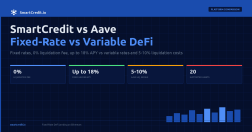
For a broader comparison of how fixed-rate and variable-rate DeFi lending platforms differ in their structural incentives, the SmartCredit.io fixed vs variable rate comparison covers the key dimensions.
What SmartCredit.io Built: The Protection Agent
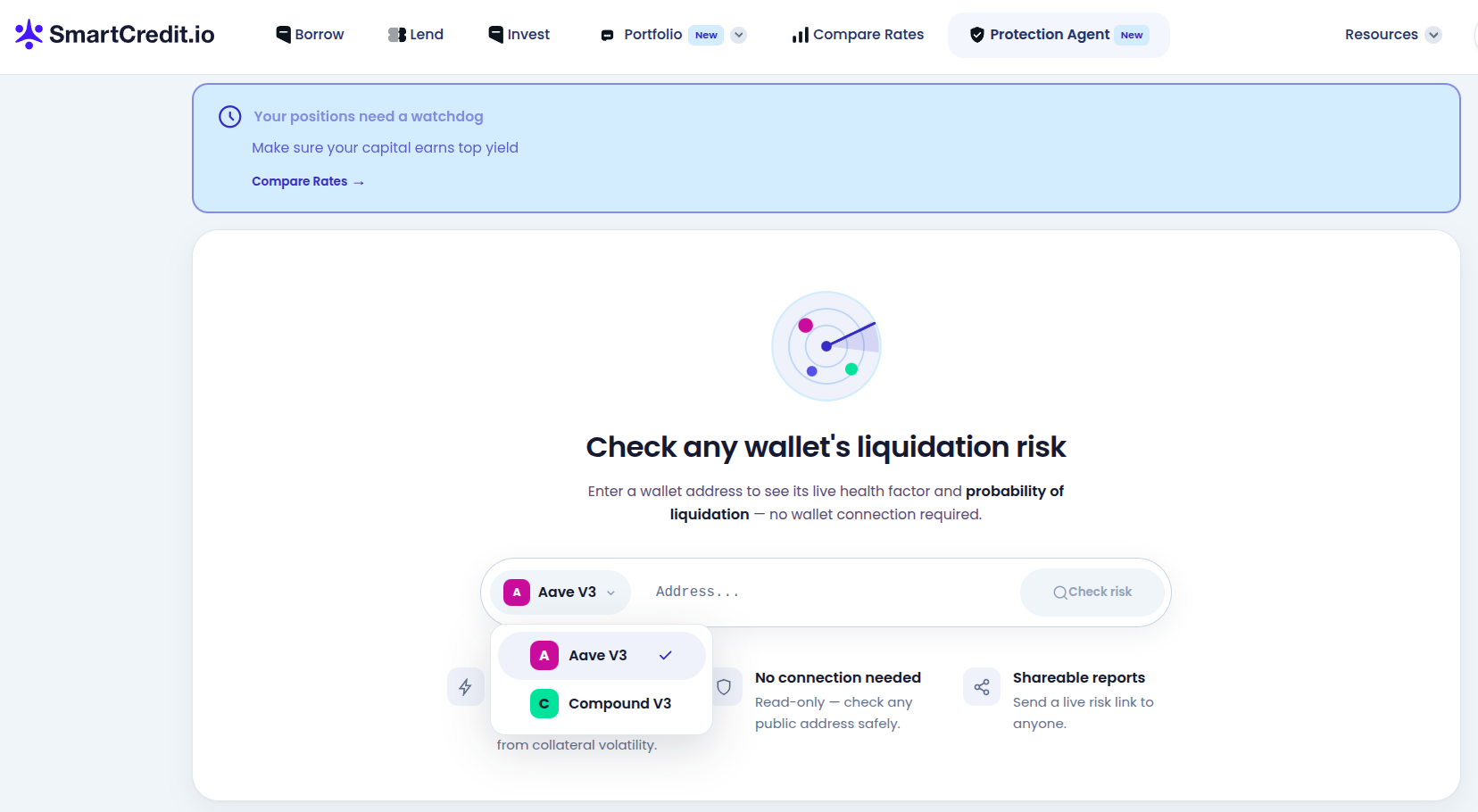
SmartCredit.io’s Protection Agent is a DeFi liquidation monitor available at smartcredit.io/protection-agent. It monitors Aave V3 and Compound V3 positions and sends Telegram alerts when liquidation probability – derived from collateral volatility – exceeds the alert threshold. It is free to use, requires no wallet connection to check risk on any public address, and supports up to nine monitored positions per account.
The Protection Agent addresses the core gap in Aave’s borrower protection: it provides a forward-looking probability estimate rather than a backward-looking ratio snapshot. When your Aave V3 position reaches a critical probability level, you receive a Telegram message with enough lead time to add collateral or repay part of the loan – before Aave’s liquidation bots execute the transaction.
Probability-Based Alerts, Not Just Health Factor Snapshots
The key technical distinction in the Protection Agent’s approach is the use of liquidation probability rather than the health factor alone. The health factor tells you where your position is now. Liquidation probability tells you how likely your position is to reach the liquidation threshold given current market conditions and collateral volatility.
A position with a health factor of 1.5 backed by a highly volatile ERC-20 token may have a liquidation probability of 30%. A position with a health factor of 1.3 backed by ETH may have a liquidation probability of 8%. The health factor alone suggests the first position is safer. The probability calculation reveals the opposite.
By firing alerts at 15% liquidation probability, the Protection Agent provides early warnings while the health factor is still comfortably above 1.0, giving borrowers the maximum available time to respond. This is the approach that Aave should offer to its own users – and the approach it has not built, for the reasons described above.
Monitor Any Aave V3 or Compound V3 Wallet Without Connecting Yours
One of the Protection Agent’s most practical features is that it can monitor any public wallet address. You do not need to connect your own wallet to check risk on a position. Enter any Ethereum address, select Aave V3 or Compound V3 as the protocol, and the tool returns a live health factor, liquidation probability, collateral breakdown and debt summary.
This functionality is useful in several scenarios. You may want to monitor a hardware wallet address without connecting it to a web application. You may want to track the positions of a DeFi protocol, a DAO treasury or a known whale address for market intelligence. You may want to check a family member’s position on their behalf. In all these cases, the Protection Agent works without requiring custody of any private keys.
To set up active monitoring with Telegram alerts, you do connect your wallet – but only to manage your subscription settings, not to authorise any transaction. The Protection Agent documentation covers the four-step setup process in detail.
How the Alert Threshold and Risk Tiers Work
The Protection Agent displays each monitored position with a risk tier based on the current health factor:
| Health factor | Risk tier | Recommended action |
|---|---|---|
| Below 1.0 | Liquidatable | Position is already eligible – act immediately |
| 1.0 – 1.2 | Critical | Liquidation imminent – add collateral or repay now |
| 1.2 – 1.35 | Danger | High risk – consider reducing exposure |
| 1.35 – 1.5 | Warning | Elevated risk – monitor closely |
| 1.5 – 2.0 | Watch | Moderate risk – safe under normal conditions |
| Above 2.0 | Safe | Low liquidation risk |
Telegram alerts fire before the position reaches the Critical tier – when the probability model indicates elevated risk while the health factor is still in the Watch or Warning range. This lead time is what distinguishes the Protection Agent from simply checking the Aave interface periodically.
Why SmartCredit.io Had No Conflict of Interest in Building This
SmartCredit.io built the Protection Agent for external protocol users – Aave V3 and Compound V3 – because they represent the largest share of DeFi borrowing by total value exposed. SmartCredit borrowers have positions monitoring built-in via Advanced Borrowing mode. Extending the tool to the two largest external protocols was therefore the highest-impact intervention available.
SmartCredit.io could build this tool without any financial conflict because SmartCredit.io earns nothing from liquidations. The Loss Provision Fund means that lenders on SmartCredit.io are protected by a dedicated reserve funded from interest income, rather than by a liquidation penalty. Consequently, every prevented liquidation is positive for SmartCredit.io’s economics – either directly (fewer Loss Provision Fund drawdowns on its own platform) or indirectly (demonstrating the platform’s alignment with borrowers to prospective users).
This dynamic also illustrates a broader principle in DeFi platform design: the alignment between platform revenue and user outcomes matters for feature development. When comparing DeFi lending platforms, it is worth asking not just what a platform charges but what a platform earns from adverse outcomes. A platform that earns from liquidations will never build the tools that prevent them. A platform that earns from healthy loan performance will.
SmartCredit.io’s own borrowers benefit from the Positions Monitoring System – the same probability-based approach applied to fixed-rate SmartCredit.io credit lines. Advanced borrowing mode on SmartCredit.io requires connecting the Telegram Positions Monitoring System before it can be activated, ensuring that any borrower using a custom collateral ratio has active monitoring in place. This design reflects the same principle: the platform invests in preventing the outcome it does not benefit from.
For a detailed look at how SmartCredit.io’s fixed-term borrowing model and probability-based collateral ratios work, the SmartCredit.io learn documentation covers the full mechanics.
SmartCredit.io
Borrow at fixed rates – 0% liquidation fee
Fixed-term crypto loans on Ethereum. 0% liquidation fee, remaining collateral returned to your credit line, Positions Monitoring System included.
Start borrowing on SmartCredit.io →What to Do Right Now If You Have Aave V3 Positions
If you currently have borrowing positions on Aave V3, the following steps will give you the protection that the protocol itself does not provide. Each step takes under five minutes to complete.
Step 1: Check your current liquidation risk. Go to smartcredit.io/protection-agent and enter your wallet address. No connection required. The tool returns your current health factor, liquidation probability and a breakdown of your collateral and debt positions on Aave V3 or Compound V3.
Step 2: Connect your Telegram account. If your risk is elevated or you want ongoing monitoring, connect the SmartCredit.io Telegram bot from within the Protection Agent interface. This takes approximately two minutes and requires only a Telegram account.
Step 3: Add your position to monitored subscriptions. Click “Add Position” or “Monitor” from the risk check result. Select Aave V3, enter your wallet address and enable Telegram notifications. The agent begins monitoring immediately and alerts you when liquidation probability exceeds the threshold.
Step 4: Know your response options before you need them. When an alert arrives, you have two main options: add more collateral to your Aave V3 position to increase your health factor, or repay part of your outstanding debt to reduce the loan-to-value ratio. The alert fires while your health factor is still above the critical range, giving you time to execute either action without urgency. For a full guide to these strategies, see how to avoid crypto loan liquidation.
Step 5: Consider whether fixed-rate borrowing is a better fit for your strategy. If the ongoing monitoring requirement for Aave positions feels burdensome, SmartCredit.io’s fixed-term, fixed-rate loans provide a more predictable alternative. The SmartCredit.io security model and 0% liquidation fee mean that the worst-case outcome of a liquidation on SmartCredit.io is significantly better than on Aave. For a comparison of fixed and variable DeFi borrowing rates, the SmartCredit.io rate comparison covers both historical and current data.
For lenders looking to put their crypto to work while avoiding the risks associated with variable-rate protocols, SmartCredit.io offers fixed interest income plus weekly SMARTCREDIT token rewards on fixed-rate lending with the Loss Provision Fund providing lender protection. The historical rate comparison tool shows how SmartCredit.io fixed yields have compared to Aave variable rates over time.
Frequently Asked Questions
Why doesn’t Aave have a liquidation warning system?
Aave earns a liquidation bonus of 5-10% on every liquidation event, which goes to liquidation bots – often operated by entities with structural advantages over ordinary users. Building a DeFi liquidation monitor that warns borrowers in advance would reduce the number of liquidation events and therefore reduce the revenue captured from these bonuses. This structural conflict of interest explains the absence of a borrower-side warning system on Aave. The same logic applies to Compound and MakerDAO, both of which earn from liquidation events.
What is a DeFi liquidation monitor and why do I need one?
A DeFi liquidation monitor is a tool that tracks your DeFi lending positions and sends alerts before your collateral ratio drops to the liquidation threshold. Without one, you must manually check your health factor – and during fast market moves, manual monitoring may not be fast enough. A good liquidation monitor uses probability modelling based on collateral volatility, not just the current health factor ratio, to alert you while there is still time to add collateral or repay. SmartCredit.io’s Protection Agent provides this functionality for Aave V3 and Compound V3 positions.
Does Compound have a liquidation warning system?
No. Compound Finance, like Aave, does not provide a built-in liquidation warning system for borrowers. Compound charges a liquidation incentive of typically 5-10% that goes to liquidators. The same conflict of interest that applies to Aave applies to Compound: warning borrowers before liquidation reduces liquidation events and therefore reduces liquidation revenue. SmartCredit.io’s Protection Agent currently supports Aave V3, with Compound V3 support coming soon.
How does SmartCredit.io’s Protection Agent work?
The Protection Agent monitors Aave V3 and Compound V3 positions and sends Telegram alerts when liquidation probability – modelled from collateral volatility – exceeds the alert threshold. It can monitor any public wallet address without requiring a wallet connection. To receive Telegram alerts, you connect a Telegram account and add your position to your monitored subscriptions. Alerts fire when probability is elevated but the health factor is still above the critical range, giving you time to act. The tool is free and supports up to nine monitored positions per account.
Why did SmartCredit.io build a monitor for Aave users specifically?
SmartCredit.io earns 0% on liquidations, which means the platform has no conflict of interest in building borrower protection tools. Aave V3 is the largest DeFi lending protocol by total value locked, so its users face the greatest aggregate liquidation risk. Building a monitor for Aave users was therefore the highest-impact available action. Additionally, demonstrating that SmartCredit.io’s interests align with borrowers – even Aave borrowers – builds trust in the platform’s commitment to user protection across the DeFi ecosystem.
What is the difference between a health factor and liquidation probability?
The health factor is a snapshot ratio that tells you how far your current collateral value is from the liquidation threshold. It does not indicate how quickly you might reach that threshold. Liquidation probability is a forward-looking estimate, calculated from historical collateral volatility, that quantifies the chance of reaching the liquidation threshold before loan maturity. A position at health factor 1.4 backed by a volatile token may have higher liquidation probability than a position at 1.3 backed by ETH. Using probability rather than health factor alone gives borrowers more actionable warning.
Can I use the Protection Agent without connecting my wallet?
Yes. The Protection Agent’s public wallet lookup works without any wallet connection. Enter any Ethereum address, select Aave V3 or Compound V3, and receive a live risk report including health factor, liquidation probability and position breakdown. To set up Telegram alerts for ongoing monitoring, you connect your wallet to manage subscriptions – but no transaction is authorised during this process. You can also monitor wallet addresses you do not own, which is useful for watching protocol treasuries, DAO positions or other addresses of interest.
SmartCredit.io
Protect your Aave V3 positions now
Free Telegram alerts before liquidation. Monitor any wallet. No transaction required. Built by SmartCredit.io – the DeFi lender that earns 0% on liquidations.
Set up Protection Agent →Sources: Aave V3 risk parameters and liquidation bonus documentation; Ethereum.org DeFi guide – overview of liquidation mechanics in decentralised lending; DeFi Llama – Aave protocol TVL and historical liquidation data; Compound Finance documentation – liquidation incentive parameters.
Related SmartCredit reading: Protection Agent: how to monitor Aave V3 and Compound V3 liquidation risk – DeFi liquidation fee: Aave takes 10%, SmartCredit.io takes 0% – Complete guide to avoiding crypto loan liquidation – Loss Provision Fund: how SmartCredit.io protects lenders – Cryptocurrency as collateral: how it works in DeFi