Every DeFi lender faces the same question, even if they rarely ask it out loud: what happens if the borrower does not pay back? In most DeFi lending protocols, the answer is: the collateral is liquidated, and if the liquidation proceeds do not fully cover the outstanding loan, the lender absorbs the loss. There is no insurance, no backstop, and no recourse — the stated yield on the way in quietly turns into a smaller, uncertain number on the way out.
SmartCredit.io handles this differently. The Loss Provision Fund (LPF) is a dedicated reserve that covers lenders’ principal and interest in the event that a liquidation falls short. It is funded by small contributions from every loan, scaled to the borrower’s risk profile, and guaranteed by the platform itself.
Key Takeaways
- When a liquidation falls short of covering a loan on most protocols, the shortfall lands directly on the lender. SmartCredit’s LPF exists specifically to close that gap.
- The LPF is pre-funded at loan origination — a small contribution from every borrower’s interest payment, scaled to their trust score — and backed by a direct platform guarantee.
- This is structurally different from Aave’s Safety Module or MakerDAO’s debt auctions, both of which are discretionary, protocol-level backstops rather than guarantees to an individual lender.
- SmartCredit does not earn liquidation revenue — unlike protocols where liquidation discounts fund a meaningful share of total revenue, whatever remains after repaying the lender goes back to the borrower.
- Combined with fixed rates locked at origination, the LPF means the stated return is designed to be the actual return, including in default scenarios.
The Default Risk Problem in DeFi Lending
DeFi lending is collateralized. Borrowers lock crypto assets worth more than the loan they take — the over-collateralization is the lender’s first line of defense.
If a borrower does not repay, the protocol liquidates the collateral and uses the proceeds to repay the lender. In the majority of cases, this works. The collateral is worth more than the loan, the liquidation recovers the full amount, and the lender receives what they are owed.
But markets move fast and sometimes in extreme ways. A sharp collateral price drop — particularly in volatile assets — can push a position from adequately collateralized to undercollateralized faster than liquidation bots can act. When that happens, the proceeds from the liquidated collateral may not fully cover the outstanding loan principal and accrued interest. In most protocols, this shortfall falls directly on the lender. There is no mechanism to make them whole.
This Isn’t Hypothetical — It Already Happened
On March 12, 2020 — a day now widely referred to in DeFi as “Black Thursday” — Ethereum’s price fell by roughly 50% within 24 hours. Network congestion drove gas fees to extreme levels, and MakerDAO’s liquidation bots, tuned to typical gas conditions, failed to submit transactions in time. A number of liquidation auctions were won with bids of 0 DAI, meaning liquidators walked away with collateral for effectively nothing while the protocol was left with roughly $4 million in bad debt that liquidation proceeds never covered. MakerDAO’s only recourse was a debt auction, minting and selling new MKR tokens to raise the funds needed to cover the gap — diluting every MKR holder to patch a shortfall that no individual lender had any say in or protection against.
This is precisely Scenario 1 in practice: not a theoretical edge case, but a real, well-documented event that cost a major protocol’s stakeholders real money because no pre-funded, per-loan reserve existed to absorb the shortfall directly.
How the Loss Provision Fund Works
SmartCredit.io addresses this gap with a dedicated reserve: the Loss Provision Fund.
The fund works through a small contribution built into every borrower’s interest payment. When a borrower takes a loan on SmartCredit.io, a portion of the interest they pay does not go to the lender — it flows into the Loss Provision Fund instead. The size of that contribution depends on the borrower’s trust score.
The better the borrower’s trust score, the smaller their contribution to the LPF. A high-trust borrower presents lower default risk, so their contribution to the reserve is smaller. A lower-trust borrower contributes more, reflecting the higher probability that a shortfall could occur.
This creates a self-funded reserve that grows with platform activity. Every active loan contributes to the fund. Over time, as loan volumes scale, the fund accumulates a meaningful buffer against adverse events.
The Loss Provision Fund is managed by the SmartCredit.io platform, and the platform acts as the ultimate guarantor. If a liquidation shortfall occurs that the accumulated reserve cannot cover, the platform backstops the difference. The lender is made whole regardless.
A Return Backed By More Than Collateral
Fixed rate at origination, plus a pre-funded reserve behind every loan. Lend with a stated return designed to be the actual return.
Start Lending on SmartCredit →What Triggers the Loss Provision Fund
The LPF activates in two specific scenarios where a liquidation fails to fully cover the borrower’s obligations.
Scenario 1: Extreme collateral price drop. If the collateral value falls sharply in a short period, it is possible for the position to move from adequately collateralized to undercollateralized before liquidation bots can act. In this case, the liquidation proceeds are less than the outstanding loan principal and interest.
Scenario 2: Borrower non-repayment at term end. Fixed-term loans have a defined repayment date. If a borrower does not repay at the end of the term, the collateral is liquidated. If the collateral value has fallen significantly during the loan term, the liquidation may not recover the full amount owed.
In both cases, the LPF pays the gap between the liquidation proceeds and the lender’s full entitlement — principal plus the fixed interest agreed at loan origination.
A Worked Example: A Shortfall, Two Outcomes
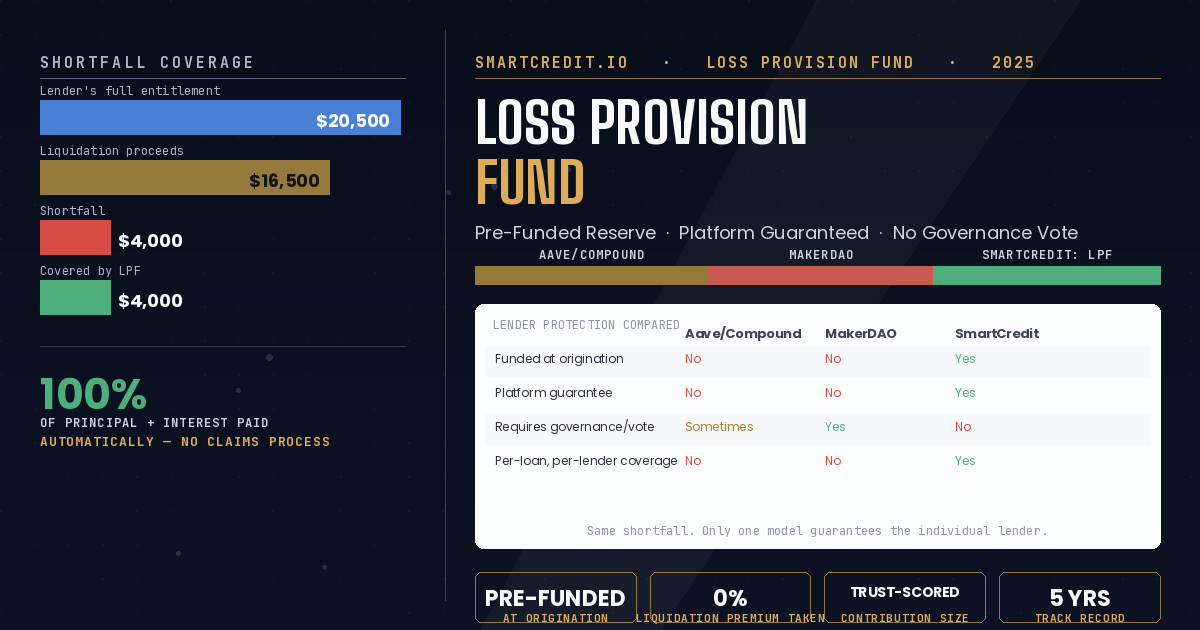
Consider a $20,000 loan backed by $30,000 in ETH collateral — a 150% collateralization ratio, comfortably above typical minimums. A sudden, extreme market move drops ETH’s value by 45% before liquidation can fully execute, a scenario consistent with the kind of rapid liquidation-threshold breach described above. The collateral, now worth roughly $16,500, is liquidated in full. The lender is owed $20,500 (principal plus accrued interest). The shortfall is $4,000.
| Outcome | On SmartCredit.io | On a Typical Pooled Protocol |
|---|---|---|
| Liquidation proceeds | $16,500 | $16,500 (minus liquidator bonus) |
| Lender’s full entitlement | $20,500 | $20,500 |
| Shortfall | $4,000 | $4,000+ (larger after liquidator bonus) |
| Who covers it | Loss Provision Fund, guaranteed by the platform — automatic, immediate | Becomes bad debt; may be socialized via governance-controlled safety module or token dilution, if and when triggered |
On SmartCredit, the lender’s $20,500 arrives without a claims process. On a pooled protocol, the same shortfall becomes bad debt sitting on the protocol’s books until governance decides how — or whether — to address it, and any eventual coverage is spread across the pool’s overall health rather than guaranteed to the specific lender who was matched to that specific bad loan.
How This Compares to Other Protocols
The gap in default protection across DeFi lending protocols is significant.
Aave and Compound operate on a pool model. When a position is liquidated, the protocol takes a liquidation bonus — typically 5–10% — from the borrower’s collateral as an incentive for liquidators. If the liquidation proceeds (minus the bonus) do not cover the outstanding debt, the shortfall becomes bad debt on the protocol’s books. Aave’s current mechanism for this, Umbrella, automates coverage by slashing staked aTokens when a deficit occurs in a given asset — a real improvement over governance-by-vote, but the stakers bearing that slashing risk are a separate pool of participants from the specific lender whose position went bad, and coverage is bounded by however much is staked at the time.
MakerDAO handles undercollateralized positions through debt auctions — new MKR tokens are minted and sold to raise funds to cover bad debt. This dilutes MKR holders and is managed at the protocol level, not at the level of individual borrower-lender relationships.
SmartCredit.io takes a different approach: a dedicated, pre-funded reserve attached to each loan at origination, with a direct platform guarantee. The lender does not need to wait for a governance vote, a token auction, or a DAO decision. The protection is structural and automatic.
| Aave / Compound | MakerDAO | SmartCredit.io | |
|---|---|---|---|
| Lender protection mechanism | Safety module (automated slashing of stakers) | MKR debt auction (token dilution) | Loss Provision Fund (pre-funded, platform guaranteed) |
| Funded at loan origination | No | No | Yes |
| Platform guarantee | No | No | Yes |
| Borrower-level contribution | No | No | Yes — scaled to trust score |
No Governance Vote Between You and Your Principal
The LPF pays out automatically. There’s no DAO proposal to wait on and no token auction to hope clears.
See Current Lending Rates →The Trust Score Connection
The Loss Provision Fund does not treat all borrowers equally, and that is by design.
SmartCredit.io assigns every borrower a trust score based on their on-chain history and any additional information they choose to provide. The trust score affects three things: the interest rate the borrower pays, the collateral ratio required, and the contribution to the Loss Provision Fund.
A borrower with a high trust score — demonstrated by a strong on-chain history and low fraud indicators — represents lower risk. Their LPF contribution is smaller. They also get a better interest rate and may qualify for a lower collateral ratio. There is a direct financial incentive to build and maintain a good trust score.
A borrower with a lower trust score contributes more to the LPF. The higher contribution reflects the higher probability of a shortfall event. The lender who is matched to a lower-trust borrower receives the same protection regardless — the fund is the backstop either way — but the risk-adjusted contribution ensures the fund is appropriately sized for the risk profile of the loan.
This is similar in principle to how traditional credit systems work: higher-risk borrowers pay higher rates and are required to maintain larger buffers. The difference is that in SmartCredit.io, that buffer flows directly into a protection fund for lenders, not into platform profit.
To make this concrete: imagine two otherwise identical $10,000 loans on SmartCredit.io. Borrower A has an established on-chain history and a high trust score; their LPF contribution might be a small fraction of a percentage point of the loan’s interest. Borrower B is newer to the platform with a thinner on-chain history and a correspondingly lower trust score; their contribution to the same fund is proportionally larger. A lender matched to either loan receives the identical guarantee — full principal and interest regardless of outcome — but the fund as a whole collects more from the loans that statistically carry more risk of needing it. Over many loans, this keeps the reserve sized to the risk it actually needs to cover, rather than charging every borrower a flat fee regardless of their individual risk profile.
Build a Trust Score, Lower Your Costs
A strong on-chain history means a smaller LPF contribution, a better rate, and potentially a lower collateral requirement on your next loan.
See Borrowing Terms →SmartCredit’s Policy on Liquidation Revenue
There is a related point worth understanding: SmartCredit.io does not earn revenue from liquidations, and this policy is worth examining on its own terms.
Most DeFi protocols do. Aave and Compound offer liquidation discounts — typically 5–10% — to liquidators. In practice, many of those liquidation bots are operated by the protocol teams themselves, converting liquidation discounts into protocol revenue. In some months, liquidation revenue has represented a substantial share of total protocol revenue at certain platforms.
SmartCredit.io runs its own liquidation bots but takes no liquidation premium. When a loan is liquidated on SmartCredit.io, what remains after repaying the lender’s principal and interest is returned to the borrower. The platform earns nothing from the liquidation itself.
This is an ethical position as well as a structural one. A borrower who is being liquidated is already in difficulty. Extracting additional value from them through a liquidation discount adds insult to injury. SmartCredit.io’s model is that protection of lenders should be funded through the LPF — not through penalties on borrowers who get liquidated.
What This Means for Lenders in Practice
The Loss Provision Fund changes the risk profile of lending on SmartCredit.io in concrete ways.
Lenders know their return upfront. The fixed rate is locked at loan origination. Combined with the LPF guarantee, lenders have high confidence that the stated return will be the actual return — including in scenarios where the borrower defaults or the market moves against the collateral. This stands in contrast to how a traditional insured deposit works: the mechanism is different, but the underlying idea — a dedicated, pre-committed reserve standing behind an individual depositor’s claim — is a familiar one from outside crypto entirely.
Protection is automatic. There is no claim process, no governance proposal, no waiting for a DAO vote to determine whether compensation is warranted. If a shortfall occurs, the LPF covers it — the lender doesn’t need to file anything or prove anything after the fact.
The platform has skin in the game. SmartCredit.io is the guarantor of the Loss Provision Fund. If the accumulated reserve is insufficient, the platform covers the remainder. This aligns the platform’s interests with lenders’ interests: the platform has every reason to ensure the LPF is adequately funded and that risk management on individual loans is sound.
The fund scales with the platform, not against it. Because every active loan contributes proportionally to its own risk, the LPF’s size grows in step with total lending volume rather than needing a separate capital raise or token-based bootstrapping event to reach meaningful scale. A protocol-level safety module has to attract enough independent stakers willing to accept slashing risk before it offers real coverage; the LPF’s coverage is a direct function of loan origination itself, which means it scales at the same pace as the platform’s own growth rather than lagging behind it.
Getting Started
Lending on SmartCredit.io means every position benefits from the same structure described here: a fixed rate agreed at origination, an individually matched borrower rather than a shared pool, and a pre-funded reserve standing behind the specific loan. There’s nothing separate to opt into — the LPF applies to loans funded through the platform by design.
Before depositing on any crypto lending platform, it’s worth asking the same question this article opened with: what actually happens if the borrower doesn’t pay back? On most protocols, the honest answer involves some version of “it depends on governance” or “the lender absorbs it.” On SmartCredit.io, the answer is a specific, pre-funded, guaranteed mechanism you can read about and verify before committing any capital at all.
Frequently Asked Questions
What is the Loss Provision Fund?
The Loss Provision Fund (LPF) is a dedicated reserve on SmartCredit.io, funded by small contributions from every borrower’s interest payment, that covers the gap between liquidation proceeds and a lender’s full principal-plus-interest entitlement if a liquidation falls short. The platform guarantees any shortfall the reserve itself can’t cover.
How is the LPF different from Aave’s Safety Module?
Aave’s Umbrella system (formerly the Safety Module) covers protocol-wide deficits by slashing staked aTokens — a separate pool of participants from the specific affected lender, with coverage bounded by staked amounts. The LPF is funded per-loan at origination and backed by a direct platform guarantee to the specific lender on that specific loan, with no separate staking pool required.
Does the LPF cover every possible loss?
It covers the two scenarios described here: an extreme, rapid collateral price drop that outpaces liquidation, and non-repayment at term end where liquidation proceeds fall short. It is a shortfall-coverage mechanism attached to collateralized, matched loans — not general insurance against every conceivable risk in crypto markets.
Do I pay extra to get LPF protection as a lender?
No. The LPF is funded by the borrower’s interest payment, not by any separate charge to the lender. The contribution is built into the loan’s terms at origination based on the borrower’s trust score.
What happens if the Loss Provision Fund itself runs out of money?
SmartCredit.io, as the platform operator, guarantees the difference. The lender is made whole regardless of whether the accumulated reserve alone was sufficient to cover a specific shortfall.
In practice: the LPF protects the lending side of a position; if you’re evaluating the other side — borrowing against your own collateral — the same trust-score mechanism that shrinks your LPF contribution also improves your rate and required ratio.
Why doesn’t SmartCredit.io take a liquidation bonus like Aave or Compound?
SmartCredit.io treats liquidation revenue as an ethically questionable source of income — extracting additional value from a borrower who is already in financial difficulty. Instead, lender protection is funded transparently through the LPF’s trust-score-based contributions, and any liquidation proceeds beyond the lender’s entitlement are returned to the borrower.
Does a higher-trust borrower mean less protection for the lender?
No. Every lender receives the same LPF-backed guarantee regardless of which borrower they’re matched to. What changes with the borrower’s trust score is the size of that borrower’s contribution to the fund — lower-trust borrowers contribute more, keeping the fund appropriately sized across the full range of risk on the platform.
Is the Loss Provision Fund related to SmartCredit’s regulatory structure?
They address different questions. The peer-to-peer matching model is what keeps SmartCredit.io outside securities classification. The LPF is what protects lenders from default and liquidation-shortfall risk within that matched structure. A platform could in principle have one without the other; SmartCredit.io was built with both.
Lend With a Reserve Standing Behind You
Fixed rates, individually matched loans, and a pre-funded, platform-guaranteed reserve if a liquidation ever falls short.
Start Lending on SmartCredit →Further Reading
- Fixed-Term/Fixed-Rate Borrowing/Lending — how SmartCredit.io’s lending model works
- How to Earn with Fixed Income Funds — lender guide
- Liquidations — how the liquidation process works and why SmartCredit.io does not earn from it
- The DeFi Regulatory Trap: Why Pooling Assets Makes You a Securities Issuer