Institutional crypto lending demands predictability – fixed costs, defined terms, and lender protections that retail DeFi pools rarely provide. Variable-rate protocols built for anonymous retail users cannot meet the reporting, risk management, and treasury planning requirements of funds, DAOs, and protocols that manage real capital at scale. This guide explains why fixed-rate DeFi lending has become the institutional standard, and how SmartCredit.io delivers it on Ethereum mainnet.
Last Updated: November 2026
What Is Institutional Crypto Lending?
Institutional crypto lending refers to borrowing and lending digital assets at a scale and structure that meets the operational requirements of professional capital managers – hedge funds, venture funds, DAOs, protocol treasuries, and corporate treasury teams. The core distinction from retail DeFi is not the size of the position but the operational constraints around it.
A retail borrower on Aave can absorb a surprise rate spike or an unexpected liquidation and treat it as a learning experience. An institutional borrower cannot: they face quarterly reporting cycles, compliance obligations, board-level risk committees, and counterparty commitments that depend on the cost of capital remaining within a defined range. When a DeFi borrowing rate doubles overnight – as Aave stablecoin rates routinely do in periods of high utilisation – an institution using that capital to fund a fixed-yield strategy faces an immediate loss.
The institutional demand for crypto lending has grown significantly. Messari’s institutional crypto research tracks growing treasury allocations to Ethereum-based assets, and Chainalysis reports that large-volume DeFi activity now accounts for a substantial share of on-chain transaction value. However, the vast majority of DeFi lending infrastructure was designed around retail users, anonymous wallets, and open-ended positions. That mismatch is exactly what fixed-rate DeFi addresses.
Three characteristics define institutional-grade crypto lending. First, the interest rate must be fixed for the life of the loan – not an average, not a cap, but a rate locked at origination that does not move. Second, the term must be defined so that treasury teams can plan cash flows and match asset-liability durations. Third, the liquidation mechanics must be transparent and fair: institutions cannot afford to lose 5-10% of their collateral to liquidation bot operators who extract value at the borrower’s expense.
SmartCredit.io
Fixed-rate crypto lending built for institutions
Lock your rate at origination. No variable surprises, no liquidation penalties, no hidden fees.
Compare current rates →Why Variable Rates Fail Institutional Borrowers
Variable-rate DeFi protocols such as Aave and Compound update their borrowing rates algorithmically, every Ethereum block, based on pool utilisation. When utilisation is low, rates fall. When utilisation is high – during periods of market stress, liquidation cascades, or high stablecoin demand – rates spike sharply. During the USDC depeg event of March 2023, Aave stablecoin borrowing rates briefly exceeded 80% APR. For a retail borrower, that spike lasts a few hours before they close the position. For an institutional borrower deploying capital into a six-month fixed-yield strategy, it is a catastrophic cost overrun.
The budget planning problem is structural, not incidental. Variable-rate protocols are designed around the assumption that borrowers monitor and manage their positions continuously, adjusting or closing them as rates move. That assumption holds for algorithmic trading desks and experienced DeFi users. It does not hold for a protocol treasury team, a family office, or a fund that has committed to a fixed-yield product and needs its borrowing cost to remain below a defined threshold for the duration.
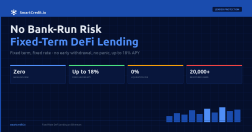
Furthermore, variable-rate protocols carry bank-run risk on the lending side. Aave and Compound lenders can withdraw at any time. If a significant share of lenders withdraw simultaneously – as happened during the Terra/LUNA collapse in May 2022 – remaining lenders face a liquidity crunch and may be temporarily unable to exit. Fixed-term lending eliminates this structural risk entirely: both lenders and borrowers commit to a defined period, and neither can disrupt the other mid-term. For a full analysis of this distinction, see our guide to no bank-run risk in fixed-term DeFi lending.
The Bank for International Settlements, in its working papers on DeFi risk, has highlighted interest rate volatility in variable-rate protocols as a key systemic concern for professional capital managers considering DeFi exposure. The conclusion is straightforward: variable-rate infrastructure is not fit for institutional use without significant hedging overhead that erodes most of the yield advantage.
Fixed-Rate DeFi: The Institutional Standard
Fixed-rate, fixed-term DeFi lending matches how institutions think about capital allocation. When a fund borrows at a fixed rate for 90 days to deploy into a strategy, it knows its cost of capital from day one. When a protocol treasury lends at a fixed rate for 180 days, it can report that yield line with certainty in its quarterly financial statements. No model, no hedging strategy, and no daily monitoring is required to maintain the economics of the position.
SmartCredit.io operates exclusively on a fixed-rate, fixed-term model. The rate is set at loan origination through a matching process between lenders and borrowers. Once set, the rate does not move for the life of the loan. The term is similarly fixed: 30, 60, 90, 180, or 365 days depending on the specific loan configuration. This model aligns directly with how institutional treasury teams plan and report on their DeFi positions.
The fixed-term fixed-rate borrowing and lending model also creates natural asset-liability matching. A lender who wants predictable income over a defined horizon locks in a rate for that exact period. A borrower who wants to deploy capital into a fixed-yield strategy for a specific duration locks in a matching borrowing rate. The result is a position with known economics at every point in its life – exactly what institutional compliance and reporting frameworks require.
Lenders also benefit from weekly SMARTCREDIT token rewards on top of the fixed interest component, adding a variable upside layer on top of the locked base rate. For institutions that can hold the token or participate in staking, this adds material additional yield. The how to earn guide breaks down the full yield structure for lenders.
Collateral Mechanics Built for Capital Efficiency
Institutional borrowers are acutely sensitive to collateral requirements. Every percentage point of collateral above the minimum represents capital that cannot be deployed elsewhere. Variable-rate protocols such as Aave set their liquidation thresholds high because they need to guarantee a profitable liquidation bonus for the bots – typically the protocol team’s own bots – that execute liquidations. That bonus must be built into the threshold: Aave needs to ensure that when a position reaches the liquidation point, there is enough excess collateral to pay the liquidator their 5-10% discount and still cover the loan in full.
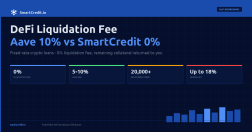
SmartCredit charges 0% on liquidations. No bonus needs to be built into the threshold. As a result, SmartCredit’s liquidation thresholds are structurally lower than Aave’s and Compound’s for comparable assets – by 10 or more percentage points in many cases. This is not a risk trade-off; it is a direct consequence of the fee structure. See our detailed analysis in DeFi liquidation fee: SmartCredit vs Aave.
| Asset | SmartCredit Liquidation Threshold | Aave Liquidation Threshold | Liquidation Fee |
|---|---|---|---|
| Stablecoins (DAI, USDC, USDT) | 106% | ~116–125% | SmartCredit: 0% | Aave: 5% |
| ETH / wBTC | 112–114% | ~121% | SmartCredit: 0% | Aave: 5–10% |
| Volatile ERC20s | up to 122% | ~130%+ | SmartCredit: 0% | Aave: 10–15% |
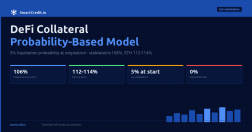
Beyond the threshold itself, SmartCredit uses a probability-based model to set starting collateral. Rather than applying a fixed LTV cap set by governance vote, the platform calculates the collateral amount that gives each specific loan exactly a 5% liquidation probability at origination, based on the asset’s historical volatility and the loan term. Longer terms require more starting collateral because there is more time for prices to move. Shorter terms on stable assets can be originated with collateral ratios close to the liquidation threshold itself.
For institutions, this approach has an important implication: a 30-day stablecoin loan can be structured with significantly less collateral than a 365-day ETH loan. Treasury teams can optimise their collateral deployment by matching loan terms to their actual capital deployment windows. The full mechanics are covered in our guide to probability-based collateral on SmartCredit.
When a position is liquidated, any surplus collateral – the amount above what is needed to cover the loan – is returned directly to the borrower’s credit line. On Aave and Compound, the liquidation bot operator keeps the difference. On SmartCredit, the borrower does. For institutions managing large positions, this distinction has real financial consequences. For more on how to avoid crypto loan liquidation, including monitoring strategies, see our comprehensive guide.
SmartCredit.io
Borrow at fixed rates with institutional-grade liquidation protection
0% liquidation fee. Surplus collateral returned. 20 supported assets on Ethereum mainnet.
Start borrowing →Lender Protection: The Loss Provision Fund
Institutional lenders need to understand their worst-case outcome before committing capital. On Aave and Compound, the worst case is a bad debt event that the protocol absorbs through its safety module – a mechanism that can itself be depleted under extreme conditions, leaving lenders exposed to unrecovered losses. The history of DeFi lending includes several significant bad debt events, including the $1.8M bad debt Aave V2 accumulated from the Mango Markets exploit in late 2022.
SmartCredit addresses lender risk through the Loss Provision Fund. This is a dedicated reserve that absorbs any shortfall when liquidation proceeds do not fully cover the outstanding loan balance. If a borrower’s collateral is liquidated and the proceeds fall short – due to extreme price movement or low liquidity in the collateral asset – the Loss Provision Fund covers the difference before any lender capital is at risk. For institutions modelling their downside exposure, the Loss Provision Fund provides a defined, transparent backstop. The Loss Provision Fund guide explains the mechanics, reserve levels, and historical performance in detail.
Combined with the fixed-rate, fixed-term structure, the Loss Provision Fund gives institutional lenders two layers of certainty that variable-rate pool lending cannot match: a known yield for the duration, and a defined backstop against borrower default. For treasury teams comparing crypto lending platforms, these two properties together represent a qualitatively different risk profile from open-ended pool lending.
Institutional Yield Strategies on SmartCredit
Institutions that want to put capital to work rather than simply hold assets have several structured yield options on SmartCredit, each with fully defined terms and predictable cost structures.
Fixed-Rate Lending
The simplest institutional yield strategy is to lend directly on SmartCredit at a fixed rate. Lenders select their asset, term, and desired rate from the order book, and earn fixed interest income plus weekly SMARTCREDIT token rewards for the duration. The rate does not change. The term is defined. The yield can be modelled into quarterly financial statements without uncertainty. The how to earn guide covers the full mechanics of lending on SmartCredit.
Leveraged Lido Staking
For institutions with ETH holdings that want to amplify staking returns without converting to a different asset class, SmartCredit’s fixed-rate leveraged Lido staking offers a compelling structure. Borrowers use stETH as collateral, borrow ETH at a fixed rate, convert the borrowed ETH to additional stETH, and stake that too – repeating the cycle to achieve 2-5x leverage on the base Lido staking yield. Because the borrowing rate is fixed, the spread between the staking yield and the borrowing cost is locked in at origination. The strategy’s economics are known before any capital is deployed.
This structure is particularly attractive for institutions that already hold ETH as a long-term asset and want to generate yield without taking on new market risk. The position is entirely within the Ethereum ecosystem, using audited Lido contracts and SmartCredit’s fixed-rate infrastructure. Historical rate data for both stETH staking yields and SmartCredit borrowing rates can be reviewed on the compare historical DeFi borrowing rates tool, which shows five years of side-by-side data for SmartCredit, Aave V2/V3, Compound, and MakerDAO.
AI Portfolio Optimisation
Institutions managing diversified DeFi allocations across multiple strategies can use SmartCredit’s Portfolio MCP – a Markowitz-optimised portfolio tool powered by Claude AI. Treasury managers describe their capital constraints, risk tolerance, and target yield, and the system returns an optimised DeFi allocation across lending, staking, and portfolio products. This bridges the gap between institutional portfolio theory and DeFi execution – a gap that has historically required significant in-house quantitative capability to bridge manually.
SmartCredit.io
Earn fixed interest income on your crypto holdings
Fixed-rate lending with Loss Provision Fund protection and weekly SMARTCREDIT token rewards.
Start lending →SmartCredit vs Aave: An Institutional Comparison
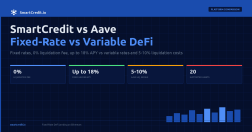
The comparison between SmartCredit and Aave is not purely a question of which platform offers higher yield or lower rates at a given moment. For institutional use, the structural differences in how each platform handles rates, terms, liquidations, and lender protection are more important than any specific rate comparison on any given day. For a full head-to-head, see the SmartCredit vs Aave comparison.
| Dimension | SmartCredit.io | Aave V3 |
|---|---|---|
| Interest rate | Fixed, locked at origination | Variable, changes every block |
| Loan term | Fixed (30–365 days) | Open-ended, no defined maturity |
| Liquidation fee | 0% | 5–15% (kept by liquidation bots) |
| Surplus collateral | Returned to borrower | Kept by liquidator |
| Lender withdrawal | Fixed term – no early withdrawal | At any time (bank-run risk) |
| Default backstop | Loss Provision Fund | Safety module (can be depleted) |
| Liquidation threshold – stablecoins | 106% | ~116–125% |
| Liquidation threshold – ETH | 112–114% | ~121% |
| Financial reporting | Fixed costs – directly reportable | Variable – requires modelling |
| Network | Ethereum mainnet | Multi-chain |
Aave’s advantages – broader asset coverage and multi-chain deployment – are real and significant for certain institutional use cases. However, those advantages become less relevant when the institutional requirement is specifically for predictable fixed-rate exposure on Ethereum, which remains the dominant chain for institutional DeFi activity according to a16z Crypto’s State of Crypto report.
The SmartCredit security documentation and revenue model are relevant reading for institutions conducting due diligence. Understanding how the protocol generates revenue – and specifically what it does not earn from (liquidations) – is a key part of assessing alignment between the protocol’s incentives and the borrower’s interests.
Frequently Asked Questions
What is institutional crypto lending?
Institutional crypto lending refers to borrowing and lending digital assets under terms that meet the operational requirements of professional capital managers – fixed rates, defined terms, transparent liquidation mechanics, and structured lender protections. Unlike retail DeFi lending, institutional lending requires that the cost of capital be known in advance, that positions can be held for defined durations without rate volatility, and that liquidation outcomes are fair and predictable.
Why are variable-rate DeFi protocols unsuitable for institutions?
Variable-rate protocols such as Aave and Compound update borrowing rates algorithmically based on pool utilisation, every Ethereum block. During periods of high demand or market stress, rates can spike dramatically – Aave stablecoin rates briefly exceeded 80% APR during the USDC depeg event of March 2023. For institutions deploying capital into fixed-yield strategies, a variable borrowing rate that moves against the position creates immediate losses that cannot be hedged without significant overhead. Fixed-rate lending eliminates this problem at source.
How does SmartCredit’s 0% liquidation fee benefit institutional borrowers?
On Aave and Compound, liquidation bot operators collect 5-15% of the liquidated collateral as a bonus. These fees are built into the protocol’s liquidation threshold design – the threshold must be high enough to guarantee a profitable liquidation, which is why Aave’s effective liquidation costs are 10 or more percentage points above SmartCredit’s. SmartCredit charges 0% on liquidations: no bonus is paid to operators, surplus collateral is returned to the borrower’s credit line, and the lower threshold design means institutions can borrow more capital against the same collateral base.
What protections do institutional lenders have on SmartCredit?
Institutional lenders on SmartCredit benefit from two layers of protection. First, the fixed-rate, fixed-term structure means lenders know their yield from day one and cannot be caught by rate compression or sudden pool withdrawals. Second, the Loss Provision Fund covers any shortfall when liquidation proceeds do not fully cover the outstanding loan balance. If borrower collateral is insufficient to repay the loan in full after liquidation, the Loss Provision Fund absorbs the gap before any lender capital is affected.
SmartCredit vs Aave: which is better for institutional use?
For institutions that need fixed borrowing costs, defined terms, and fair liquidation mechanics, SmartCredit is structurally superior to Aave. Aave offers broader asset coverage and multi-chain deployment, which may matter for certain use cases. However, for Ethereum-focused institutions that need predictable costs for financial reporting and risk management, SmartCredit’s fixed-rate model, 0% liquidation fee, surplus collateral return, and Loss Provision Fund represent a qualitatively different and more institutionally appropriate risk profile than Aave’s variable-rate pool structure.
What collateral assets does SmartCredit support for institutional borrowing?
SmartCredit supports 20 collateral assets on Ethereum mainnet, including ETH, wETH, wBTC, DAI, USDC, USDT, SMARTCREDIT, and a range of partner ERC20 tokens. Liquidation thresholds are asset-specific: 106% for stablecoins, 112-114% for ETH and wBTC, and up to 122% for more volatile ERC20s. All liquidation thresholds are set without a liquidation bonus, so they are structurally lower than comparable thresholds on Aave and Compound.
Can institutional borrowers monitor their positions in real time?
Yes. SmartCredit provides a Positions Monitoring System that tracks loan health in real time and sends alerts before a position approaches the liquidation threshold. The Protection Agent extends this to Aave V3 and Compound V3 positions as well, sending probability-based alerts via Telegram – or displaying risk levels on the dashboard without Telegram – so institutional teams can monitor multiple positions across protocols from a single interface. Telegram alerts are optional; the dashboard shows the same information at any time.
SmartCredit.io
Fixed-rate DeFi lending for professional capital managers
Compare current fixed rates across SmartCredit, Aave, Compound, and MakerDAO – five years of historical data.
Compare rates →Sources: Ethereum.org – Decentralised Finance (DeFi), Messari – Institutional Crypto Research, Chainalysis – Crypto Market Reports, Bank for International Settlements – DeFi Working Papers, a16z Crypto – State of Crypto Report
Related SmartCredit reading: DeFi liquidation fee: SmartCredit vs Aave, SmartCredit vs Aave: full comparison, No bank-run risk: fixed-term DeFi lending, Loss Provision Fund explained, Fixed rate vs variable rate DeFi, DeFi interest rates comparison, Compare historical DeFi borrowing rates, Best crypto lending platforms