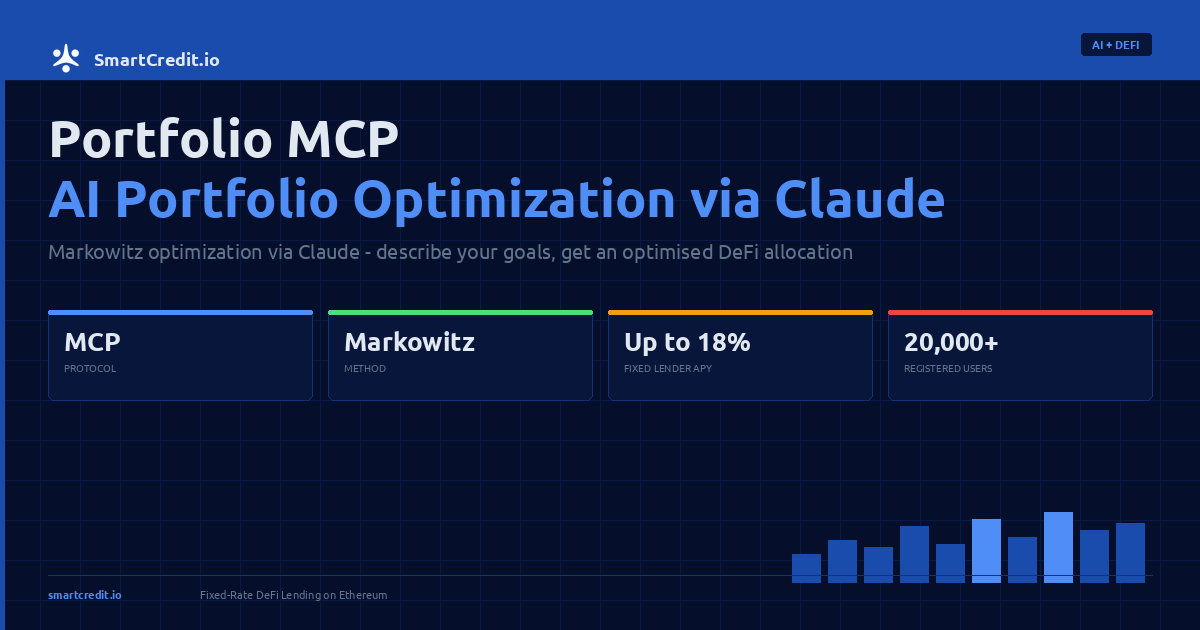
Portfolio MCP on SmartCredit.io is the first DeFi lending platform integration built on the Model Context Protocol – the open standard that lets Claude and other AI assistants connect directly to external tools and data. Instead of manually running portfolio calculations, you describe what you want to Claude in plain language, and Portfolio MCP returns an optimised allocation using Nobel Prize-winning Markowitz mathematics, CoinGecko sector data and SmartCredit.io’s live DeFi yield rates. This post explains what Portfolio MCP is, how the MCP integration works, and how to use it to build a fixed-income DeFi portfolio in minutes.
Last Updated: November 2026
What Is Portfolio MCP?
Portfolio MCP is an AI-assisted portfolio construction tool available at portfolio.mcp.smartcredit.io. It applies Markowitz portfolio optimization to DeFi yield strategies and crypto assets, then makes those calculations available to Claude and other AI agents via the Model Context Protocol (MCP). The result is that you can ask an AI assistant, in plain language, to build you an optimised crypto portfolio – and receive a mathematically rigorous allocation based on live data.
Three things make Portfolio MCP different from other crypto portfolio tools. First, it focuses on interest-bearing strategies rather than price speculation – the goal is optimising yield allocation across lending platforms and tokens, not predicting market direction. Second, it uses the Markowitz efficient frontier framework, the same mathematical method used by institutional fund managers for equity portfolios, applied to DeFi and crypto. Third, it is accessible via MCP, meaning AI agents can query it programmatically as part of a broader analytical conversation.
Portfolio MCP works alongside other SmartCredit.io products. The optimiser identifies where to allocate; SmartCredit.io’s fixed-rate lending with fixed interest income plus weekly SMARTCREDIT token rewards, Broad Portfolio and Categories Portfolio products provide the vehicles for deploying that allocation. The comparison of historical DeFi rates gives context for how yields have behaved over time before committing capital.
What Is the Model Context Protocol?
The Model Context Protocol (MCP) is an open standard developed by Anthropic that allows AI assistants such as Claude to connect to external tools, databases and APIs in a structured, secure way. Rather than an AI assistant being limited to its training data, MCP lets it query live systems – retrieve current data, run calculations and return results – all within a natural-language conversation.
Think of MCP as the connection layer between an AI assistant and the world of real-time data. A Claude session connected to Portfolio MCP via the protocol can ask “what is the optimal portfolio for a 12-month fixed-income strategy with moderate risk tolerance?” and receive a live calculation – not a generic answer from training data, but an actual portfolio allocation based on current SmartCredit.io yield rates, CoinGecko category correlations and the user’s specified parameters.
The Model Context Protocol specification is open source and supported by a growing ecosystem of integrations. SmartCredit.io’s Portfolio MCP server is one of the first DeFi-native MCP integrations, exposing the platform’s portfolio optimization engine to any MCP-compatible AI agent. Claude is the primary supported assistant, but the protocol is designed to be model-agnostic.
For users building AI-driven workflows, MCP enables Portfolio MCP to be called programmatically as part of a larger agent pipeline – for example, an agent that monitors DeFi rates, identifies rebalancing opportunities, and generates an updated allocation recommendation automatically. The Portfolio MCP documentation covers the technical setup for connecting the MCP server to Claude.
The Mathematics Behind Portfolio MCP: Markowitz Optimization
Portfolio MCP applies Markowitz Portfolio Optimization – the mathematical framework developed by economist Harry Markowitz in 1952 and awarded the Nobel Prize in Economics in 1990. The core insight is that portfolio risk depends on the correlation between assets, not just the individual risk of each asset. Two assets that move independently of each other reduce overall portfolio volatility even if each is individually risky.
The framework identifies the efficient frontier: the set of portfolio allocations that offer the maximum possible return for each level of risk. Any portfolio on the efficient frontier is mathematically optimal – no reallocation can improve return without also increasing risk. Prior to digital tools, calculating the efficient frontier for a large asset universe required significant computational resources and financial expertise. Portfolio MCP makes this calculation accessible through a plain-language request to Claude.
Key Metrics Portfolio MCP Outputs
When Portfolio MCP generates an allocation, it returns several quantitative metrics alongside the portfolio weights. Understanding these metrics helps you evaluate whether a given allocation suits your risk profile.
Sharpe Ratio measures excess return per unit of total volatility. A Sharpe Ratio above 2.0 represents excellent risk-adjusted performance. It is calculated as: (Portfolio Return – Risk-Free Rate) / Portfolio Volatility. A higher Sharpe Ratio means more return per unit of risk taken.
Sortino Ratio refines the Sharpe Ratio by measuring excess return per unit of downside volatility only – ignoring positive price movements. This is particularly relevant for crypto, where large upside swings should not penalise a portfolio’s risk score. A higher Sortino Ratio indicates the portfolio generates strong returns relative to downside risk specifically.
Portfolio volatility is the annualised standard deviation of returns. For context: the S&P 500 historically runs at 15-20% annualised volatility; Bitcoin at 60-100%; well-diversified crypto portfolios typically at 30-50%. Lower volatility within a given return target indicates a more efficient allocation.
These metrics allow you to compare multiple portfolio configurations objectively – for example, comparing a conservative yield-focused allocation against a higher-risk strategy targeting greater exposure to growth sectors, and selecting the one that best matches your objectives. The AI crypto portfolio optimizer post covers the mathematical underpinnings in more detail for readers who want a deeper understanding of the Markowitz framework.
SmartCredit.io
AI portfolio optimization via Claude – Portfolio MCP
Describe your portfolio goals to Claude. Portfolio MCP returns a Markowitz-optimised allocation based on live DeFi yield rates and CoinGecko sector data.
Try Portfolio MCP →CoinGecko Categories as Sector Indexes
One of Portfolio MCP’s distinctive design choices is the use of CoinGecko crypto categories – DeFi, Layer 2, Payments, Gaming, Infrastructure, and others – as sector-level indexes for portfolio construction. This mirrors the way institutional equity investors allocate across industry sectors (technology, healthcare, financials, etc.) rather than selecting individual stocks.
The sector approach solves a specific problem in crypto portfolio construction: individual token correlation data is noisy, frequently changes and is difficult to maintain reliably. By contrast, sector-level category data provides more stable correlation estimates, enables meaningful diversification analysis and aligns with how most sophisticated DeFi users already think about their exposure – “I am overweight DeFi and underweight Layer 2” rather than “I hold too much AAVE relative to ARB”.
CoinGecko’s category data provides return and correlation history at the sector level. Portfolio MCP uses this data to calculate inter-category correlations and feed them into the Markowitz optimisation. The result is a sector allocation recommendation – for example, 30% DeFi, 20% Layer 2, 25% yield-bearing stablecoins, 15% Payments, 10% Infrastructure. Users then select representative tokens within each recommended sector to implement the allocation.
This approach closely parallels institutional equity management. A fund manager does not simply pick the highest-returning individual stocks – they allocate across sectors to control concentration risk and benefit from diversification. Portfolio MCP brings this discipline to DeFi yield portfolios, making sector-level diversification analysis accessible to individual users without requiring specialist financial training. The Categories Portfolio guide explains how sector-based allocation works in practice on SmartCredit.io.
How to Use Portfolio MCP with Claude
Using Portfolio MCP requires connecting the SmartCredit.io MCP server to a Claude session. Once connected, the workflow is conversational – you describe your portfolio goals in plain language and Claude queries Portfolio MCP for the optimised allocation. The following steps cover the typical workflow from setup through to deployment.
Step 1: Connect the Portfolio MCP Server to Claude
Navigate to portfolio.mcp.smartcredit.io and follow the setup instructions to connect the SmartCredit.io MCP server to your Claude session. The connection uses the Model Context Protocol standard and does not require any API keys or wallet authorisation – Portfolio MCP exposes read-only portfolio optimisation queries.
Once connected, Claude will have access to Portfolio MCP’s tools: portfolio optimisation queries, rate comparison data and allocation analysis. You can verify the connection is active by asking Claude to describe the available SmartCredit.io MCP tools.
Step 2: Describe Your Portfolio Goals
With the MCP server connected, describe what you want to achieve. Portfolio MCP understands natural-language goal descriptions. Examples of effective requests include:
- “Build me a conservative yield-focused portfolio with low volatility and a 12-month horizon”
- “I want maximum Sharpe Ratio across DeFi lending strategies with $50,000 to allocate”
- “Give me a balanced allocation across CoinGecko sectors with the highest risk-adjusted return”
- “I already have heavy ETH exposure – what sectors should I add to reduce concentration risk?”
- “Optimise for Sortino Ratio – I care more about downside protection than total return”
Portfolio MCP does not require you to specify correlation matrices, volatility inputs or return assumptions manually. The system retrieves current data from CoinGecko and SmartCredit.io’s live rate feed and runs the Markowitz optimisation automatically based on your stated objectives.
Step 3: Review the Optimised Allocation
Portfolio MCP returns a structured allocation output that includes: sector weights as percentages, expected annual return, expected volatility, Sharpe Ratio, Sortino Ratio, diversification analysis and concentration risk flags. Review these metrics in the context of your goals before committing capital.
If the allocation does not match your preferences – for example, if the optimiser recommends a sector you want to avoid, or if the volatility is higher than you are comfortable with – simply describe the constraint to Claude and Portfolio MCP will recalculate. The conversational interface means you can iterate quickly without re-entering parameters manually.
Step 4: Select Tokens and Deploy on SmartCredit.io
CoinGecko categories are not directly investable – you need to select representative tokens within each recommended sector. For example, a recommended 25% DeFi allocation might be implemented as a mix of AAVE, UNI and SMARTCREDIT tokens. Portfolio MCP can suggest representative tokens for each sector based on liquidity, market capitalisation and relevance to the sector’s return characteristics.
Once token selection is complete, deploy the fixed-income portion of the allocation on SmartCredit.io’s lending and earning products. SmartCredit.io supports 20 collateral assets and offers fixed-rate lending plus weekly SMARTCREDIT token rewards. The strategy of lending without selling means you maintain long exposure to your crypto holdings while generating fixed yield on them simultaneously.
Step 5: Rebalance Monthly or at 5% Drift
An optimised portfolio drifts over time as different sectors perform differently. A strong Bitcoin rally, for instance, might push your crypto sector exposure from a target of 30% to 45%, creating unintended concentration. Portfolio MCP supports systematic rebalancing to maintain the mathematically optimal allocation.
Two rebalancing approaches work effectively. Monthly rebalancing – running a fresh Portfolio MCP query each month and adjusting weights accordingly – captures most of the efficiency benefit while keeping transaction frequency manageable. Threshold-based rebalancing – triggering a rebalance whenever any sector drifts five or more percentage points from its target weight – is an effective alternative that responds to market conditions rather than a calendar schedule.
Both approaches enforce a disciplined “sell winners, buy laggards” approach that counteracts the common psychological tendency to hold outperforming positions too long. The personal investment funds guide covers automated rebalancing in more detail for users who want systematic, hands-off portfolio maintenance.
SmartCredit.io
Build a fixed-income DeFi portfolio with AI
Earn fixed interest income plus weekly SMARTCREDIT token rewards. Use Portfolio MCP to optimise your allocation via Claude – Markowitz math, CoinGecko sectors, live DeFi rates.
Start lending → Try Portfolio MCP →Portfolio MCP vs Manual Portfolio Construction
Manual crypto portfolio construction typically involves selecting assets based on narrative conviction, checking price performance, and adjusting allocations based on intuition. This approach is accessible but has well-documented weaknesses: it concentrates risk in assets with strong recent performance, ignores correlations between holdings, and is subject to emotional biases that drive poor timing decisions.
Portfolio MCP addresses each of these weaknesses directly. The Markowitz framework calculates allocations based on return-and-correlation data, not narrative conviction, so recent performance does not automatically create overweighting. Sector-level correlation analysis ensures diversification is structural, not coincidental. The mathematical output provides a clear benchmark against which to evaluate any deviation from the recommended allocation.
The comparison below summarises the key differences between the two approaches:
| Dimension | Manual portfolio construction | Portfolio MCP |
|---|---|---|
| Basis for allocation | Narrative conviction, price history, intuition | Markowitz optimisation on correlation and return data |
| Diversification analysis | Informal, based on perceived dissimilarity | Quantified correlation matrix across CoinGecko sectors |
| Risk metrics | Not calculated or approximated informally | Sharpe Ratio, Sortino Ratio, annualised volatility |
| Rebalancing trigger | Ad hoc, often delayed or emotionally driven | Monthly schedule or 5% drift threshold |
| Time required | Hours of research per allocation review | Minutes via plain-language query to Claude |
| Yield integration | Separate tool required for rate comparison | Live SmartCredit.io rates integrated in optimisation |
The key advantage of Portfolio MCP is not simply automation – it is access to a methodology that was previously available only to professional fund managers with sophisticated modelling tools. By exposing Markowitz optimisation through a conversational AI interface, Portfolio MCP makes institutional-grade portfolio construction accessible to individual DeFi users without requiring financial expertise or specialist software. For a deeper look at modern portfolio management approaches for cryptocurrencies, the SmartCredit.io research post covers the academic foundations in detail.
Portfolio MCP and the SmartCredit.io Product Ecosystem
Portfolio MCP is one component of SmartCredit.io’s broader portfolio product suite, which includes three distinct tools for managing crypto allocation and yield:
Portfolio MCP – the AI-assisted optimiser available via Claude at portfolio.mcp.smartcredit.io. Outputs Markowitz-optimised sector allocations and risk metrics. Best for users who want to build a custom portfolio from scratch or analyse their current allocation. See the full documentation.
Categories Portfolio – a managed allocation tool that organises your crypto into CoinGecko-based sector buckets and rebalances automatically. Best for users who want sector diversification without manually selecting tokens or running optimisation queries. Try it at smartcredit.io/portfolio or see the Categories Portfolio documentation.
Broad Portfolio (Tokens Portfolio) – a wider-market allocation tool that optimises across a larger token universe using Modern Portfolio Theory. Best for users who want broader market exposure alongside yield-generating positions. Try it at smartcredit.io/portfolio/broad or see the Broad Portfolio documentation.
These three products address different levels of customisation. Portfolio MCP offers maximum flexibility through the conversational interface. Categories Portfolio offers structured automation. Broad Portfolio offers wide market exposure with optimisation. Together, they cover the range from hands-on custom analysis to fully automated diversified allocation. For a comparison of when to use each, the DeFi yield strategy comparison covers the key decision points. For historical yield data to inform your allocation, the compare historical DeFi borrowing rates tool provides rate context across protocols and terms.
Frequently Asked Questions
What is Portfolio MCP on SmartCredit.io?
Portfolio MCP is an AI-assisted portfolio construction tool on SmartCredit.io that applies Markowitz portfolio optimisation to DeFi yield strategies and crypto assets. It exposes a Model Context Protocol (MCP) server that Claude and other AI agents can connect to, enabling plain-language portfolio queries that return mathematically optimised allocations based on live CoinGecko sector data and SmartCredit.io yield rates. The tool outputs platform and token allocation, expected return, volatility, Sharpe Ratio, Sortino Ratio and diversification analysis – all in one conversation with Claude.
What is the Model Context Protocol (MCP) in DeFi?
The Model Context Protocol is an open standard developed by Anthropic that allows AI assistants such as Claude to connect to external tools and live data sources. In DeFi, MCP enables AI agents to query portfolio optimisation engines, live rate feeds and on-chain data directly within a conversation – rather than relying on static training data. SmartCredit.io’s Portfolio MCP server is one of the first DeFi-native MCP integrations, allowing Claude to run Markowitz portfolio calculations against SmartCredit.io’s live rate data on demand.
How does Portfolio MCP use Markowitz optimisation?
Portfolio MCP applies Harry Markowitz’s Modern Portfolio Theory – a Nobel Prize-winning mathematical framework – to identify the portfolio allocation that maximises risk-adjusted return for a given set of assets. It calculates the correlation matrix between CoinGecko crypto categories, runs the efficient frontier calculation, and returns the optimal sector weights alongside Sharpe Ratio, Sortino Ratio and volatility metrics. Users describe their goals in plain language; Portfolio MCP handles the mathematical calculation automatically.
Can I use Portfolio MCP without connecting Claude?
Yes. Portfolio MCP is accessible directly at portfolio.mcp.smartcredit.io through the SmartCredit.io web interface as well as via the MCP server connection in Claude. The web interface allows you to run portfolio optimisation queries directly without an AI assistant. However, the MCP integration with Claude adds the ability to iterate on allocations conversationally, ask follow-up questions and incorporate Portfolio MCP results into broader AI-driven analysis workflows.
How often should I rebalance a Portfolio MCP allocation?
SmartCredit.io recommends monthly rebalancing for most users, which captures the majority of the efficiency benefit from systematic rebalancing while keeping transaction frequency manageable. An alternative is threshold-based rebalancing: trigger a rebalance whenever any sector drifts five or more percentage points from its target weight. During periods of high market volatility, more frequent rebalancing may be warranted. Each rebalance requires running a fresh Portfolio MCP query to get an updated optimal allocation based on current correlation data.
What is the difference between Portfolio MCP, Categories Portfolio and Broad Portfolio?
Portfolio MCP is a flexible, AI-queryable optimisation tool that produces custom allocations based on user-specified goals via Claude. Categories Portfolio is an automated product that organises your holdings into CoinGecko sector buckets and rebalances automatically – best for users who want structured sector diversification without manual optimisation. Broad Portfolio applies Modern Portfolio Theory across a wider token universe for broader market exposure. All three use Markowitz-based mathematics; they differ in the level of customisation, automation and market breadth.
Does Portfolio MCP guarantee investment returns?
No. Portfolio MCP provides analytical insights and mathematically optimised allocations based on historical correlation and return data. It does not guarantee future returns, predict market conditions or replace personal risk management. All outputs are informational. The fixed-rate yields on SmartCredit.io’s lending products (fixed interest income plus weekly SMARTCREDIT token rewards) are confirmed at loan origination and represent actual contracted rates – not estimates – but all DeFi investing involves risk and positions should be sized appropriately.
SmartCredit.io
Optimise your DeFi portfolio with AI – Portfolio MCP
Connect Portfolio MCP to Claude. Describe your goals. Get a Markowitz-optimised allocation in minutes – then deploy on SmartCredit.io at fixed interest income plus weekly SMARTCREDIT token rewards.
Try Portfolio MCP →Sources: Model Context Protocol specification – the open standard for AI tool connections developed by Anthropic; CoinGecko crypto categories – sector-level classification and historical return data used by Portfolio MCP; Ethereum.org DeFi guide – overview of DeFi yield and lending protocols; Nobel Memorial Prize in Economic Sciences 1990 – awarded to Harry Markowitz for Modern Portfolio Theory.
Related SmartCredit reading: AI crypto portfolio optimizer: Markowitz and CoinGecko explained – Categories Portfolio: sector diversification for DeFi – Broad Portfolio: token optimization with Modern Portfolio Theory – Personal Investment Funds: automatic crypto rebalancing – How to earn fixed interest income plus weekly SMARTCREDIT token rewards on SmartCredit.io