DeFi liquidations rarely come as a surprise in hindsight. The signs are usually there — collateral volatility rising, positions thinning, market conditions deteriorating. What is missing is not the information, it is the alert at the right time. By the time most borrowers notice their health factor has become critical, the window to act is already closing, and liquidator bots do not wait for anyone to catch up.
Liquidation in DeFi is automatic and immediate. When a position’s health factor drops below 1.0, liquidator bots execute within seconds. There is no grace period, no phone call from a margin desk, no opportunity to negotiate. SmartCredit.io’s Protection Agent is built to close that gap: it monitors DeFi lending positions continuously and sends Telegram alerts before a position reaches the critical zone — not when it is already there, and not after the decision has already been made for you.
Key Takeaways
- Protection Agent models liquidation probability from collateral volatility, not just the raw health factor — two positions at the same ratio can carry very different real risk.
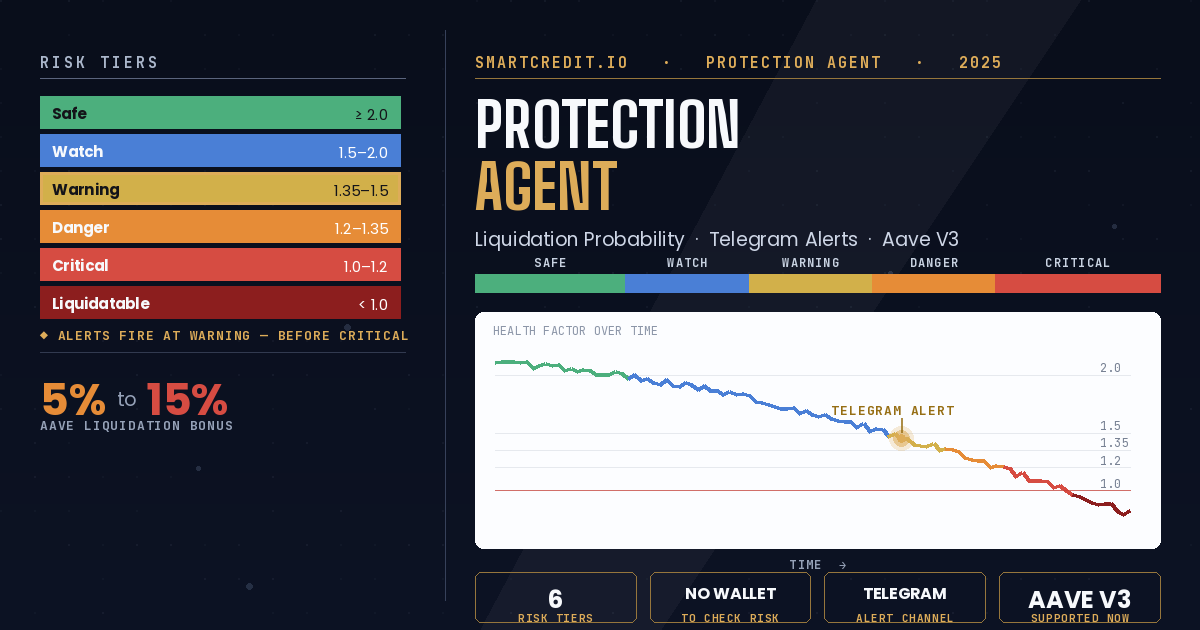
- Health factors are mapped to six risk tiers, with alerts firing at Warning or Danger — while there’s still time to act, not at Critical.
- You can check any wallet’s risk without connecting one; continuous monitoring requires a one-time wallet + Telegram setup.
- On Aave V3, liquidation penalties run 5% to 15% of collateral seized — on top of the market loss that triggered the liquidation.
- Currently supports Aave V3, with Compound V3, Morpho, and SmartCredit positions in the pipeline.
The Problem with the Health Factor
Every DeFi lending protocol displays a health factor: the ratio of the collateral value to the borrowed value, adjusted for the asset’s liquidation threshold. Below 1.0, the position can be liquidated. Most borrowers treat this as the primary risk indicator, watching for the number to drop toward 1.0.
The problem is that the health factor is a snapshot. It tells you where the position is right now, not how fast it is moving or how likely it is to breach the liquidation threshold. Two positions with identical health factors can carry very different liquidation risk depending on what is backing them.
A position at a health factor of 1.4 backed by a volatile memecoin can reach the liquidation threshold in minutes during a sharp market move. A position at 1.3 backed by ETH may be safer — ETH is volatile, but its intraday swings are narrower and better absorbed by the collateral buffer. Looking at the health factor alone treats these positions as equivalent. They are not.
Protection Agent models liquidation probability from collateral volatility, not just the current ratio. The alert you receive reflects actual risk — how likely the position is to be liquidated given the volatility profile of the collateral — rather than a raw number that looks safe until it suddenly is not.
Remove One Entire Axis of Liquidation Risk
Aave and Compound rates can spike and push utilization-driven positions toward liquidation. A SmartCredit fixed-rate loan can’t — the rate never moves for the life of the term.
See Fixed-Rate Borrowing →Risk Tiers
Protection Agent maps health factors to six risk tiers, each with a clear meaning:
| Health Factor | Tier | Meaning |
|---|---|---|
| < 1.0 | Liquidatable | Position is already eligible for liquidation |
| 1.0 – 1.2 | Critical | Liquidation imminent — act immediately |
| 1.2 – 1.35 | Danger | High risk — consider adding collateral or repaying |
| 1.35 – 1.5 | Warning | Elevated risk — monitor closely |
| 1.5 – 2.0 | Watch | Moderate risk — safe under normal conditions |
| ≥ 2.0 | Safe | Low liquidation risk |
Alerts fire before the position reaches Critical. The goal is to reach the borrower at Warning or Danger — when there is still time to add collateral, repay part of the loan, or make a considered decision — not at the point where the only option left is emergency action under pressure.
Why Liquidation Risk Is About Speed, Not Just Price
A single price move rarely tells the whole story. Academic research into DeFi liquidations has documented that liquidation events tend to cluster — one protocol’s liquidations increasing the likelihood of liquidations on others in a short window, as forced selling pushes prices down further and triggers the next round. An empirical study of DeFi liquidations across Aave, Compound, MakerDAO, and dYdX found that liquidation mechanics themselves — not just underlying price volatility — shape how quickly and severely these events unfold.
This is why a position sitting comfortably at Watch tier one hour can be at Danger the next: it isn’t only that the collateral price fell, it’s that the fall accelerated as other positions across the same market started liquidating simultaneously. A monitoring tool built only around a static health factor threshold reacts to this the same way a smoke detector reacts to a fire already in the next room — correctly, but late. Modeling liquidation probability from volatility, rather than distance from 1.0 alone, is what allows an alert to fire while the position is still moving through Warning and Danger rather than the moment it crosses into Critical.
There is a second, related factor worth understanding: the price a protocol uses to calculate a health factor comes from an oracle, not directly from every exchange at once. Oracles update on a delay and can, in rare cases, reflect a brief and extreme price dislocation on a single venue rather than a broad market move — a scenario sometimes described as an oracle-driven or “flash crash” liquidation. A position with a comfortable buffer against normal volatility can still be caught by this kind of event, which is one more reason a liquidation-probability model that accounts for how thin or illiquid a collateral asset is tends to be more informative than the health factor in isolation.
Check Any Wallet — Without Connecting
One of the more useful features of Protection Agent is that checking a position does not require connecting a wallet. Enter any public wallet address, select a protocol, and click Check risk. The tool returns:
- Health factor — current collateral-to-debt ratio
- Liquidation probability — modeled from collateral volatility
- Collateral and debt values — in USD
- Shareable report — a live risk link that can be sent to anyone
This means you can check the position of any wallet — your own, a wallet you manage, a friend’s, or any public address you are monitoring for other reasons. The check is immediate and requires no on-chain transaction.
From the result page, clicking Monitor adds the wallet to your active subscriptions and begins continuous monitoring.
Setting Up Monitoring
Active monitoring requires a one-time four-step setup:
- Connect Wallet — sign in with your wallet to access the monitoring dashboard
- Connect Telegram — link the SmartCredit Telegram bot; this is required before any alerts can fire
- Add a position — click + Add Position or Monitor from a lookup result; select the protocol, enter the wallet address, and enable the Telegram notification channel
- Receive alerts — the agent monitors continuously; Telegram messages arrive when risk crosses the alert threshold
Each step is done once. After that, monitoring is passive — no further action is needed unless you want to add, pause, or remove subscriptions.
You can monitor up to 9 positions per page, with pagination available for larger sets. Importantly, you can monitor any wallet, not only wallets you control. This is useful for fund managers monitoring multiple client positions, or for anyone who wants to keep an eye on a specific address for risk management or research purposes.
When an Alert Fires: Your Options
An alert at Warning tier (health factor 1.35–1.5) is actionable but not urgent — you have time to think. An alert at Danger (1.2–1.35) requires prompt attention. Critical (below 1.2) means act immediately.
The three responses available in any order:
Add collateral. Depositing more collateral increases the health factor directly. This is the fastest response and does not require closing any part of the position. The trade-off is that it increases your exposure to the collateral asset — adding ETH to protect an ETH-backed position adds more ETH risk at a moment when ETH may already be falling.
Repay part of the loan. Repaying reduces the debt side of the ratio and raises the health factor without adding collateral. It requires holding enough of the borrowed asset to repay, which is not always the case if the capital has already been deployed elsewhere. Partial repayment is often the cleanest option when available.
Close the position. If neither adding collateral nor repaying is feasible — or if the market move looks like it will continue — closing the position entirely stops the clock. You crystallize the current loss rather than risking the additional liquidation penalty. This is the decision most borrowers delay too long.
The alert exists to put this decision in your hands while options are still open. Monitoring without a plan for what to do when the alert fires reduces the value of the tool — deciding in advance which of the three responses you’d reach for, and under what conditions, turns an alert into an action rather than a moment of scrambling.
A Worked Example: The Cost of Waiting
Consider a position with $50,000 in ETH collateral against a $30,000 debt, at an 80% liquidation threshold — a health factor of roughly 1.33, sitting in the Danger tier. A sharp market move drags ETH down further, and the position eventually crosses below a health factor of 1.0.
Under Aave V3’s close factor rules, a liquidator can typically repay up to 50% of the outstanding debt in a single liquidation call — in this case, $15,000. In exchange, the liquidator receives $15,000 worth of ETH collateral plus a liquidation bonus, which for ETH-denominated collateral commonly falls in the 5–15% range described above. At a representative 10% bonus, that’s an additional $1,500 in collateral seized beyond the debt repaid — value transferred directly to the liquidator, not recovered by the borrower.
| Action | Debt Repaid | Collateral Given Up | Extra Cost vs. Manual Close |
|---|---|---|---|
| Manual repayment at Danger tier | $15,000 | $0 | — |
| Automatic liquidation at HF < 1.0 | $15,000 | $16,500 | $1,500 |
That $1,500 is not a market loss — it’s the direct, mechanical cost of being liquidated rather than acting first, on top of whatever the market already moved against the position. An alert that reaches the borrower at Danger, while there’s still ETH or stablecoins available to repay $15,000 voluntarily, is the difference between these two rows. Multiply that gap across a leveraged strategy running several positions at once, and the avoided cost compounds quickly.
Managing Subscriptions
Each subscription card in the dashboard shows the wallet address, protocol, current health factor, and the time of the last alert. From the card you can:
- Pause — temporarily stop monitoring without deleting the subscription; useful during planned maintenance periods or when you know a position will be adjusted shortly
- Edit — update notification channel settings
- Remove — permanently delete the subscription
Pausing is underused. If you are actively managing a position and plan to add collateral or repay in the next few hours, pausing the alert temporarily avoids noise without losing the monitoring setup entirely. Resuming is one click, and the subscription remembers its previous configuration rather than requiring you to re-enter the wallet address and protocol from scratch.
Supported Protocols
Protection Agent currently supports Aave V3, with Compound V3, Morpho, and SmartCredit positions in the pipeline. Aave V3 is the largest DeFi lending protocol by total value locked, making it the highest-priority coverage for most borrowers.
As additional protocols are added, existing subscribers receive the same monitoring infrastructure across all supported platforms from a single dashboard, without needing to reconfigure existing subscriptions or learn a new interface for each new integration.
Pooled Risk vs. Matched Risk
Lenders on pooled protocols share exposure to every borrower’s health factor at once. SmartCredit’s P2P model matches each loan individually against its own collateral instead.
See How P2P Lending Works →Who It Is For
Protection Agent is relevant to anyone carrying a collateralized DeFi borrowing position — from retail users with a single Aave position to active DeFi participants managing multiple borrowing strategies across wallets.
The no-connection lookup makes it useful beyond just active borrowers. Risk researchers, portfolio managers, and liquidation bot operators can use it to assess the health of public positions without going through on-chain queries or third-party explorers.
For borrowers who use automated leverage strategies — borrowing to buy more of the same asset — the combination of liquidation probability modeling and Telegram alerts provides a risk layer that fixed loan-to-value thresholds alone cannot match. Leveraged positions unwind faster during volatility spikes precisely because the collateral and the debt are correlated; a single market move hits both simultaneously.
The tool is equally relevant whether a position is small or large. A single retail Aave position with a few thousand dollars of collateral is just as exposed to a fast market move as a much larger one — the liquidation penalty is proportional, not fixed, so the percentage cost of being caught off guard is the same regardless of position size. What changes with scale is usually the number of positions someone is tracking at once, which is exactly where the dashboard’s multi-position view and pagination become useful rather than optional.
Monitoring Catches Risk. It Doesn’t Remove It.
Pairing careful, fixed-rate borrowing with predictable-yield lending is how experienced DeFi users balance risk across an entire portfolio — not just one position.
Explore Lending Rates →Getting Started
Protection Agent is available at smartcredit.io/protection-agent. No wallet connection is required to check a position — start by entering any wallet address and reviewing the risk output, whether that’s your own position or one you simply want to keep an eye on.
To enable continuous monitoring with Telegram alerts, connect your wallet, link the Telegram bot, and add your first position. The setup takes a few minutes and runs passively from that point — there’s no dashboard to check daily unless an alert tells you there’s a reason to.
The best time to set up monitoring is before a position needs it. Waiting until a market move is already underway to look for a monitoring tool defeats the purpose of the early-warning tiers in the first place.
Frequently Asked Questions
What is Protection Agent?
Protection Agent is a free monitoring tool on SmartCredit.io that tracks DeFi lending positions and sends Telegram alerts before they reach a critical liquidation risk, based on a liquidation-probability model rather than the raw health factor alone.
Do I need to connect my wallet to check a position?
No. You can check any public wallet address without connecting anything — enter the address, select the protocol, and view the health factor, liquidation probability, and collateral/debt values immediately. A wallet connection is only required to set up continuous monitoring with Telegram alerts.
Why does Protection Agent use liquidation probability instead of just the health factor?
The health factor is a snapshot; it doesn’t reflect how volatile the underlying collateral is or how quickly a position could move toward liquidation. Two positions at the same health factor can carry very different real risk depending on whether they’re backed by a stable, liquid asset or a volatile one — liquidation probability accounts for that difference.
What protocols does Protection Agent support?
Aave V3 is currently supported. Compound V3, Morpho, and SmartCredit positions are in the pipeline, and existing subscribers will get access to new protocols from the same dashboard as they’re added.
What should I do when I get a Warning or Danger alert?
Three options are available in any order: add collateral to raise the health factor directly, repay part of the loan if you’re holding the borrowed asset, or close the position entirely if the market move looks likely to continue. Warning gives you time to think; Danger requires prompt attention.
How much does a liquidation actually cost beyond the market loss?
On Aave V3, liquidators receive a bonus of roughly 5% to 15% of the collateral seized, on top of repaying part of the debt. That bonus is a direct, mechanical cost paid to the liquidator — separate from and in addition to whatever price decline triggered the liquidation in the first place.
In practice: an alert only helps if you can act on it — keep some of the borrowed asset available for a partial repayment, and consider whether a fixed-rate loan or maintaining a lower collateral ratio reduces how often you need to react at all.
Can I monitor a wallet that isn’t mine?
Yes. Protection Agent doesn’t restrict monitoring to wallets you control, which is useful for fund managers tracking client positions, researchers studying public liquidation risk, or anyone keeping an eye on a specific address.
How many positions can I monitor at once?
The dashboard displays up to 9 positions per page, with pagination for larger sets. There’s no hard limit on the number of subscriptions tied to a single wallet.
What’s the difference between pausing and removing a subscription?
Pausing temporarily stops alerts without deleting the setup — useful if you know you’ll adjust a position soon and want to avoid alert noise in the meantime. Removing deletes the subscription entirely; you’d need to add the position again to resume monitoring.
Does using Protection Agent eliminate liquidation risk?
No. It reduces the chance of being caught by surprise by alerting earlier than a raw health factor threshold would, but it doesn’t change the underlying mechanics of the protocol you’re borrowing on. Acting on the alert — adding collateral, repaying, or closing — is still up to the borrower.
Know Before It’s Critical
Check any wallet’s liquidation risk for free, then set up Telegram alerts before your next position needs them.
Check Your Risk Now →