When Celsius froze withdrawals in June 2022 and Anchor Protocol collapsed months later, millions of crypto lenders learned the same lesson: variable-rate DeFi and CeFi lending platforms that allow withdrawal at any time carry a structural vulnerability. When enough depositors try to leave at once, there is not enough liquidity for everyone – and the last lenders out are trapped. SmartCredit.io’s fixed-term lending model eliminates this risk by design: lenders commit capital for a defined period, borrowers commit to repay at a fixed rate, and no one can trigger a panic withdrawal mid-term. This post explains why the bank-run risk is structural in variable-rate DeFi, how fixed terms solve it, and how the Loss Provision Fund adds a second layer of lender protection.
Last Updated: November 2026
What Is Bank-Run Risk in DeFi?
A bank run occurs when a large number of depositors attempt to withdraw their funds simultaneously, faster than the institution can process them. In traditional banking, this happens when depositors lose confidence in a bank’s solvency. The same dynamic applies to DeFi lending protocols – but with a critical difference: on-chain transactions are transparent and instant, so panic can spread and execute far faster than in the traditional financial system.
On a variable-rate DeFi lending protocol like Aave or Compound, lenders deposit assets into a shared liquidity pool and can withdraw at any time. This is presented as a feature – flexibility and instant liquidity. In stable conditions it works well. However, the system contains a structural vulnerability: if a significant portion of lenders decide to withdraw simultaneously – triggered by a market crash, a protocol hack, a regulatory scare or simply social media panic – the available liquidity can be drained before all withdrawal requests are processed.
When that happens, lenders who have not yet withdrawn face a choice: wait until new deposits refill the pool (which may not happen quickly if confidence is low), or accept that their funds are temporarily inaccessible. The interest rate typically spikes sharply as utilisation approaches 100%, which is Aave’s mechanism to attract new deposits and discourage further borrowing – but this rate spike is a symptom of the liquidity crisis, not a resolution of it. In the worst case, lenders are locked in with no yield and no exit.
What Celsius and Anchor Demonstrated
The 2022 crypto lending crisis illustrated this dynamic at scale. Celsius Network, a centralised crypto lending platform, allowed users to deposit assets and earn yield while maintaining apparent liquidity. When confidence collapsed in June 2022, withdrawal requests exceeded available liquidity within days. Celsius froze all withdrawals on 13 June 2022, trapping approximately $4.7 billion of customer funds. The flexibility that attracted depositors became the mechanism of their entrapment.
Anchor Protocol on the Terra blockchain offered a similar promise: stable 20% APY on UST deposits, withdrawable at any time. When the Terra ecosystem began to collapse in May 2022, over $14 billion in deposits were withdrawn within days. The protocol’s reserve fund, designed to maintain the yield during periods of low borrowing demand, was exhausted in a matter of hours. Depositors who withdrew early were made whole; those who waited lost most or all of their funds.
These are extreme cases – both involved additional structural problems beyond simple liquidity risk. However, they illustrate the core vulnerability: any system that promises instant liquidity while lending those same funds out on a longer horizon faces a potential mismatch between withdrawal demand and available capital. The more participants trust the promise of instant liquidity, the more catastrophic the outcome when that promise cannot be kept.
Even well-engineered variable-rate protocols like Aave are not immune to liquidity squeezes during market stress. During the March 2020 market crash and several subsequent DeFi crises, Aave’s utilisation rates hit near-100% across multiple asset pools, temporarily restricting withdrawals and spiking borrow rates. No protocol that allows simultaneous lending and borrowing with instant withdrawal on both sides can fully eliminate this risk. The comparison of fixed vs variable DeFi interest rates covers how variable rate mechanics create this exposure in more detail.
SmartCredit.io
Earn fixed interest income plus SMARTCREDIT token rewards – no bank-run risk
Fixed-term, fixed-rate lending on Ethereum. Your rate is locked at loan start – no variable surprises, no panic withdrawal risk.
Start lending →How Fixed-Term Lending Eliminates Bank-Run Risk
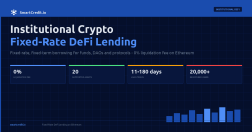
SmartCredit.io’s fixed-term lending model removes the structural cause of bank-run risk rather than trying to manage its symptoms. The mechanism is straightforward: lenders and borrowers both commit to a fixed term at a fixed rate. A lender who deposits capital for a 90-day loan at 15% APY cannot withdraw early – the capital is committed for 90 days. A borrower who takes that loan at the same rate repays at term end. Neither party faces uncertainty about the other’s behaviour during the loan period.
This term commitment is what prevents bank-run dynamics. Because no lender can withdraw early, there is no mechanism for simultaneous withdrawal to drain the pool. Each loan’s liquidity is committed and sequenced: when a 90-day loan matures and the borrower repays, that capital is returned to the lender at the agreed rate. There is no pool of “potentially withdrawable at any moment” capital that could disappear overnight.
The fixed rate works in concert with the fixed term. Because the rate is locked at loan origination, neither lender nor borrower faces variable rate risk during the term. A lender who locks in 15% APY for 90 days earns exactly that – regardless of what happens to market rates during that period. By contrast, an Aave lender’s yield fluctuates with utilisation and can drop significantly during the same period. When rates drop, Aave lenders are incentivised to withdraw and seek better yield elsewhere – which is precisely the behaviour that contributes to utilisation fluctuations and, in extremis, liquidity squeezes.
The analysis of fixed vs variable interest rates explains how the predictability of fixed rates benefits both sides: lenders know what they will earn, borrowers know what they will pay, and neither needs to monitor the market constantly or react to rate changes during the term.
What Fixed-Term Lending Means for Lenders in Practice
For a lender choosing between SmartCredit.io and a variable-rate protocol, the fixed-term model has practical implications beyond the theoretical protection from bank runs.
Predictable yield. You know exactly what you will earn before the loan starts. 90 days at 15% APY on $10,000 of USDC returns exactly $369 in interest (15% × 90/365 × $10,000). No variable rate changes, no utilisation fluctuations, no surprises. The guide to earning on SmartCredit.io covers how to set up fixed-rate lending positions across different assets and terms.
No monitoring required. Variable-rate lenders need to track their yield and compare it to alternatives, because the rate they are earning can change daily. A fixed-rate lender does not: the rate is set, the term is set, and the return is determined at origination. This reduces cognitive overhead and the risk of missing a rate deterioration that would have prompted a reallocation.
Immunity to panic dynamics. If a market event triggers a rush to exit Aave, Aave lenders face a choice between accepting illiquidity or withdrawing quickly enough to beat the queue. SmartCredit.io lenders face no such choice: the term structure means no queue exists. Other lenders’ behaviour during your loan term cannot affect your position.
fixed interest income plus weekly SMARTCREDIT token rewards on supported assets. Fixed-rate yields on SmartCredit.io reach fixed interest income plus weekly SMARTCREDIT token rewards, reflecting the market rate for fixed-term, fixed-rate capital across the platform’s borrower base. For historical context on how these rates compare to variable-rate protocols, the historical DeFi borrowing rates tool shows rate data across protocols and terms. For passive income strategies that combine fixed lending with other DeFi approaches, the DeFi passive income guide covers the full range of options.
The Loss Provision Fund: A Second Layer of Protection
The fixed-term structure eliminates bank-run risk. However, it does not eliminate the risk that a borrower’s collateral falls in value and the resulting liquidation proceeds are insufficient to repay the full loan. This residual risk – which exists in any lending platform regardless of term structure – is covered by the Loss Provision Fund.
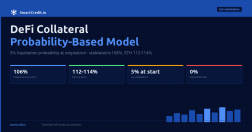
When a borrower’s position is liquidated and the proceeds fall short of the outstanding loan amount, the Loss Provision Fund covers the difference. Lenders receive their full principal and contracted interest regardless of the liquidation outcome. This protection applies on top of SmartCredit.io’s probability-calibrated collateral model, which sets starting collateral at a level corresponding to only 5% liquidation probability – meaning most positions are never liquidated at all.
The two protections work at different points in the risk chain. The fixed-term structure prevents bank-run dynamics by eliminating the possibility of simultaneous lender withdrawal. The Loss Provision Fund prevents lender losses in the rare cases where a liquidation does occur and proceeds fall short. Together, they address the two primary ways a DeFi lender can lose capital: a liquidity crisis and a borrower default shortfall.
The Loss Provision Fund guide explains in detail how the fund is maintained, what scenarios trigger it, and how lenders benefit from it in practice. For lenders who have experienced shortfalls on other platforms – or who want to understand how SmartCredit.io’s lender protections compare to those of variable-rate protocols – this post is the most relevant starting point.
SmartCredit.io
Compare fixed DeFi lending rates before you commit
See how SmartCredit.io’s fixed rates compare to variable-rate protocols across terms and assets.
Compare rates →Fixed-Term vs Variable-Rate: Lender Risk Compared
The table below summarises the key differences in lender risk between SmartCredit.io’s fixed-term model and variable-rate protocols like Aave and Compound.
| Risk dimension | Aave / Compound (variable-rate) | SmartCredit.io (fixed-term) |
|---|---|---|
| Bank-run risk | Yes – simultaneous withdrawals can drain liquidity | No – term commitment prevents simultaneous withdrawal |
| Rate certainty | None – yield fluctuates with utilisation | Full – rate locked at loan origination |
| Withdrawal flexibility | Yes – withdraw anytime (when liquidity available) | No – capital committed for loan term |
| Lender shortfall protection | None – lender absorbs any liquidation shortfall | Loss Provision Fund covers shortfall |
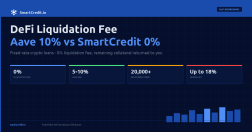
| Liquidation fee impact on lenders | Protocol earns 5-10%; lender receives net proceeds | 0% fee – full proceeds applied to loan repayment |
| Monitoring required | Yes – yield and liquidity conditions change | No – rate and term fixed at origination |
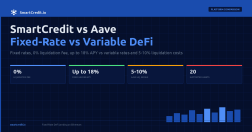
The trade-off is clear: Aave lenders get withdrawal flexibility; SmartCredit.io lenders get yield certainty and structural protection from bank-run dynamics. For lenders whose primary concern is knowing what they will earn – and not being trapped in a liquidity crisis – the fixed-term model is structurally superior. The full SmartCredit vs Aave comparison covers all eight dimensions, including interest rate model, borrower protection and collateral mechanics.
Fixed-Term Lending as Part of a DeFi Yield Strategy
Fixed-term lending with fixed interest income plus weekly SMARTCREDIT token rewards is not the only yield strategy available on SmartCredit.io. The platform also supports leveraged Lido staking at 2-5x on stETH yield, investment funds with automatic rebalancing, and portfolio products built on Markowitz optimisation. Fixed-term lending is the foundation: predictable, protected and straightforward.
For lenders who want to diversify across multiple terms and assets, SmartCredit.io’s platform allows positions across different loan terms simultaneously – giving a staggered maturity profile that balances liquidity events across the calendar. A lender with positions maturing at 30, 60 and 90-day intervals always has capital returning to them regularly, without needing to monitor a variable-rate pool for the right moment to withdraw.
The yield farming with fixed-term loans guide covers strategies for combining fixed lending positions across terms and assets. For platform documentation on how fixed-term lending works technically, the borrowing and lending documentation covers the full mechanics. The how to earn guide walks through setting up lending positions step by step. Platform security and smart contract details are in the security documentation, and the revenue model page explains how SmartCredit.io earns – and why it earns 0% on liquidations. For lenders who also hold crypto collateral and want to borrow against it while earning yield on the same assets in a different position, the guide to taking crypto profits without selling explains how fixed-rate borrowing enables this.
Frequently Asked Questions
What is bank-run risk in DeFi lending?
Bank-run risk in DeFi refers to the possibility that a large number of lenders attempt to withdraw their funds simultaneously, faster than the protocol can accommodate them. Variable-rate protocols like Aave and Compound allow withdrawal at any time, which creates this vulnerability: in a market panic, simultaneous withdrawal requests can exceed available liquidity, trapping lenders in illiquid positions. This dynamic contributed to the collapse of Celsius Network and Anchor Protocol in 2022.
How does fixed-term lending prevent DeFi bank runs?
Fixed-term lending prevents bank runs by design: lenders commit capital for a defined period and cannot withdraw early. Because no lender can exit before the term ends, there is no mechanism for simultaneous withdrawals to drain liquidity. Each loan’s capital is committed and sequenced – it returns to the lender at term maturity when the borrower repays. No other lender’s behaviour during your loan term can affect your position or yield.
What is the Loss Provision Fund on SmartCredit.io?
The Loss Provision Fund is a reserve that covers any shortfall when a borrower’s liquidation proceeds are insufficient to repay the full outstanding loan. If collateral is liquidated and the sale proceeds do not cover the loan amount, the fund makes lenders whole. It is a second layer of lender protection that operates separately from the fixed-term structure – addressing borrower default risk rather than bank-run risk.
Can I withdraw my funds early on SmartCredit.io?
No. Capital committed to a fixed-term loan on SmartCredit.io cannot be withdrawn before the loan matures. This is the structural feature that eliminates bank-run risk – it is a constraint by design, not an oversight. At term maturity, the borrower repays and capital is returned to the lender at the contracted fixed rate. Lenders who need ongoing liquidity access should consider staggering positions across multiple terms to create a regular cadence of maturity events.
How does SmartCredit.io’s fixed yield compare to Aave’s variable yield?
SmartCredit.io offers fixed yields fixed interest income plus weekly SMARTCREDIT token rewards, locked at loan origination for the full term. Aave’s variable yields fluctuate with pool utilisation – they can be high when demand is strong and very low when it is not. The key difference is certainty: a SmartCredit.io lender knows their return before committing capital; an Aave lender does not. During periods of market stress when Aave utilisation drops sharply, SmartCredit.io lenders continue earning their contracted rate.
Is Aave at risk of a bank run?
Aave is not immune to liquidity squeezes. During market stress events, utilisation across Aave pools has historically approached 100%, temporarily restricting withdrawals and spiking borrow rates. While Aave’s interest rate model is designed to attract new deposits when utilisation rises, this mechanism takes time to work and does not prevent temporary liquidity restrictions. Any protocol that allows lenders to withdraw at any time while lending those funds out on a longer horizon faces this structural tension.
SmartCredit.io
Fixed-rate DeFi lending – fixed interest income plus weekly SMARTCREDIT token rewards, no bank-run risk
Your rate is locked. Your term is fixed. No variable surprises, no panic withdrawal risk. Loss Provision Fund covers any shortfall.
Start lending →Sources: Ethereum.org DeFi guide – overview of DeFi lending mechanics and liquidity risk on Ethereum; Chainalysis Crypto Crime Report – data on DeFi protocol collapses and lender losses in 2022; Messari State of DeFi Lending – analysis of variable-rate lending liquidity dynamics; BIS Working Paper: Runs on algorithmic stablecoins – academic analysis of bank-run dynamics in DeFi protocols.
Related SmartCredit reading: How to earn fixed interest income plus weekly SMARTCREDIT token rewards on SmartCredit.io – Loss Provision Fund: how lenders are protected – Fixed vs variable DeFi interest rates – SmartCredit vs Aave: full platform comparison – DeFi interest rates compared: fixed vs variable