Most DeFi lending protocols set a single fixed loan-to-value cap that determines both how much you can borrow and how close you start to the liquidation trigger. SmartCredit.io separates these two concepts: the liquidation threshold is fixed per asset, but the collateral required at loan origination is calculated by a probability model – set at the level where there is only a 5% chance of reaching the liquidation threshold during your specific loan term. The longer the term, the more starting buffer you need. This post explains how that model works, what it means in practice, and how Simple mode and Advanced mode give different levels of control.
Last Updated: November 2026
Two Distinct Concepts: Liquidation Threshold vs Starting Collateral
Understanding how SmartCredit.io handles collateral requires keeping two concepts separate. Most DeFi protocols blur them together, which is part of why borrowers often misread their actual risk exposure.
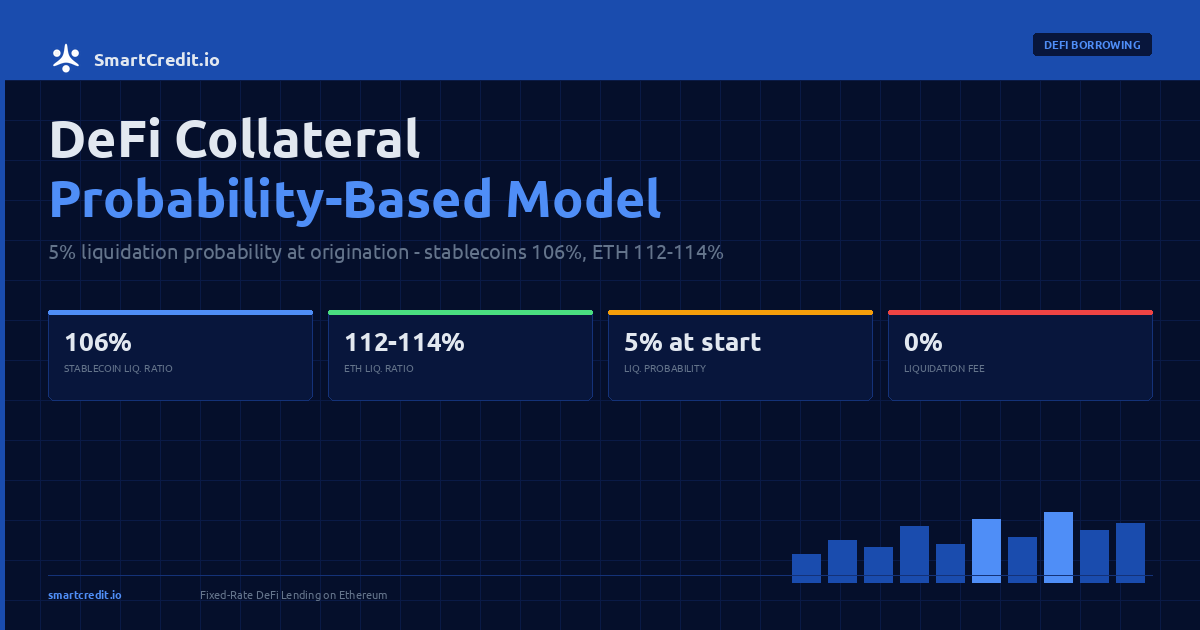
The liquidation threshold is the collateral ratio at which a position is liquidated. On SmartCredit.io these are fixed per asset type: 106% for stablecoins (DAI, USDC, USDT), 112-114% for ETH and wBTC, and up to 122% for more volatile ERC-20 tokens. If your collateral value falls to these levels relative to the outstanding loan, the position is liquidated.
The starting collateral is what you actually need to deposit when taking out the loan. This is a different number – and it is the number that SmartCredit.io’s probability model determines. The model asks: given this asset’s historical volatility and this loan term, how much collateral does the borrower need to start with so there is only a 5% chance of the position ever reaching the liquidation threshold before the loan matures?
The answer depends on two variables: the asset’s volatility, and how long the loan runs. A short-term loan against a stable asset needs a modest starting buffer above the liquidation threshold. A long-term loan against a volatile token needs a much larger buffer – because there is more time for the price to move against you, increasing the probability of hitting the threshold. The result is a starting collateral requirement that is higher than the liquidation threshold, sized to the actual risk.
How Aave Handles Collateral – and Why It Is Different
On Aave, the loan-to-value cap and the liquidation threshold are two parameters that sit close together by design. For ETH on Aave, the LTV cap is 80% (meaning you can borrow up to 80% of your ETH’s value) and the liquidation threshold is 82.5%. The gap between them – 2.5 percentage points of LTV – is a thin buffer. If ETH drops even modestly, your position moves from safe to in-the-liquidation-zone quickly.
Furthermore, Aave’s LTV cap is a governance-set parameter, voted on by token holders and adjusted infrequently. It is set conservatively enough to work across a range of market conditions, but it does not adapt to the specific volatility of the current moment, and it does not account for how long you plan to hold the position. A borrower taking a 7-day loan and a borrower planning to hold for 6 months face the same 80% LTV cap, even though their actual risk profiles are very different.
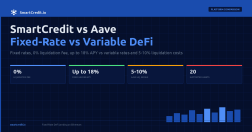
SmartCredit.io’s approach is structurally different. The liquidation threshold is fixed – it is what it is for each asset class. But the collateral you need to start with is calculated fresh for each loan, based on the specific asset’s volatility and the specific loan term you have selected. The goal is a 5% liquidation probability at origination: you start far enough above the threshold that only the unluckiest 5% of market scenarios would push you into liquidation territory before the loan ends. For more context on how the two platforms compare across all dimensions, the SmartCredit vs Aave comparison covers rates, liquidation fees and borrower protection in detail.
SmartCredit.io Liquidation Thresholds by Asset
The liquidation thresholds on SmartCredit.io reflect each asset’s risk profile. Stablecoins have the tightest threshold because their price stability means minimal risk of a large adverse move. ETH and wBTC have a wider threshold to account for crypto market volatility. Volatile ERC-20 tokens carry the widest threshold because their price movements are the most unpredictable.
| Asset Type | Examples | Liquidation Threshold | Characteristic |
|---|---|---|---|
| Stablecoins | DAI, USDC, USDT | 106% | Near-zero price volatility |
| Major crypto | ETH, wETH, wBTC | 112-114% | Significant but bounded volatility |
| Volatile ERC-20s | SMARTCREDIT, partner tokens | Up to 122% | Higher day-to-day price movements |
These thresholds define the danger zone. Your starting collateral – what the probability model calculates – will always be meaningfully above these figures, with the gap sized to your loan term and the asset’s volatility. A borrower taking a 30-day loan against ETH will have a smaller starting buffer above 112% than a borrower taking a 90-day loan against the same asset, because the 30-day loan has fewer opportunities for a large adverse price move.
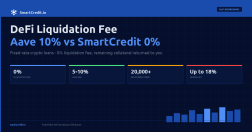
The thresholds also set the context for the 0% liquidation fee SmartCredit.io charges. When a position is liquidated, the collateral is sold to repay the loan and any remaining collateral is returned to the borrower’s credit line. Unlike Aave and Compound, which charge a 5-10% liquidation bonus that the protocol earns, SmartCredit.io earns nothing on liquidations. The DeFi liquidation fee comparison explains why this zero-fee model is a significant financial differentiator, particularly for borrowers who are occasionally caught by market volatility.
SmartCredit.io
Borrow with probability-calibrated collateral
Your starting buffer is sized to your specific asset, term and market conditions. 0% liquidation fee – remaining collateral returned to your credit line.
Start borrowing →Why Loan Term Changes Your Starting Collateral
The relationship between loan term and starting collateral is one of the clearest illustrations of why a probability model produces better outcomes than a fixed LTV cap. Consider an ETH loan with a 112% liquidation threshold. The question is: how far above 112% do you need to start to have only a 5% chance of reaching 112% before the loan ends?
For a 7-day loan, the answer is a relatively modest buffer. ETH’s historical volatility means it is unlikely to drop far enough to reach the 112% threshold in just seven days – possible, but unlikely. The probability model reflects this by requiring a starting collateral that is not dramatically higher than the threshold.
For a 90-day loan, however, the buffer must be meaningfully larger. Over three months there are many more opportunities for ETH to experience a sharp correction, and the cumulative probability of a large adverse move is significantly higher than over a single week. The model calculates the required buffer for the full 90-day exposure and sets the starting collateral accordingly. The borrower deposits more upfront, but in exchange they have a loan that is properly sized for the duration they have committed to.
This term-sensitivity is absent from fixed LTV protocols. Aave applies the same 80% LTV cap to ETH regardless of whether you are holding the position for a week or a year. This means short-term Aave borrowers are over-collateralised relative to their actual risk, and long-term borrowers may be under-collateralised relative to the full duration of their exposure. SmartCredit’s model calibrates to both dimensions simultaneously – asset volatility and term length – producing a starting collateral that is appropriate for the specific loan, not a one-size-fits-all cap. The comparison of fixed vs variable DeFi lending explains how term commitment enables this kind of precise risk pricing across the platform.
Simple Mode: Automatic Probability-Based Collateral
Simple mode is the default borrowing experience on SmartCredit.io. You select your collateral asset, your borrow amount and your loan term. The probability model calculates the starting collateral required for a 5% liquidation probability at those parameters and displays the figure clearly before you confirm. No manual configuration is needed – you see the required collateral, review the fixed rate, and proceed.
The 5% threshold is a deliberate choice. It is not a guarantee that liquidation will not occur – it means that at origination, only the unluckiest 5% of modelled market scenarios would lead to liquidation. In practice, borrowers who actively monitor their positions and can top up collateral when market conditions tighten will face even lower liquidation rates, because the monitoring system gives early warning well before the threshold is reached.
Simple mode suits the majority of borrowers who want a straightforward experience. The model handles the risk calibration; you benefit from a starting position that is evidence-based for your specific loan rather than determined by a governance vote that cannot account for your individual circumstances. For borrowers who want to review historical rate data before choosing a term, the historical DeFi borrowing rates tool shows how rates have varied across terms and market conditions.
Advanced Mode: Custom Collateral with Mandatory Monitoring
Advanced mode gives experienced borrowers the ability to set their own starting collateral ratio, independent of the 5% probability default. This is meaningful in practice: a borrower who wants more leverage can set a starting collateral closer to the liquidation threshold, accepting a higher liquidation probability in exchange for greater capital efficiency.
However, Advanced mode comes with a non-negotiable condition: positions monitoring is mandatory. When you operate closer to the liquidation threshold, the gap between your current collateral and the danger zone is narrower. A fast-moving market can close that gap before a borrower doing daily manual checks would notice. The Positions Monitoring System tracks your position in real time and sends Telegram alerts when conditions deteriorate – giving you time to top up collateral, partially repay or take other action before liquidation.
This mandatory monitoring requirement reflects SmartCredit.io’s zero-liquidation-fee model. Because SmartCredit earns nothing on liquidations – unlike Aave and Compound, which earn 5-10% and therefore benefit financially when borrowers are liquidated – the platform’s interest is aligned with keeping your position healthy. Advanced mode’s mandatory monitoring is a practical expression of that alignment: users who have accepted higher risk are precisely the users who most need real-time alerts.
The analysis of why Aave has no liquidation monitor covers the conflict-of-interest argument in detail: Aave earns from liquidations and runs liquidation bots that profit from the event. SmartCredit earns nothing, so it built a monitoring system instead. Advanced mode on SmartCredit is the most direct expression of this – higher leverage with mandatory monitoring, rather than higher leverage with no warning at all.
The Positions Monitoring System and Protection Agent
Whether you use Simple mode or Advanced mode, the Positions Monitoring System is available for all SmartCredit.io borrowing positions. It tracks collateral values in real time and sends Telegram alerts when a position approaches the liquidation threshold – giving borrowers actionable warning rather than a post-liquidation notification.
The Protection Agent extends this monitoring to Aave V3 and Compound V3 positions held outside SmartCredit.io. Borrowers with existing Aave or Compound exposure can connect their wallet to Protection Agent and receive probability-based liquidation alerts for those positions as well. The alert fires at 15% liquidation probability – earlier than these protocols’ own health factor thresholds – precisely because the goal is to give borrowers enough time to act, not simply to flag an imminent liquidation. SmartCredit borrowers have positions monitoring built-in via Advanced Borrowing mode.
Together, the probability-based starting collateral and real-time monitoring form a coherent protection stack. The starting collateral ensures the position is sized appropriately for the risk. The monitoring system ensures borrowers are informed if conditions change after origination. And if liquidation does occur despite both layers, the 0% fee and collateral return ensure borrowers are not penalised beyond the actual loss. The complete guide to avoiding crypto loan liquidation covers all three layers in full.
The Loss Provision Fund: Protection for Lenders
The probability model is calibrated to 5% liquidation probability – rare but not zero. In extreme market conditions, a position may be liquidated and the proceeds may not fully cover the outstanding loan. This residual risk is covered by the Loss Provision Fund.
When liquidation proceeds fall short of the loan amount, the Loss Provision Fund covers the difference. Lenders are made whole regardless of whether the collateral realised its expected value at the time of liquidation. In a sharp, fast-moving market downturn – where liquidation prices can be significantly below pre-crash valuations – this fund provides meaningful protection that is absent from most DeFi lending protocols.
The Loss Provision Fund is the final layer of a risk management chain that runs from loan origination through to liquidation outcomes: probability-calibrated collateral reduces the chance of liquidation occurring; real-time monitoring gives borrowers time to act if conditions deteriorate; and the fund protects lenders from any residual shortfall if liquidation proceeds fall short. For borrowers, this chain means lower fees and collateral return; for lenders, it means yield that is backed by a genuine backstop.
SmartCredit.io
Monitor your DeFi position before liquidation hits
Protection Agent monitors Aave V3 and Compound V3 positions and sends Telegram alerts at 15% liquidation probability – before Aave’s bots act.
Set up Protection Agent →A Practical Example: 30-Day vs 90-Day ETH Loan
To make the probability model concrete, consider two borrowers both using ETH as collateral. Both face the same 112% liquidation threshold. The difference is their loan term.
Borrower A takes a 30-day loan. The probability model calculates the buffer required above 112% such that only 5% of modelled ETH price paths over 30 days would reach that threshold. Given ETH’s historical volatility, this results in a starting collateral that is meaningfully above 112% but not dramatically so – the 30-day window limits the range of likely price outcomes.
Borrower B takes a 90-day loan. Over three months, the range of likely ETH price outcomes is much wider. A price path that stays comfortably above the liquidation threshold for 30 days might dip below it over a full quarter. Consequently, the probability model requires a larger starting buffer above 112% to maintain the same 5% liquidation probability target over the longer horizon. Borrower B deposits more collateral upfront, but their position is appropriately sized for the duration they have committed to.
Both borrowers benefit from the fixed rate locked at origination – regardless of what happens to ETH’s market price during the loan, their borrowing cost is fixed. And if either position is liquidated despite the probability-calibrated buffer, the 0% liquidation fee applies – surplus collateral is returned, not retained by the protocol. For background on how SmartCredit.io’s fixed-rate structure protects both lenders and borrowers, the DeFi fixed vs variable rate comparison covers the mechanics in detail.
Supported Collateral Assets
SmartCredit.io supports 20 collateral assets on Ethereum mainnet, including ETH, wETH, wBTC, DAI, USDC, USDT, SMARTCREDIT and a range of partner ERC-20 tokens. Each asset falls into one of the three liquidation threshold tiers, with the probability model setting starting collateral based on that asset’s specific volatility profile.
Stablecoin collateral offers the smallest buffer requirement above the 106% threshold, because stablecoin price movements are minimal. ETH and wBTC require a moderate buffer above their 112-114% threshold. Volatile ERC-20s require the most starting collateral above their up-to-122% threshold, reflecting the higher day-to-day price movements of smaller-cap tokens. The cryptocurrency as collateral guide covers which assets are supported and how each is handled in the risk model. Full technical details on collateral ratios and liquidation mechanics are available in the SmartCredit.io borrowing documentation, and the Protection Agent documentation covers monitoring setup. For platform security and smart contract audit details, see the security documentation. Historical rate data is available via the compare historical rates tool.
Frequently Asked Questions
What is the difference between a liquidation threshold and a starting collateral ratio in DeFi?
The liquidation threshold is the collateral ratio at which a position is liquidated – on SmartCredit.io, 106% for stablecoins, 112-114% for ETH/wBTC, and up to 122% for volatile ERC-20s. The starting collateral ratio is what you deposit when taking out the loan – this is higher than the threshold, sized by the probability model so there is only a 5% chance of reaching the threshold during the loan term. Most DeFi protocols set a single LTV cap that serves both purposes simultaneously; SmartCredit separates them.
How does loan term affect collateral requirements on SmartCredit.io?
Longer terms require more starting collateral. Over a longer period there are more opportunities for the collateral asset’s price to move adversely and reach the liquidation threshold. A 90-day ETH loan requires a larger starting buffer above the 112% threshold than a 30-day loan, because the range of likely price outcomes over three months is much wider than over one month. The probability model calculates the required buffer for the specific term you select.
What does 5% liquidation probability mean in practice?
It means that at the moment of loan origination, the probability of the collateral value reaching the liquidation threshold before the loan matures – based on the asset’s historical volatility – is 5%. Put differently, 95% of modelled market scenarios would not trigger liquidation. It is not a guarantee: unexpected market events can exceed historical volatility. However, the Positions Monitoring System provides real-time alerts if conditions deteriorate after origination, giving borrowers time to act before the threshold is reached.
What is Simple mode vs Advanced mode on SmartCredit.io?
Simple mode applies the 5% liquidation probability collateral automatically – the system calculates the required starting collateral for your asset and term, and you proceed without manual configuration. Advanced mode lets experienced borrowers set their own starting collateral ratio, potentially accepting a higher liquidation probability in exchange for more capital efficiency (more leverage). Advanced mode requires positions monitoring via Telegram – this is mandatory, not optional, because a position running closer to the liquidation threshold needs real-time alerts to give the borrower time to act.
What happens if my position is liquidated on SmartCredit.io?
SmartCredit.io charges a 0% liquidation fee. The collateral is sold to repay the outstanding loan and any remaining collateral is returned to your credit line. This contrasts with Aave and Compound, which charge a 5-10% liquidation bonus retained by the protocol. If the liquidation proceeds do not fully cover the loan amount, the Loss Provision Fund covers the shortfall so lenders are always made whole.
SmartCredit.io vs Aave: how do collateral requirements compare?
Aave applies a fixed LTV cap per asset that is set by governance vote and does not vary by loan term. For ETH, Aave’s LTV cap implies a starting collateral of 125%. SmartCredit.io’s liquidation threshold for ETH is 112-114%, and the probability-calibrated starting collateral will vary based on term – shorter loans may require a buffer not far above 112%, while longer terms require a wider buffer. Additionally, SmartCredit.io charges 0% on liquidations versus Aave’s 5-10%, and the Loss Provision Fund protects lenders from shortfalls that Aave does not cover.
SmartCredit.io
Fixed-rate crypto borrowing with probability-calibrated collateral
Starting buffer sized to your asset, term and market conditions. 0% liquidation fee – remaining collateral returned to your credit line.
Borrow now →Sources: Ethereum.org DeFi guide – overview of DeFi lending and collateral mechanics on Ethereum; Aave risk parameter documentation – LTV caps and liquidation thresholds by asset; Messari DeFi liquidations research – liquidation frequency and cost analysis across protocols; BIS Working Paper: DeFi lending and collateral risk – academic analysis of collateral ratio methodology in decentralised lending.
Related SmartCredit reading: DeFi liquidation fee: Aave 5-10% vs SmartCredit.io 0% – SmartCredit vs Aave: full platform comparison – How to avoid crypto loan liquidation – Protection Agent: DeFi liquidation monitoring – Loss Provision Fund: how lenders are protected