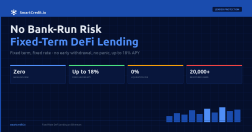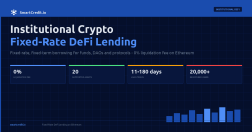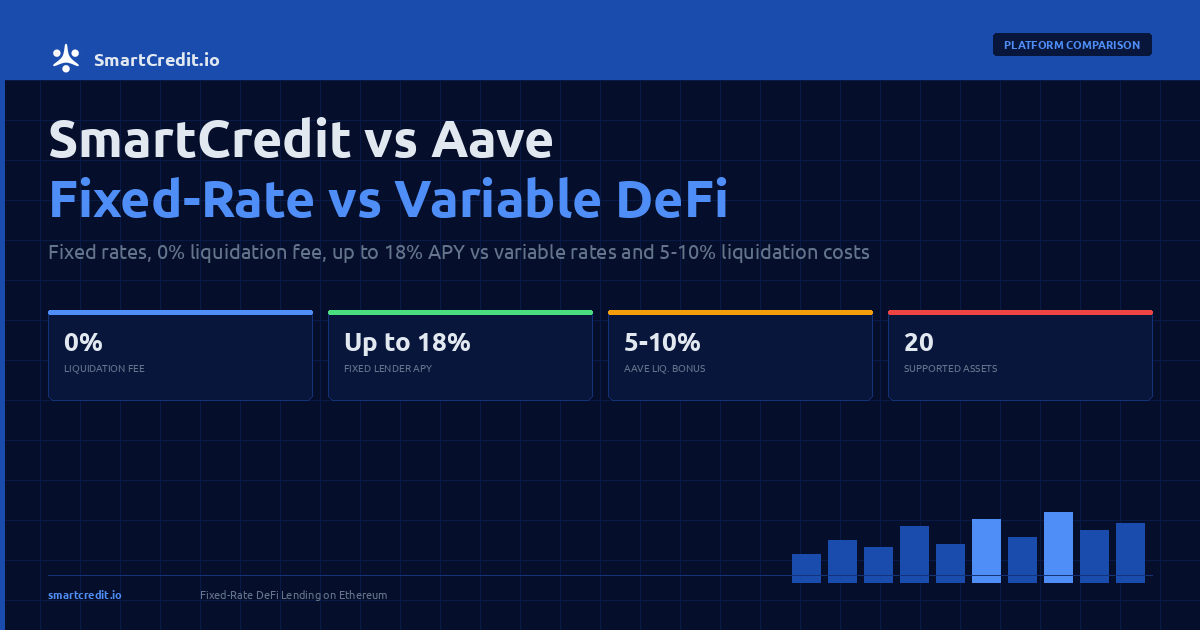
SmartCredit vs Aave is the central comparison for any DeFi borrower in 2026. SmartCredit.io offers fixed-rate, fixed-term loans with 0% liquidation fees and fixed interest income plus weekly SMARTCREDIT token rewards for lenders. Aave V3 offers variable rates, deeper liquidity and a wider asset range – but charges 5-10% on liquidations and has no borrower warning system. This comparison covers five dimensions in depth, with a verdict table upfront and a clear recommendation for each user type.
Last Updated: November 2026
SmartCredit vs Aave: The Verdict at a Glance
The table below summarises the five most important dimensions for borrowers and lenders comparing the two platforms. Each dimension is covered in detail in the sections that follow.
| Dimension | SmartCredit.io | Aave V3 | Winner |
|---|---|---|---|
| Interest rate model | Fixed rate, fixed term – locked at origination | Variable rate – changes with utilisation | SmartCredit (predictability) |
| Liquidation fee | 0% – remaining collateral returned to borrower | 5-10% bonus to liquidators | SmartCredit (cost) |
| Collateral calculation | Probability-based: 5% liquidation probability | Fixed LTV caps per asset class | SmartCredit (efficiency) |
| Borrower protection | Positions Monitoring System + Telegram alerts at 15% probability | No built-in warning system | SmartCredit (protection) |
| Lender yield | Fixed yield fixed interest income plus weekly SMARTCREDIT token rewards – locked at origination | Variable APY – fluctuates with utilisation | SmartCredit (certainty) |
| Supported assets | 20 assets: ETH, wETH, wBTC, stablecoins, partner ERC-20s | 30+ assets including long-tail tokens | Aave (breadth) |
| Liquidity depth | Fixed-term pools – cannot withdraw early | Open-ended – withdraw anytime (if liquidity available) | Aave (flexibility) |
| Protocol composability | Standalone fixed-income platform | Integrates with most DeFi protocols via aTokens | Aave (ecosystem) |
Summary verdict: SmartCredit.io wins on cost and protection for borrowers who value predictability – fixed rates, 0% liquidation fees and an active warning system. Aave wins on liquidity and asset range for users who need flexibility or want to interact with the broader DeFi ecosystem. The right choice depends on whether you prioritise knowing your exact cost upfront or maintaining flexibility to exit at any time.
Interest Rate Model: Fixed vs Variable
The most fundamental difference between SmartCredit.io and Aave V3 is the interest rate model. SmartCredit.io offers fixed-rate, fixed-term loans: the rate you agree at origination is the rate you pay for the entire loan duration. Aave V3 uses variable interest rates that change continuously based on pool utilisation.
How Aave Variable Rates Work
Aave’s interest rate model is based on utilisation: the percentage of the available lending pool currently borrowed. When utilisation is low, borrowing rates are low to incentivise more borrowing. As utilisation rises toward the optimal utilisation threshold, rates increase gradually. Beyond that threshold, rates rise sharply – designed to incentivise repayments and attract new lenders.
In practice, this means your borrowing cost on Aave is not fixed. During periods of high DeFi activity – market volatility, protocol launches or yield farming campaigns that attract capital – utilisation can spike and borrowing rates can rise sharply within hours. Historical data shows Aave USDC borrowing rates have ranged from under 2% during calm periods to over 20% during high-demand events. If you are borrowing on Aave for a planned purpose – collateralised purchasing, yield farming or tax-efficient liquidity – this unpredictability is a material risk.
Furthermore, Aave positions are open-ended. There is no defined end date. This flexibility is valuable if you want to repay early or extend indefinitely – but it also means there is no natural point at which the loan closes and collateral is settled. The position remains open until you actively close it, exposing you to market conditions indefinitely. For a detailed breakdown of how fixed and variable DeFi interest rates compare in practice, the SmartCredit.io fixed vs variable comparison covers the key scenarios.
How SmartCredit.io Fixed Rates Work
SmartCredit.io operates on fixed terms. When you open a loan, you specify the amount, the collateral asset, the loan duration (measured in months) and the currency. The interest rate is then set at loan origination and does not change for the duration of the loan. You know your exact repayment amount on day one.
This fixed-rate model is made possible by the platform’s matching architecture: each loan is matched to a specific lender who commits capital for the same fixed term at the same fixed yield. Neither party can exit early – borrowers repay at maturity, and lenders receive their principal plus yield at maturity. This mutual commitment is what makes the fixed-rate promise structurally sound rather than merely contractual.
The fixed-term structure also means that SmartCredit.io is immune to the bank-run dynamics that can affect variable-rate protocols. On Aave, if many lenders withdraw simultaneously, utilisation spikes and borrowing rates rise sharply – exactly when borrowers are most vulnerable. On SmartCredit.io, lenders cannot withdraw before maturity, so the lending pool is stable throughout the loan term. This structural protection is covered in the SmartCredit.io fixed-term borrowing documentation.
Which Interest Rate Model Is Better for Borrowers?
The answer depends on your use case. If you are borrowing for a defined purpose with a known repayment timeline – for example, accessing liquidity while holding ETH through a specific period, or financing a time-bound DeFi strategy – a fixed rate is significantly better. You model your total cost at the outset and face no rate-driven surprises.
If you are borrowing with maximum flexibility – no defined timeline, wanting to repay early if conditions change, or needing access to assets that SmartCredit.io does not currently support – Aave’s variable-rate model offers that flexibility at the cost of rate uncertainty. As the DeFi interest rates comparison shows, variable rates have historically been lower during calm periods but significantly higher during stress events – exactly when borrowers can least afford cost increases.
SmartCredit.io
Know your borrowing cost on day one
Fixed-rate, fixed-term crypto loans on Ethereum. Your rate is locked at origination – no variable surprises, no rate spikes during market stress.
Start borrowing →Liquidation Fees: 0% on SmartCredit.io vs 5-10% on Aave
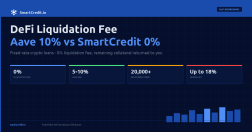
The liquidation fee comparison is where SmartCredit.io has its clearest financial advantage over Aave. As covered in detail in the DeFi liquidation fee comparison, Aave V3 charges a liquidation bonus of 5-10% (depending on the collateral asset) that goes to whoever executes the liquidation. SmartCredit.io charges 0% and returns any surplus collateral to the borrower’s credit line.
To illustrate the financial impact: if you borrow $7,000 against $10,000 of ETH on Aave V3 and your position is liquidated, the liquidator repays $3,500 of your debt and takes $3,850 of your ETH (the $3,500 repayment plus the 10% bonus). You lose $350 to the liquidation fee alone – before accounting for any ETH price movement. On SmartCredit.io, the same position would result in $0 in liquidation fees, with remaining collateral returned to your account.
Moreover, Aave’s partial liquidation model means that a sharp price move can trigger multiple consecutive liquidation events, each extracting another fee. SmartCredit.io’s fixed-term structure means the loan is settled in full at liquidation – there are no cascading partial events. The Loss Provision Fund covers any shortfall if proceeds are insufficient to cover the loan, protecting lenders without requiring a fee from the borrower.
For borrowers thinking about worst-case scenarios – a sharp market decline that triggers liquidation before they can respond – the 0% fee on SmartCredit.io means the worst-case outcome is significantly better than on Aave. When comparing DeFi platforms, the liquidation cost under adverse conditions matters as much as the nominal interest rate under normal conditions.
Collateral Calculation: Probability-Based vs Fixed LTV Caps
Aave V3 sets loan-to-value limits per asset class. For ETH, the maximum LTV is typically around 80% (meaning you can borrow up to $8,000 against $10,000 of ETH). Liquidation is triggered when the loan-to-value ratio exceeds the liquidation threshold – typically 82.5% for ETH. These caps are set conservatively to account for the worst-case price movements across all borrowers using that asset at any given time.
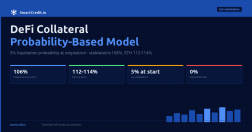
SmartCredit.io takes a different approach. Rather than applying a fixed LTV cap, the platform calculates the collateral ratio that corresponds to a specific liquidation probability for the specific asset, loan amount and loan term. In Simple borrowing mode, the platform sets the ratio automatically at 5% liquidation probability – meaning that under historical volatility conditions, there is a 5% chance of the position reaching the liquidation threshold before maturity.
This probability-based approach produces lower collateral requirements than conservative LTV caps for stable assets and appropriate collateral requirements for volatile assets. The resulting ratios are as follows:
| Asset | SmartCredit.io liquidation ratio | Aave V3 liquidation threshold (approx.) |
|---|---|---|
| USDC / USDT / DAI | 106% | 88% LTV / 90% liquidation threshold |
| ETH / wETH | 112-113% | 80% LTV / 82.5% liquidation threshold |
| wBTC | 112% | 73% LTV / 78% liquidation threshold |
| Volatile ERC-20 tokens | Up to 122% | Varies by asset, often lower LTV |
An important note on how to read this table: SmartCredit.io expresses collateral as a ratio (collateral / loan), while Aave expresses it as LTV (loan / collateral). A 112% collateral ratio on SmartCredit.io is equivalent to an 89% LTV – which is higher than Aave’s typical 80% maximum LTV for ETH. However, the probability model means this ratio is calibrated to actual risk for the specific term and asset, rather than a universal cap. Advanced mode on SmartCredit.io allows borrowers to set a lower collateral ratio – but requires connecting the Telegram Positions Monitoring System first, ensuring active monitoring is in place for any riskier configuration.
Borrower Protection: Active Monitoring vs No Warning System
The borrower protection comparison is stark. SmartCredit.io has built two distinct systems to help borrowers avoid liquidation. Aave has built neither. The reason – as covered in the analysis of why Aave has no liquidation monitor – is a structural conflict of interest: Aave earns 5-10% on every liquidation and has no financial incentive to prevent them.
SmartCredit.io Positions Monitoring System
For SmartCredit.io borrowers, the Positions Monitoring System sends Telegram alerts when liquidation probability – derived from collateral volatility – exceeds 15%. This alert fires while the collateral ratio is still comfortably above the liquidation threshold, giving borrowers time to add collateral or repay a portion of the loan before liquidation occurs.
Advanced borrowing mode on SmartCredit.io requires the Positions Monitoring System to be active before it can be used. This design means that any borrower who chooses a custom (lower) collateral ratio has automatic, active monitoring in place. The platform’s investment in preventing liquidations reflects its 0% liquidation fee: SmartCredit.io has no income from liquidation events and therefore has strong commercial motivation to help borrowers avoid them.
Protection Agent for Aave V3 and Compound V3 Users
SmartCredit.io’s Protection Agent extends this monitoring to Aave V3 and Compound V3 borrowers. It monitors any public wallet address on Aave V3 and sends Telegram alerts when liquidation probability exceeds the alert threshold. No wallet connection is required for the initial risk check. Setup takes under five minutes.
The fact that SmartCredit.io built a protection tool for Aave borrowers – its direct competitors’ customers – is itself evidence of the alignment difference between the two platforms. SmartCredit.io earns nothing from Aave liquidations, so it loses nothing by helping Aave borrowers avoid them. For users currently on Aave, the Protection Agent provides the monitoring layer that Aave has chosen not to build. Support for Compound V3 and Morpho is in development.
Lender Yields: Fixed Returns vs Variable APY
The lender comparison mirrors the borrower comparison: SmartCredit.io offers fixed yields locked at origination; Aave offers variable yields that fluctuate with pool utilisation.
On SmartCredit.io, lenders can currently earn fixed interest income plus weekly SMARTCREDIT token rewards on fixed-rate lending. This yield is confirmed at the point of commitment and does not change for the duration of the loan term. At maturity, lenders receive their principal plus the agreed yield in full. The Loss Provision Fund provides a first line of defence if borrower defaults or insufficient liquidation proceeds create a shortfall.
On Aave, lender yields vary continuously. During low-utilisation periods, Aave supply APYs for stablecoins have been as low as 0.5-2%. During high-demand periods, they can exceed 10-15% – but these periods are unpredictable and typically short-lived. For lenders who want to plan around a known yield – for example, those using DeFi lending as a fixed-income allocation in a broader portfolio – Aave’s variable model makes precise financial planning difficult.
Furthermore, Aave lenders face redemption risk: if many lenders withdraw simultaneously (a bank-run scenario), the remaining lenders may find their capital locked in a high-utilisation pool until borrowers repay. SmartCredit.io’s fixed-term model eliminates this risk structurally – lender capital is committed for the loan term and cannot be withdrawn early, so lenders always receive their principal at maturity regardless of platform-level activity. For a comparison of historical DeFi borrowing and lending rates across both fixed and variable protocols, SmartCredit.io’s rate comparison tool provides the data.
SmartCredit.io
Earn fixed interest income plus weekly SMARTCREDIT token rewards – fixed rate, fixed term
Lend crypto at locked rates on Ethereum. Your yield is confirmed at origination. Loss Provision Fund protects your capital. 20,000+ registered users.
Start lending →Asset Coverage and Liquidity: Where Aave Has the Advantage
An honest comparison requires acknowledging the dimensions where Aave leads. Aave V3 on Ethereum supports over 30 assets, including long-tail tokens, yield-bearing assets such as stETH and rETH, and assets that SmartCredit.io does not currently support. For users who want to borrow against a less common ERC-20 or use their staked ETH positions as collateral, Aave offers coverage that SmartCredit.io’s current 20-asset list does not.
Aave also offers significantly deeper liquidity. Because Aave pools are open and aggregated, large borrowing positions can be opened and closed quickly. SmartCredit.io’s fixed-term matching model means that large positions may require more time to fill as the platform matches borrowers with lenders committing to the same term. For institutional or high-volume users who need to deploy large amounts quickly, this is a material consideration.
Additionally, Aave’s aToken architecture integrates with the broader DeFi ecosystem. aTokens can be used as collateral in other protocols, enabling leveraged strategies and capital-efficient DeFi composability. SmartCredit.io is a standalone fixed-income platform and does not currently offer this kind of ecosystem composability. For users building complex DeFi strategies that chain multiple protocols, Aave is the more flexible foundation.
That said, Aave’s ecosystem depth comes with corresponding complexity and risk. The more protocols interact, the more potential failure points exist. SmartCredit.io’s standalone architecture means that its risk surface is limited to its own smart contracts and collateral assets – which is a significant advantage for users prioritising capital safety over capital efficiency in a complex stack. The SmartCredit.io revenue model and platform architecture reflect this focus on simplicity and predictability over composability.
SmartCredit vs Aave: Which Platform Is Right for You?
The choice between SmartCredit.io and Aave V3 ultimately comes down to your priorities as a borrower or lender. Neither platform is universally superior – each excels in a specific set of use cases.
Choose SmartCredit.io if:
- You want to know your exact borrowing cost upfront with no rate surprises over the loan term
- You are borrowing for a defined purpose with a known repayment timeline
- You want the best-case outcome if liquidation occurs – 0% fee, surplus collateral returned
- You want active Telegram alerts before liquidation risk builds (not after it triggers)
- You are lending and want a fixed, confirmed yield rather than a variable APY
- You prefer a straightforward fixed-income structure over complex DeFi composability
- You want to access liquidity without selling your crypto at a predictable cost
Choose Aave V3 if:
- You need to borrow against assets that SmartCredit.io does not currently support
- You want maximum flexibility to repay early or adjust your position at any time
- You are building a complex DeFi strategy that requires aToken composability
- You need very large-scale liquidity access quickly
- You are comfortable monitoring your own health factor and do not need active warning alerts
Many experienced DeFi users use both platforms for different purposes: Aave for flexible short-term borrowing against a wide range of assets, SmartCredit.io for fixed-income lending and planned, cost-certain borrowing against ETH, wBTC and stablecoins. For a broader comparison of DeFi lending platforms including Compound, MakerDAO and others, the SmartCredit.io platform comparison covers the full market.
If you currently have Aave V3 or Compound V3 positions and want the borrower protection that these protocols do not provide, setting up the Protection Agent takes under five minutes and requires no wallet connection for the initial risk check.
Frequently Asked Questions
Is SmartCredit.io better than Aave?
SmartCredit.io is better than Aave on cost predictability, liquidation fees and borrower protection. SmartCredit.io charges 0% on liquidations versus Aave’s 5-10%, offers fixed rates locked at origination versus Aave’s variable rates, and provides active Telegram alerts before liquidation occurs via the Positions Monitoring System. Aave is better on asset range (30+ assets versus SmartCredit.io’s 20), liquidity depth and DeFi composability. The right platform depends on whether you prioritise cost certainty and protection or flexibility and ecosystem integration.
What is the difference between SmartCredit.io and Aave interest rates?
SmartCredit.io offers fixed interest rates that are locked at the moment you open a loan and do not change for the entire loan duration. Aave V3 uses variable interest rates that fluctuate continuously based on pool utilisation. Aave rates can range from under 2% during calm periods to over 20% during high-demand events – making total borrowing cost unpredictable. SmartCredit.io fixed rates provide certainty over the total cost of borrowing from day one.
SmartCredit vs Aave: which has lower liquidation risk?
SmartCredit.io has a significantly better outcome if liquidation occurs: 0% liquidation fee versus Aave’s 5-10% bonus taken from the borrower’s collateral. Additionally, SmartCredit.io’s Positions Monitoring System sends Telegram alerts before the liquidation threshold is reached, while Aave has no equivalent warning system. The fixed-term structure also prevents cascading partial liquidations that can occur on Aave during sharp market moves. On SmartCredit.io, once a loan is settled at liquidation, the event is complete – surplus collateral is returned to the borrower’s credit line.
Can I use both SmartCredit.io and Aave?
Yes. Many DeFi users use both platforms for different purposes. A common approach is to use Aave for flexible short-term borrowing against a wide asset range, and SmartCredit.io for planned borrowing with a fixed rate and known repayment timeline, as well as for fixed-income lending with fixed interest income plus weekly SMARTCREDIT token rewards. If you use both, the SmartCredit.io Protection Agent can monitor your Aave V3 and Compound V3 positions and send Telegram alerts – providing the borrower protection that Aave does not offer natively.
How does SmartCredit.io’s Loss Provision Fund compare to Aave’s lender protection?
SmartCredit.io maintains a Loss Provision Fund – funded from a portion of every interest payment – that covers any shortfall if liquidation proceeds are insufficient to fully cover a loan. This provides direct protection to lenders without requiring a liquidation fee from borrowers. Aave protects lenders primarily through its overcollateralisation model and the liquidation bonus incentive for third-party liquidators. Aave’s Safety Module provides a secondary backstop funded by AAVE token stakers, but lenders are not explicitly protected from liquidation shortfalls in the same direct way as on SmartCredit.io.
What assets can I use as collateral on SmartCredit.io vs Aave?
SmartCredit.io supports 20 collateral assets: ETH, wETH, wBTC, DAI, USDC, USDT, SMARTCREDIT and a range of partner ERC-20 tokens. Aave V3 on Ethereum supports over 30 assets including stETH, rETH and various long-tail tokens. For borrowers who need to use assets outside SmartCredit.io’s current list, Aave offers broader coverage. SmartCredit.io’s supported asset list is expanding as the platform grows and new collateral assets are assessed for the probability-based risk model.
Does SmartCredit.io have a token?
Yes. The SMARTCREDIT token is a utility token that provides fee discounts on the platform and can be staked to earn rewards. It can also be used as collateral for borrowing. Aave has the AAVE token, which is primarily a governance token that can be staked in the Safety Module to earn staking yield and provide a backstop for protocol losses. Both platforms’ tokens offer staking mechanics, but the SMARTCREDIT token’s primary use case is fee reduction and utility within the SmartCredit.io platform rather than governance.
SmartCredit.io
Fixed-rate DeFi lending – borrow or earn
Borrow at locked rates with 0% liquidation fee, or lend with fixed interest income plus weekly SMARTCREDIT token rewards. 20,000+ registered users on Ethereum.
Start borrowing → Start lending →Sources: Aave V3 risk parameters – LTV, liquidation threshold and bonus per asset; Ethereum.org DeFi guide – overview of lending and liquidation mechanics; DeFi Llama – Aave TVL, utilisation and historical rate data; Compound Finance documentation – variable rate model and liquidation incentive parameters.
Related SmartCredit reading: DeFi liquidation fee: Aave takes 10%, SmartCredit.io takes 0% – Why Aave has no liquidation monitor – Fixed vs variable DeFi interest rates compared – How to earn fixed interest income plus weekly SMARTCREDIT token rewards on SmartCredit.io – Best crypto lending platforms 2026