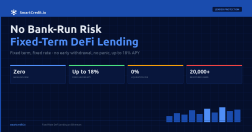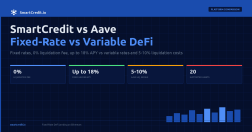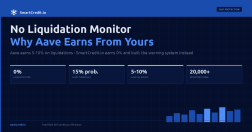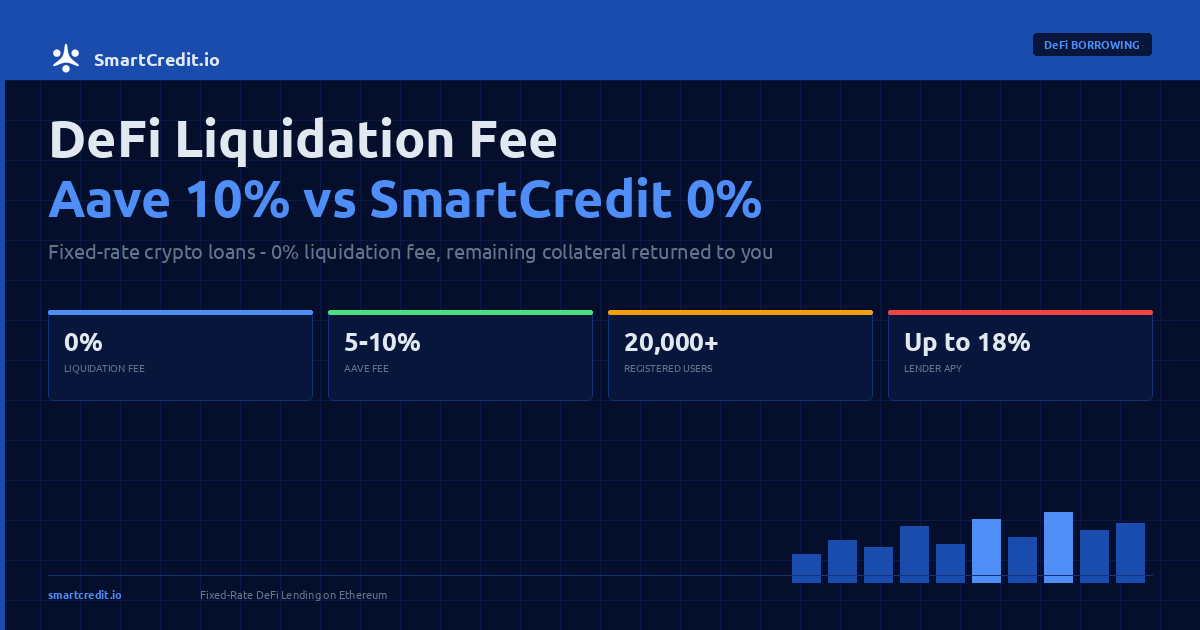
Most DeFi borrowers focus on interest rates when comparing lending platforms. However, the DeFi liquidation fee – what a protocol charges when it seizes and sells your collateral – can cost you far more than any interest rate differential. Aave and Compound typically charge 5-10% of your collateral value at the moment of liquidation, a fee that goes directly to liquidation bots rather than to lenders or platform development. SmartCredit.io charges 0%, returns any remaining collateral to your credit line, and maintains a Loss Provision Fund to cover shortfalls. This post explains why that difference exists and what it means for your funds.
Last Updated: November 2026
What Is a DeFi Liquidation Fee?
A DeFi liquidation fee – also called a liquidation bonus or liquidation penalty – is the extra percentage of collateral that a third-party liquidator receives when they repay part of your debt during a liquidation event. The DeFi liquidation fee exists because someone needs an incentive to repay your debt quickly when your collateral value drops. Without a bonus, no external actor would bother doing so.
From the borrower’s perspective, this fee is a direct financial loss on top of the stress of a liquidation. If you borrow $7,000 against $10,000 of ETH and ETH drops sharply, triggering a liquidation, you do not simply get back your surplus collateral. Instead, the liquidator claims your collateral at a discount – and that discount is deducted from what you receive.
Furthermore, the size of this fee varies significantly across DeFi protocols. Understanding how much each platform charges, and why, is therefore essential before you take out a crypto loan. The difference between a 0% fee and a 10% fee on a large position is not trivial – it can represent thousands of dollars.
On SmartCredit.io, avoiding liquidation is built into the platform design – but when liquidation does occur, the fee charged is 0%. That structural choice has significant downstream consequences for how the platform behaves toward borrowers, as this post explains.
How Much Aave, Compound and MakerDAO Charge on Liquidations
Aave V3, Compound Finance and MakerDAO each charge a liquidation fee that is built into their smart contract parameters. The exact percentages vary by collateral asset, but the general range is 5-10% for Aave and Compound and historically around 13% for MakerDAO vaults.
On Aave V3, the liquidation bonus for major assets typically runs as follows:
| Collateral asset | Aave V3 liquidation bonus (penalty to borrower) |
|---|---|
| Stablecoins (USDC, USDT, DAI) | 4.5 – 5% |
| ETH / wETH | 5 – 10% |
| wBTC | 5 – 10% |
| Volatile ERC-20 tokens | Up to 15% |
These percentages are charged at the moment of liquidation on the amount repaid. Because Aave allows partial liquidations of up to 50% of outstanding debt per event, a single liquidation can cost a borrower thousands of dollars in fees alone – before accounting for the original loan amount.
MakerDAO’s historical liquidation penalty on collateralised debt positions (CDPs) has been around 13%, meaning that if your ETH position is liquidated, you lose an additional 13% of the liquidated collateral value on top of any market price movement. That is a substantial penalty, particularly during volatile market conditions when liquidations tend to cluster.
A Worked Example: What a Liquidation Costs on Aave
To illustrate the financial impact, consider a concrete example. Suppose you deposit $10,000 of ETH as collateral on Aave V3 and borrow $6,500 of USDC. Your initial loan-to-value ratio is 65%, which is within safe bounds. Then ETH prices drop sharply. Your health factor falls below 1.0, making your position eligible for liquidation.
A liquidator steps in and repays $3,250 of your USDC debt (50% of outstanding). In return, they receive $3,250 plus the 10% liquidation bonus – a total of $3,575 worth of your ETH collateral. As a result, you have lost $325 to the liquidation fee alone, on top of the ETH price movement that triggered the event in the first place.
Your remaining position: $6,425 of ETH collateral and $3,250 of remaining USDC debt. However, depending on how far ETH has fallen, a second liquidation event may follow shortly after. Each event extracts another liquidation fee. In a sharp market downturn, multiple partial liquidations can compound the loss significantly.
Who Actually Runs the Liquidation Bots?
Aave and Compound publicly describe their liquidation systems as open to any third party. In practice, however, protocol teams and their associated entities run sophisticated, well-capitalised liquidation bots that compete at the smart contract level. These bots operate with low-latency connections to the blockchain, significant capital reserves, and direct knowledge of the protocol’s parameters.
Consequently, the liquidation fee does not flow to anonymous third parties operating in a purely competitive market. Rather, it flows systematically to well-resourced actors – often connected to the same organisations that govern the protocol. MakerDAO, for instance, has historically published liquidation revenue as a line item in protocol income statements, confirming that liquidations are a revenue source for the protocol ecosystem.
This arrangement creates a structural alignment of incentives that works against borrowers. As the next section explains, it also explains why these protocols have never built a genuine borrower-side warning system.
SmartCredit.io
Borrow at fixed rates with 0% liquidation fee
Fixed-term, fixed-rate crypto loans on Ethereum. If liquidation occurs, SmartCredit.io charges 0% – remaining collateral is returned to your credit line.
Start borrowing →Why DeFi Protocols Profit From Liquidating You
The DeFi liquidation fee structure creates a fundamental conflict of interest at the core of variable-rate lending protocols. When a protocol earns revenue from liquidations, every liquidation event is profitable for the protocol ecosystem. This means the protocol has no financial incentive to help borrowers avoid being liquidated.
Consider what building a genuine borrower warning system would mean for a protocol like Aave. Such a system would alert borrowers before their health factor drops to the liquidation threshold – giving them time to add collateral, repay part of the loan, or otherwise avoid the liquidation event. Fewer liquidations would mean less liquidation revenue. Therefore, building that warning system would directly reduce protocol income.
This is not a criticism of Aave as a team. It is simply a description of how the incentive structure works. Protocol teams optimise for protocol revenue, as any commercially rational organisation would. However, the consequence for borrowers is that the platforms they rely on have no built-in motivation to protect them from the most expensive single event that can occur during a loan – the liquidation itself.
By contrast, SmartCredit.io’s revenue model does not include any income from liquidations. The platform earns from the spread between borrower interest and lender yield. The Loss Provision Fund – funded from a portion of every interest payment – exists specifically to cover any shortfall if liquidation proceeds are insufficient. SmartCredit.io therefore has a strong incentive to prevent liquidations: they cost the platform money, rather than generating revenue.
This distinction is why SmartCredit.io built the Protection Agent – a tool that monitors Aave V3 and Compound V3 positions and sends Telegram alerts before liquidation occurs. It is also why SmartCredit.io built the Positions Monitoring System for its own borrowers. These products exist because the platform benefits from borrowers avoiding liquidation, not from profiting when they do not.
The decentralised finance ecosystem is built on transparent smart contracts and open protocols. However, transparency in code does not automatically translate to alignment of interests between protocols and their users. The liquidation fee structure is one of the clearest examples of a gap between protocol interests and borrower interests in the current DeFi landscape.
How SmartCredit.io Handles Liquidations Differently
SmartCredit.io’s approach to liquidations differs from Aave and Compound in three specific ways: the fee structure, the treatment of remaining collateral, and the backstop mechanism for lenders. Each of these differences matters for borrowers making a decision about where to take out a crypto-backed loan.
0% Liquidation Fee – No Hidden Costs
When a SmartCredit.io position is liquidated, the platform charges 0%. There is no liquidation bonus taken from the borrower’s collateral. The collateral is used to cover the outstanding loan balance, and nothing additional is deducted as a protocol fee or liquidation incentive.
This zero-fee structure is possible because SmartCredit.io operates on fixed terms. Unlike Aave’s open-ended variable-rate model, SmartCredit.io loans have a defined start date, end date and fixed interest rate. This structure allows the platform to calculate risk precisely at the point of loan origination, using probability-based collateral ratios that are set for each specific asset and term length. As a result, the platform does not need to rely on external liquidation bots motivated by a fee; the smart contract handles the process directly.
Remaining Collateral Returned to Your Credit Line
On Aave and Compound, when a portion of your position is liquidated, the liquidator receives your collateral at a discount. Any surplus collateral remains in your Aave or Compound position – but the liquidation fee has already been extracted from the amount used to repay the debt.
On SmartCredit.io, any collateral remaining after the loan is settled is returned directly to the borrower’s credit line. Because there is no liquidation fee, the amount returned is the actual surplus – not a surplus that has already been reduced by a 5-10% penalty. This distinction is particularly significant during partial liquidation scenarios in volatile markets, where the cumulative effect of repeated small fees can erode a large portion of a borrower’s collateral over time.
For borrowers using cryptocurrency as collateral, the ability to recover surplus funds without penalty is a material financial benefit. It means the worst-case outcome of a liquidation is significantly better than on competing platforms.
The Loss Provision Fund as a Backstop for Lenders
A natural question follows: if SmartCredit.io charges 0% on liquidations, how are lenders protected if the proceeds from liquidated collateral are insufficient to cover the loan?
The answer is the Loss Provision Fund – a dedicated reserve funded from a portion of every interest payment made on the platform. This fund covers any shortfall between the proceeds of a liquidation and the amount owed to lenders. It acts as a first line of defence, allowing SmartCredit.io to offer full lender protection without needing to extract a fee from borrowers at the moment of liquidation.
This model aligns the platform’s interests with both borrowers and lenders simultaneously. Lenders benefit from the protection of the Loss Provision Fund. Borrowers benefit from the 0% liquidation fee and the return of surplus collateral. SmartCredit.io benefits from avoiding the platform costs associated with liquidation events. All three parties therefore have a shared interest in keeping positions healthy and avoiding liquidation altogether. The SmartCredit.io revenue model documentation explains in detail how the platform generates income without relying on liquidation events.
Comparing Liquidation Costs: SmartCredit.io vs Aave
The following comparison uses the same starting scenario on both platforms to illustrate the financial difference in liquidation outcomes. Both examples assume $10,000 of ETH deposited as collateral and a loan that triggers liquidation due to a sharp ETH price decline.
| Scenario | Aave V3 (10% liquidation bonus) | SmartCredit.io (0% fee) |
|---|---|---|
| ETH collateral deposited | $10,000 | $10,000 |
| USDC borrowed | $6,500 | $6,500 |
| Liquidation triggered | Health factor below 1.0 | Collateral ratio at liquidation threshold |
| Amount repaid by liquidator | $3,250 (50% of debt) | Full loan settled |
| Collateral taken by liquidator | $3,575 ($3,250 + 10% bonus) | $6,500 (loan amount only) |
| Liquidation fee paid by borrower | $325 | $0 |
| Remaining collateral returned | $6,425 (may be liquidated again) | $3,500 returned to credit line |
| Protocol revenue from liquidation | $325 (goes to liquidation bots) | $0 |
The difference becomes more pronounced in a scenario where ETH continues to fall after a partial Aave liquidation, triggering a second or third liquidation event. Each event extracts another fee. By contrast, SmartCredit.io’s fixed-term structure means that once the loan is settled at liquidation, the event is complete. There are no cascading partial liquidations that repeatedly extract fees from the same position.
For borrowers comparing fixed-rate and variable-rate DeFi options, this structural difference in liquidation outcomes should factor heavily into the total cost of borrowing calculation – not just the nominal interest rate.
SmartCredit.io
Monitor your Aave V3 positions before liquidation
Protection Agent sends Telegram alerts when your liquidation probability exceeds 15% – in time to add collateral or repay. Free to use.
Set up Protection Agent →How SmartCredit.io Removes the Conflict of Interest
Because SmartCredit.io earns nothing from liquidations, the platform actively invests in tools that help borrowers avoid them. This is the direct consequence of the 0% fee structure: aligning platform revenue with healthy loan performance rather than with liquidation events. Two products reflect this alignment directly.
Positions Monitoring System for SmartCredit.io Borrowers
SmartCredit.io’s Positions Monitoring System sends Telegram alerts to borrowers when their liquidation probability exceeds 15%. Crucially, the alerts are based on probability modelled from collateral volatility – not just the static collateral ratio at a given moment. This distinction matters because a position with a healthy collateral ratio but volatile underlying collateral can reach the liquidation threshold faster than a position with a lower ratio backed by stable assets.
The SmartCredit.io fixed-rate borrowing model also supports this through its Simple and Advanced borrowing modes. In Simple mode, the platform sets the collateral ratio automatically at the level corresponding to 5% liquidation probability for the specific asset and loan term. Advanced mode allows borrowers to set their own ratio – but only after connecting the Telegram Positions Monitoring System, which acts as a safety gate ensuring that any borrower using a custom ratio has active monitoring in place.
This design reflects the same underlying logic: because SmartCredit.io has no interest in seeing positions liquidated, the platform builds tools that make liquidation less likely – and gates riskier borrowing modes behind active monitoring. Aave has no equivalent mechanism because such a mechanism would reduce Aave’s liquidation revenue.
Protection Agent for Aave V3 and Compound V3 Users
SmartCredit.io’s Protection Agent takes this logic even further by monitoring Aave V3 and Compound V3 positions on behalf of Aave’s own borrowers. The Protection Agent is available at smartcredit.io/protection-agent and can monitor any public wallet address without requiring the wallet to be connected. It sends Telegram alerts when a monitored position’s liquidation probability – derived from collateral volatility – exceeds the alert threshold.
The fact that SmartCredit.io built a protection tool for Aave users is itself an illustration of the conflict-of-interest argument. Aave is the leading DeFi lending protocol by total value locked. According to DeFi Llama, Aave has consistently ranked among the top three DeFi protocols by TVL. Aave’s engineering team is well-resourced and technically capable. The absence of a borrower-side liquidation warning system in Aave is therefore a choice – and the most plausible explanation for that choice is the revenue alignment described above.
SmartCredit.io built Protection Agent for Aave users because SmartCredit.io earns 0% on liquidations and has no such conflict. The product is free to use and requires only a Telegram account to receive alerts. Support for Compound V3, Morpho and SmartCredit.io’s own borrowing positions is currently in development. For the full setup guide, see the Protection Agent documentation.
How SmartCredit.io Sets Collateral Ratios Using Liquidation Probability
SmartCredit.io’s approach to collateral ratios is fundamentally different from the fixed LTV caps used by Aave and Compound. Rather than applying a uniform LTV limit to an asset class, SmartCredit.io calculates the collateral ratio that corresponds to a specific liquidation probability for each combination of asset, loan term and current market conditions.
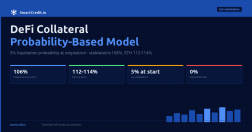
In Simple borrowing mode, the platform sets this ratio automatically at 5% liquidation probability. This means that under historical volatility conditions for the specific collateral asset and loan duration, there is a 5% chance of the position reaching the liquidation threshold before loan maturity. The resulting ratios are as follows:
| Collateral asset | SmartCredit.io liquidation ratio | Liquidation fee |
|---|---|---|
| DAI, USDC, USDT | 106% | 0% |
| ETH / wETH | 112-113% | 0% |
| wBTC | 112% | 0% |
| Volatile ERC-20 tokens | Up to 122% | 0% |
These ratios are set at a relatively low level compared to protocols that require 150-200% collateralisation, because SmartCredit.io uses probability-based modelling rather than conservative rule-of-thumb buffers. The fixed-term structure allows the platform to model the specific risk over a known time horizon rather than an open-ended position.
The combination of probability-based ratios and 0% liquidation fees means that SmartCredit.io borrowers face a lower capital requirement than on many competing platforms, and a significantly better financial outcome if liquidation does occur. The platform’s security model and smart contract architecture underpin both the fixed-term structure and the 0% liquidation fee guarantee. By contrast, Aave’s higher collateral requirements partially serve as a buffer against the financial impact of their own liquidation fees – a problem SmartCredit.io does not have because those fees do not exist.
For a detailed comparison of borrowing rates across protocols, the SmartCredit.io historical rate comparison tool provides data on how fixed and variable rates have performed over time. For a broader overview of the best crypto lending platforms, the platform comparison guide covers the key variables in detail.
Practical Steps to Reduce Your Liquidation Risk on Any Platform
Regardless of which DeFi lending platform you use, managing liquidation risk effectively requires both the right platform structure and active position monitoring. The following steps apply across protocols, with notes on where SmartCredit.io’s features provide additional protection.
Monitor your collateral ratio actively. The collateral ratio changes as asset prices move. On Aave, track your health factor daily during volatile market conditions. On SmartCredit.io, the Positions Monitoring System sends automatic Telegram alerts so you do not need to check manually.
Understand the liquidation fee before you borrow. On Aave, check the specific liquidation bonus for your chosen collateral asset in the Aave V3 risk parameters documentation. On SmartCredit.io, the fee is 0% regardless of asset.
Use the Protection Agent if you have Aave V3 or Compound V3 positions. The Protection Agent monitors your Aave V3 and Compound V3 positions and sends Telegram alerts based on liquidation probability, not just the health factor. It is free and requires no wallet connection to check risk on any public address.
Keep a buffer above your liquidation ratio. Do not borrow to the maximum available amount. Even on SmartCredit.io with probability-based ratios set at 5% liquidation probability, maintaining additional buffer reduces the chance of an event during unexpected market conditions. The complete guide to avoiding crypto loan liquidation covers buffer strategies in detail.
Consider whether you can borrow without selling. In some cases, borrowing against crypto holdings is a way to access liquidity without triggering a taxable disposal. However, this strategy only makes sense if the borrowing cost and liquidation risk are well managed. Fixed-rate loans with 0% liquidation fees make the cost calculation more predictable.
Compare fixed-rate and variable-rate options on a total-cost basis. A fixed interest rate eliminates interest rate risk over the loan term. Combined with a 0% liquidation fee, the total worst-case cost of borrowing on SmartCredit.io is significantly more predictable than on variable-rate platforms where both the interest rate and the liquidation fee are cost variables.
Use the Loss Provision Fund as a signal of platform alignment. A platform that maintains a dedicated Loss Provision Fund funded from interest income – rather than relying on liquidation fees to protect lenders – is structurally aligned with healthy loan performance. It is a useful signal when evaluating which platform’s interests are closest to your own as a borrower.
Frequently Asked Questions
What is a DeFi liquidation fee and how does it work?
A DeFi liquidation fee – also called a liquidation bonus – is an extra percentage of collateral that a third-party liquidator receives when they repay part of a borrower’s debt after the borrower’s collateral ratio drops below the liquidation threshold. On Aave V3, this bonus is typically 5-10% depending on the collateral asset, meaning the liquidator receives the repaid debt amount plus 5-10% of the repaid value from the borrower’s collateral. The borrower loses this percentage as a direct financial cost of the liquidation event.
How much does Aave charge on liquidations?
Aave V3 charges a liquidation bonus of approximately 4.5-5% for stablecoins and 5-10% for ETH, wBTC and other major assets. For volatile ERC-20 tokens the bonus can reach 15%. This bonus is taken from the borrower’s collateral and given to the liquidator. Protocol-connected liquidation bots typically capture a significant portion of this revenue in practice, as they have capital and speed advantages over independent liquidators.
Does SmartCredit.io charge a liquidation fee?
No. SmartCredit.io charges 0% on liquidations. When a position is liquidated, the collateral is used to cover the outstanding loan balance and no additional fee is deducted. Any surplus collateral after the loan is settled is returned to the borrower’s credit line. The Loss Provision Fund covers any shortfall if liquidation proceeds are insufficient to fully cover the loan amount, protecting lenders without requiring a liquidation fee from borrowers.
Why do Aave and Compound charge liquidation fees but SmartCredit.io does not?
Aave and Compound use variable-rate, open-ended loan structures where external liquidators must be incentivised to act quickly. The liquidation bonus is that incentive. SmartCredit.io uses fixed-term, fixed-rate loans with probability-based collateral ratios, allowing the smart contract to handle liquidation directly without an external incentive payment. Additionally, SmartCredit.io earns 0% on liquidations and uses the Loss Provision Fund – funded from interest income – to protect lenders instead. This removes the financial motivation to allow or encourage liquidation events.
SmartCredit.io vs Aave: which is better for avoiding liquidation costs?
SmartCredit.io has a structural advantage in liquidation costs: 0% fee compared to Aave’s 5-10%. Additionally, SmartCredit.io’s Positions Monitoring System alerts borrowers via Telegram before liquidation probability exceeds 15%, and the platform’s fixed-term structure prevents the cascading partial liquidations that can occur on Aave during sharp market declines. For borrowers who prioritise total cost predictability and minimising downside in adverse scenarios, SmartCredit.io’s model is significantly more favourable. Aave offers greater liquidity and a wider asset selection, which may matter more for certain use cases.
What is the Loss Provision Fund on SmartCredit.io?
The Loss Provision Fund is a reserve maintained by SmartCredit.io, funded from a portion of every interest payment made on the platform. It covers any shortfall between the proceeds of a liquidated position and the amount owed to lenders. This fund replaces the liquidation fee as the mechanism for lender protection – meaning lenders benefit from a dedicated reserve while borrowers avoid paying a liquidation penalty. The fund acts as a first line of defence in adverse market scenarios where collateral prices fall faster than the liquidation process can capture sufficient value.
Can I monitor my Aave positions for liquidation risk on SmartCredit.io?
Yes. SmartCredit.io’s Protection Agent monitors Aave V3 and Compound V3 positions and sends Telegram alerts when liquidation probability – modelled from collateral volatility – exceeds the alert threshold. It can monitor any public wallet address without requiring you to connect your wallet. The tool is available at smartcredit.io/protection-agent. This product exists because SmartCredit.io earns 0% on liquidations and has no conflict of interest in helping borrowers avoid them – unlike Aave, which earns liquidation revenue and therefore has no financial incentive to build a borrower-side warning system.
SmartCredit.io
Fixed-rate crypto loans with 0% liquidation fee
Borrow against ETH, wBTC and stablecoins at fixed rates on Ethereum. 20,000+ registered users. fixed interest income plus weekly SMARTCREDIT token rewards for lenders.
Start borrowing on SmartCredit.io →Sources: Aave V3 Risk Parameters – liquidation bonus by asset; Ethereum.org DeFi guide – overview of decentralised lending and liquidation mechanics; DeFi Llama – protocol TVL and market data; Compound Finance documentation – liquidation incentive parameters.
Related SmartCredit reading: Loss Provision Fund: how SmartCredit.io protects lenders – Protection Agent: monitor Aave V3 and Compound V3 positions before liquidation – Complete guide to avoiding crypto loan liquidation – Fixed vs variable DeFi interest rates compared – How to earn fixed interest income plus weekly SMARTCREDIT token rewards on SmartCredit.io