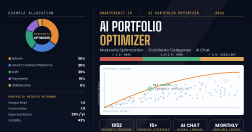
Most crypto investors diversify by counting tokens, not by measuring how those tokens actually move. Ten tokens sounds diversified. But if all ten are DeFi protocols, that portfolio is not ten independent bets — it is one concentrated DeFi position expressed through ten instruments, because the correlation between them is close to 1.0.
Equity investors solved this problem decades ago by allocating across sectors first — technology, healthcare, financials, energy — and picking individual stocks second. SmartCredit.io’s Categories based Portfolio applies the same logic to crypto: instead of picking tokens, you allocate across crypto market segments like DeFi, Layer 2, Payments, and Liquid Staking, treating each as its own sector.
Key Takeaways
- Categories based Portfolio applies Modern Portfolio Theory at the crypto sector level instead of the individual token level.
- It’s a chat interface — describe the portfolio you want in plain language and the AI returns an optimized sector allocation with a correlation matrix.
- Genuine diversification comes from combining low-correlation sectors, not from holding more tokens inside the same correlated group.
- An “interest bearing” prompt steers the optimizer toward yield-generating segments — categories whose returns can be put to work lending rather than depending purely on price appreciation.
- No wallet connection is required to build and explore an allocation.
Why Categories, Not Tokens
Token-level portfolio optimization runs into two practical problems.
The first is data noise. Individual token returns are volatile enough that historical data produces unstable optimization results — the optimizer seizes on short-term anomalies and produces portfolios that were optimal for a period that no longer exists. A token that outperformed for three months looks attractive to an optimizer, but that outperformance is often mean-reverting noise, not a persistent signal.
The second is correlation structure. Most tokens within a sector are highly correlated to each other. A portfolio of five DeFi tokens is not a diversified portfolio — it is a concentrated DeFi bet expressed through five instruments. The correlation between them is close to 1.0, which means the diversification benefit is approximately zero.
Categories solve both problems. Working at the sector level aggregates returns across many tokens, which smooths out idiosyncratic noise and produces more stable historical signals. Genuine diversification — the kind that actually reduces portfolio volatility without proportionally reducing return — comes from choosing sectors with low pairwise correlation, not from holding more tokens within correlated groups. The same logic underlies traditional sector investing in equity markets, where allocating across industries is treated as a distinct decision from picking stocks within them.
The crypto market has developed enough that real sector structure now exists. DeFi protocols, Layer 2 scaling solutions, payment networks, liquid staking platforms, and AI-adjacent tokens do not all move identically. The correlation between sectors is lower than the correlation within them — which is exactly the condition that makes sector-level diversification meaningful.
A Concrete Illustration: Five Tokens vs Five Sectors
The difference is easiest to see with illustrative numbers. Suppose an investor builds two $50,000 portfolios, each holding five positions with similar individual volatility:
| Portfolio | Composition | Avg. Pairwise Correlation | Resulting Portfolio Volatility |
|---|---|---|---|
| Five DeFi tokens | Single sector | ~0.85–0.95 | Close to a single-asset position |
| Five sectors (one token each) | DeFi, L2, Payments, LSD, Stablecoins | ~0.20–0.40 | Meaningfully lower |
Both portfolios hold five positions and both look “diversified” by a simple headcount. Only one of them actually reduces risk relative to holding a single asset. This is the entire argument for categories over tokens in one table: the number of positions tells you almost nothing about diversification; the correlation between them tells you everything. The exact figures in any live allocation will differ from these illustrative ranges — which is precisely why the tool calculates and displays the correlation matrix for the current market rather than relying on assumed values.
The Markowitz Framework at the Sector Level
Categories based Portfolio applies Modern Portfolio Theory (MPT) — the Nobel Prize-winning framework developed by Harry Markowitz in his 1952 paper “Portfolio Selection” — at the category level rather than the individual asset level.
The core insight of MPT is that portfolio risk depends on the correlation between assets, not just the average risk of each asset in isolation. Two assets that move independently reduce portfolio volatility even if each one is individually volatile. The framework identifies the Efficient Frontier: the set of portfolios that offer the maximum possible return for each level of risk. No reallocation can improve return without also increasing risk.
Applied to crypto categories, the optimizer asks: given the historical return and correlation of DeFi, Layer 2, Payments, Stablecoins, and other segments — what allocation maximizes the Sharpe Ratio (return per unit of risk)?
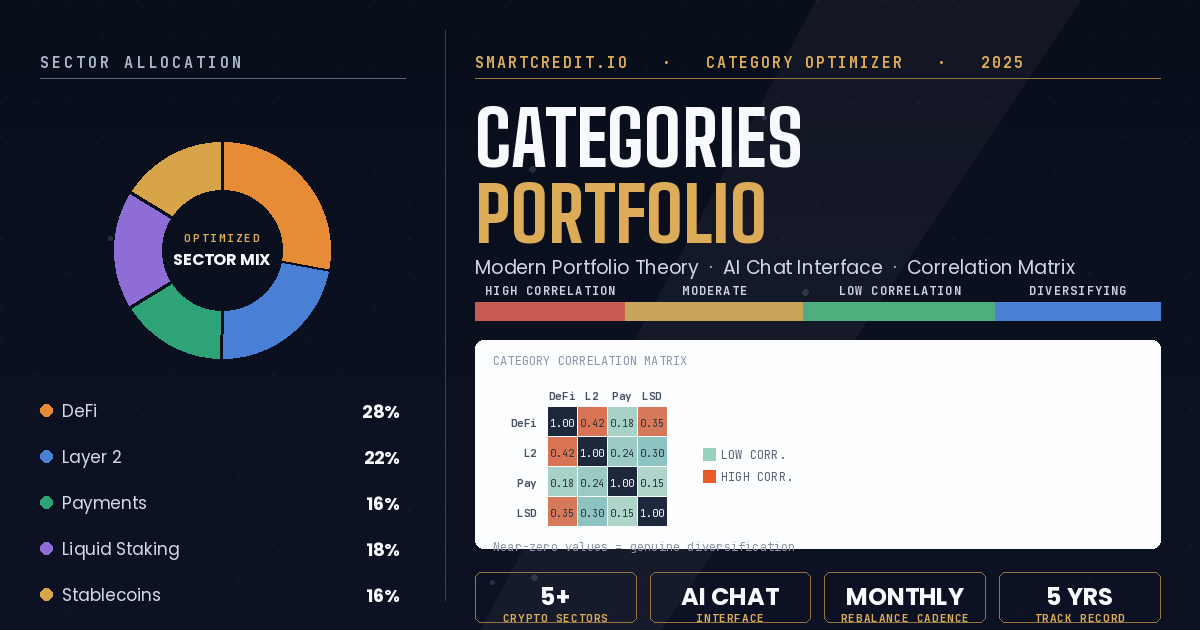
The output is a sector-level allocation with weights, expected annual return, volatility, Sharpe Ratio, and Sortino Ratio — plus a correlation matrix that shows exactly which categories are providing genuine diversification and which are moving together.
How the Tool Works
Categories based Portfolio is available at smartcredit.io/portfolio. Unlike a form-based tool, the interface is a chat window. You describe the portfolio you want in plain language, and the AI returns an optimized allocation.
Example prompts:
Create a long only portfolio with 5 crypto categoriesCreate a long only portfolio with 5 interest bearing categoriesShow me the correlation matrix for top 5 categories
You can continue the conversation — ask for more or fewer categories, request a different risk profile, or ask the optimizer to explain why a particular sector received its weight. Use Clear to reset and start a new allocation.
The conversation format means you can iterate quickly. If the first allocation is too concentrated in one sector, ask for a version with a cap on any single category. If you want to see whether adding a sixth category improves the Sharpe Ratio, just ask.
Want to Add a Sector Without Selling Another?
If your capital is tied up in one category, borrow against it on SmartCredit and fund the new allocation without a forced disposal.
See Borrowing Terms →Interest-Bearing Portfolios
A notable feature of the Categories based approach is the ability to steer the optimizer toward yield-generating segments of the market.
Adding “interest bearing” to your prompt — for example, 5 interest bearing categories — focuses the allocation on categories where the underlying assets produce income: DeFi lending protocols, liquid staking platforms, yield aggregators, real-world asset tokenization, and similar segments. The result is a portfolio optimized not just for price appreciation but for recurring yield from the crypto holdings themselves.
This matters because yield-generating categories behave differently from pure price-appreciation assets. A liquid staking position earns staking rewards regardless of whether the token price is rising or falling. A DeFi lending allocation earns interest from borrower demand. These income streams reduce the portfolio’s dependence on market direction — the return has two components instead of one.
Applying Markowitz optimization to an interest-bearing category selection ensures the yield exposure is not simply concentrated in the highest-yielding category, which is usually the highest-risk one. The optimizer balances yield potential against correlation, producing a spread across income-generating sectors that is diversified in the same way a good bond portfolio is diversified: by source of income, not just by name. On SmartCredit itself, that same principle applies directly — you can lend across multiple assets rather than concentrating yield exposure in a single position, mirroring the diversification logic the optimizer applies at the category level.
Turn a Yield-Generating Category Into Actual Yield
An interest-bearing allocation only pays off if the underlying assets are actually earning. Lend eligible holdings on SmartCredit to realize that yield directly.
Explore Lending Rates →Reading the Output
For each proposed portfolio, the AI returns six pieces of information:
| Metric | What It Tells You |
|---|---|
| Weights | How much of the portfolio goes to each category |
| Expected Annual Return | Return estimate based on historical category performance |
| Volatility | Portfolio-level standard deviation — lower means more stable |
| Sharpe Ratio | Return per unit of total risk — the primary optimization target |
| Sortino Ratio | Return per unit of downside risk — better suited to asymmetric crypto return distributions |
| Correlation Matrix | Pairwise correlations between categories — near-zero or negative values indicate genuine diversification |
A portfolio with a Sharpe Ratio above the average of its component categories is outperforming its parts on a risk-adjusted basis. That improvement is the diversification working.
Categories Based vs Token-Level Optimization
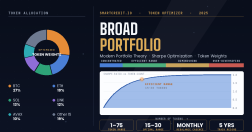
SmartCredit.io also offers Broad Portfolio, which runs Markowitz optimization at the individual token level rather than the sector level. The two tools serve different use cases and are described in more detail in our guide to token-level portfolio optimization:
| Categories Based Portfolio | Broad Portfolio | |
|---|---|---|
| Interface | AI chat | Form (enter token count) |
| Optimization unit | Crypto sectors | Individual tokens |
| Best for | Sector-level strategy, interest-bearing portfolios, exploring allocations | Getting a direct token-weight list for a specific number of assets |
| Output | Weights, metrics, correlation matrix — as chat responses | Token weights table, Sharpe/Volatility charts, historical simulation |
Categories based Portfolio is the right starting point when you want to understand your macro allocation across market segments. Broad Portfolio is the right tool when you want a specific list of tokens and their optimal weights. The two complement each other: use Categories to set sector targets, then use Broad Portfolio to select tokens within each sector.
Rebalancing
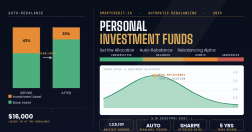
The optimizer produces a snapshot allocation based on historical data. As markets move, actual weights drift from the optimized target.
Crypto markets move faster than equities. A sector that receives a 20% allocation can drift to 35% within a month if that segment outperforms — and at that point the portfolio’s risk profile has changed materially, even if nothing in the underlying thesis has changed. The position that grew was not selected at that weight; it arrived there through drift.
Rebalance monthly: run a fresh prompt with the same objective, compare the new output to your current holdings, and adjust. Monthly rebalancing captures most of the efficiency benefit without generating excessive transaction costs. Some users run a quarterly check and only rebalance if any single category drifts beyond a threshold — for example, more than 10 percentage points from the target weight. Both approaches are reasonable depending on transaction cost sensitivity and portfolio size.
A Worked Example: Rebalancing a $100,000 Sector Allocation
Consider a $100,000 portfolio optimized across five categories, with Layer 2 initially weighted at 20%. A strong month for that sector pushes the position to 35% of the portfolio — a 15-percentage-point drift, well past any reasonable threshold:
| Category | Target Weight | Drifted Weight | Dollar Value |
|---|---|---|---|
| Layer 2 | 20% | 35% | $35,000 |
| Amount to trim back to target | — | — | ~$15,000 |
That $15,000 needs to move into the underweight categories to restore the optimized allocation — but the reallocation across four other sectors rarely happens in a single transaction. It’s common for a portion to sit in stablecoins for one to three weeks while the rest of the rebalance is executed, or while waiting for a better entry point into the underweight sectors.
At 0% yield, that $15,000 earns nothing during the wait. Lent out on SmartCredit at a representative 9% APY instead, the same capital held for an average of two weeks would generate roughly $52 in that window — and across four quarterly rebalances a year on a portfolio that consistently sees a similar drift, that’s on the order of $200–$250 annually in yield that would otherwise have gone unearned. It doesn’t change the underlying sector thesis, but it means the rebalancing process itself stops leaking value while capital is in transit.
Don’t Let Rebalancing Proceeds Sit Idle
While you’re moving capital between sectors, lend the trimmed portion on SmartCredit instead of holding it at 0%.
Start Lending on SmartCredit →What to Keep in Mind
Category definitions shift. “DeFi,” “Layer 2,” and similar labels are useful shorthand, but the tokens inside each category — and their behavior — change as the market evolves. A sector that was purely speculative eighteen months ago may now contain established, cash-flow-generating protocols. Re-running the tool periodically ensures the category composition reflects current market structure rather than an outdated classification. Aggregators such as DeFiLlama illustrate how quickly sector boundaries and the protocols within them shift.
Correlation is a historical estimate, not a guarantee. Sector correlations that were low during calm markets can rise sharply during systemic shocks, when most crypto assets sell off together regardless of category. Categories based diversification meaningfully reduces sector-specific risk; it does not eliminate market-wide risk during a broad downturn.
Concentration you want to keep is still an option. If you have high conviction in a specific sector and don’t want the optimizer to underweight it, you can run the tool on your remaining capital and treat that conviction position as a separate allocation — one that can still be lent for yield or used as collateral rather than folded into the optimized set.
Sample size still matters, even at the sector level. Aggregating tokens into categories reduces noise compared with single-token analysis, but some sectors are newer than others and simply have less historical data to draw on. A category built primarily from protocols that launched in the last year will have a shorter, less battle-tested return history than DeFi or payments, which have traded through multiple market cycles. Treat the confidence you place in any single category’s statistics as proportional to how long that segment has actually existed, not just how it has performed recently.
Getting Started
Categories based Portfolio is available at smartcredit.io. No wallet connection is required to build and explore allocations — you can run the optimizer and examine the output before committing any capital, which makes it a reasonable first step even if you’re only trying to sanity-check how your current holdings are distributed across sectors.
Start with: Create a long only portfolio with 5 crypto categories. Then ask for the correlation matrix, request a version with interest-bearing categories, and compare the Sharpe Ratios across the variations. The tool is designed to be iterated — the value comes from exploring the allocation space, not from accepting the first output as final. Ask follow-up questions the way you would with an analyst: why did one sector receive a larger weight, what happens to the Sharpe Ratio if a category is capped, or how the allocation changes if stablecoin exposure is excluded entirely.
Once you’ve settled on a sector allocation, treat every category the same way you’d treat any real position: decide whether it’s a price-appreciation bet, a yield source, or both — and use lending or borrowing on SmartCredit accordingly, rather than leaving the capital to simply sit in a wallet between rebalances.
Frequently Asked Questions
What is Categories based Portfolio?
Categories based Portfolio is a chat-based tool on SmartCredit.io that applies Modern Portfolio Theory at the crypto sector level. Instead of selecting individual tokens, you describe the allocation you want in plain language, and the AI returns an optimized weighting across categories like DeFi, Layer 2, Payments, and Liquid Staking, along with risk metrics and a correlation matrix.
How is this different from picking tokens myself?
Picking tokens individually often produces false diversification — multiple tokens within the same sector tend to be highly correlated, so holding several of them behaves like one concentrated bet. Categories based Portfolio optimizes at the sector level first, where genuine low-correlation combinations exist, which is the same principle equity sector investing relies on.
What does “interest bearing categories” mean?
It’s a prompt modifier that focuses the optimizer on segments where the underlying assets generate yield — DeFi lending, liquid staking, yield aggregators, and similar categories — rather than segments that depend purely on price appreciation. Assets from those categories are also the ones best suited to actually lending on SmartCredit to realize that yield directly.
How often should I rebalance a category-based portfolio?
Monthly is a reasonable default, since crypto sectors can drift significantly faster than equity sectors. Some users prefer a quarterly check combined with a drift threshold — rebalancing only when a category moves more than roughly 10 percentage points from its target weight — which reduces transaction costs for larger portfolios.
Can I borrow against a category position instead of selling it to rebalance?
Yes. If a rebalance calls for funding an underweight category but your available capital is tied up in a position you’d rather not trim, borrowing against that position on SmartCredit is often more capital-efficient than selling it outright, particularly if selling would trigger a taxable event.
In practice: a category allocation is only as good as what happens to the capital between rebalances — lending idle proceeds or borrowing against a position you want to keep both keep the portfolio working rather than sitting still.
Does the correlation matrix update automatically?
The correlation matrix reflects the historical data available at the time you run the tool. Because crypto correlation structure can shift meaningfully within months, re-running the query periodically — rather than relying on a single historical snapshot — keeps the diversification assessment current.
Can I combine Categories based Portfolio with Broad Portfolio?
Yes, and it’s a natural workflow. Use Categories based Portfolio first to decide how much capital goes to each sector, then use Broad Portfolio to select and weight the specific tokens within each of those sectors.
Is Categories based Portfolio only useful for large portfolios?
No. Sector-level allocation is arguably more useful for smaller portfolios, since it avoids the temptation to hold many small, correlated token positions that add complexity without adding real diversification. A five-category allocation can be implemented with as few as five positions.
Do I need a SmartCredit account to use the tool?
No wallet connection or account is required to run the optimizer and review a proposed allocation. An account becomes relevant only once you act on the output — for example, lending a yield-generating category or borrowing against a concentrated position.
Diversify by Sector, Not Just by Name
Build a category allocation with SmartCredit’s AI, then lend or borrow against it to keep every position working.
Try Categories Based Portfolio →