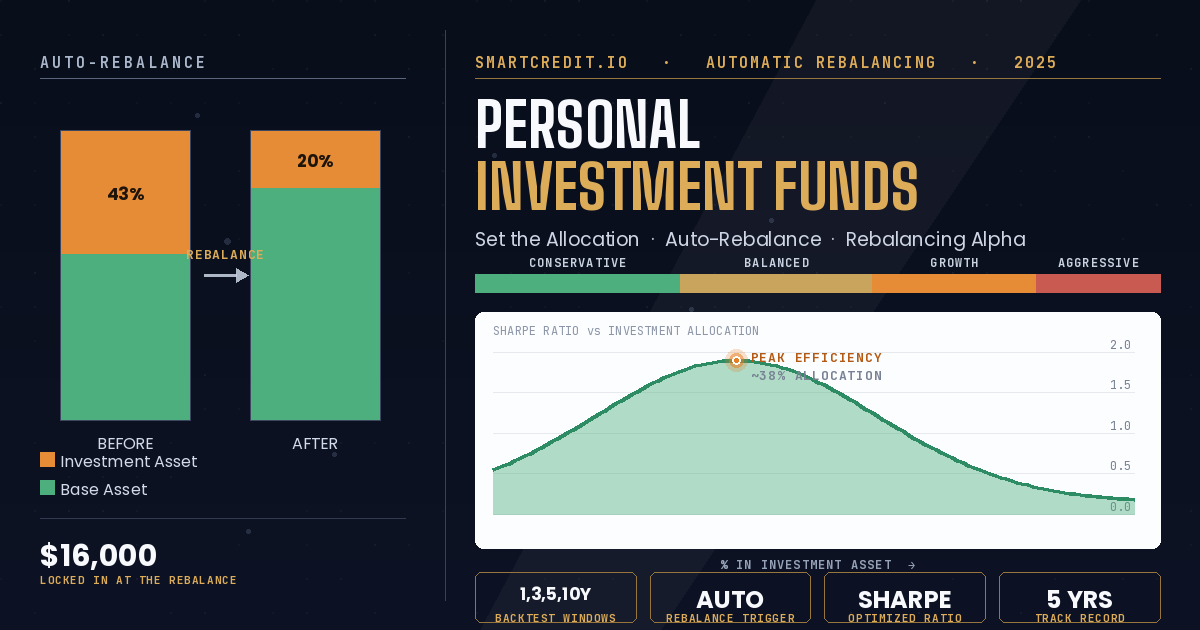
Active crypto portfolio management is harder than it looks. The theory is straightforward — buy when assets are cheap, sell when they are overweight, maintain a disciplined allocation. The practice is different. Most investors hold through drawdowns without rebalancing, concentrate at the top of cycles, and sell during corrections. The gap between what a systematic strategy would have delivered and what the investor actually earned is not a market problem. It is a behavior problem, and crypto’s faster cycles and sharper volatility make that gap wider than it tends to be in traditional markets.
SmartCredit.io’s Personal Investment Funds (PIFs) address this directly. A PIF is a structured crypto portfolio product that holds a defined allocation between a base asset and investment assets, and rebalances automatically when the allocation drifts beyond a threshold. The investor sets it up once, deposits capital, and the fund runs — without requiring ongoing decisions about when to buy or sell.
Key Takeaways
- A PIF holds a base asset and investment assets at a target ratio you choose, and rebalances automatically when that ratio drifts.
- Automatic rebalancing is not just maintenance — it is a source of return in itself, known as rebalancing alpha: systematically selling strength and buying weakness.
- Before committing capital, the platform shows backtested performance (return, volatility, drawdown, Sharpe, Sortino) across 1, 3, 5, and 10-year windows for your chosen allocation.
- PIFs are for capital growth; SmartCredit’s Fixed Income Funds are the right product if your goal is predictable yield instead.
- Funding a new PIF doesn’t require selling an existing position — you can borrow against it instead.
What a Personal Investment Fund Is
A PIF holds two types of assets: a base asset and one or more investment assets.
The base asset is the anchor — typically a stable or lower-volatility asset that represents the conservative portion of the portfolio. The investment assets are the growth-oriented portion. The investor sets the split between them — for example, 80% base / 20% investment — and the fund maintains that target allocation automatically.
When market movements push the actual allocation away from the target, the fund rebalances: it sells what has grown above its target weight and buys what has fallen below. This is the mechanical expression of buy-low / sell-high discipline — enforced by the fund’s rules, not by the investor’s judgment in a volatile market.
This structure makes PIFs distinct from most crypto investment approaches. There is no manual intervention required after setup. The strategy does not depend on the investor making correct calls about market timing. It runs the same way in a bull market as it does in a bear market.
Choosing a Base Asset
The base asset does more than sit passively in the fund — it defines what “safety” means for that specific PIF, and different choices carry different trade-offs. A stablecoin base asset behaves close to cash: its dollar value doesn’t move, so the fund’s overall volatility is driven almost entirely by the investment-asset portion and by how often rebalancing trims that exposure. A lower-volatility crypto asset used as the base — Bitcoin relative to a small-cap altcoin investment allocation, for example — still fluctuates in dollar terms, which means the “safe” side of the portfolio is not actually flat, and the fund’s overall drawdown can be larger than a stablecoin-based equivalent even at the same nominal allocation split.
Neither choice is inherently correct. A stablecoin base isolates the fund’s risk entirely within the investment-asset selection, which is easier to reason about but forgoes any upside from the conservative portion. A crypto base asset keeps more of the portfolio exposed to the asset class overall, which can improve returns across a full bull cycle but means the backtested drawdown figures for that specific base/investment pairing deserve closer attention before committing capital — the historical performance data provided at setup reflects exactly this distinction across the available Investment Products.
How PIFs Differ from Fixed Income Funds
SmartCredit.io also offers Fixed Income Funds (FIFs) — a separate product for P2P lending where deposited assets are matched to borrowers at fixed rates. The two products are often confused because they share the word “fund,” but they serve entirely different purposes.
| Investment Fund (PIF) | Fixed Income Fund (FIF) | |
|---|---|---|
| What you do | Invest in a crypto portfolio | Lend to P2P borrowers |
| Returns | Portfolio performance + rebalancing | Fixed-term loan interest |
| Rebalancing | Automatic, rule-based | Not applicable |
| Counterparty risk | None — no borrower involved | Borrowers on the platform |
| Withdrawal | Subject to withdrawal fee | Must wait for borrowers to repay |
PIFs are for investors who want managed exposure to crypto asset price performance. FIFs are for lenders who want fixed income from deploying their assets into loans. The choice depends on whether the goal is capital growth or fixed yield.
Want Yield Instead of Price Exposure?
If your goal is predictable income rather than managed market exposure, lending directly on SmartCredit is the more direct path.
Explore Fixed Income Funds →Setting Up a Personal Investment Fund
The setup process is designed to be completed before any capital is committed:
- Select an Investment Product — SmartCredit.io offers pre-defined investment products, each specifying a base asset, investment assets, rebalance strategy, rebalance threshold, and fee structure.
- Set your allocation ratio — use the slider to choose the split between base and investment assets. The platform shows pre-computed performance data for the chosen ratio across 1, 3, 5, and 10-year backtests as you adjust.
- Review performance metrics — before creating the fund, you can see how that allocation would have historically performed.
- Create your PIF — confirm the transaction from your wallet. This deploys the fund on-chain.
- Deposit funds — transfer the amount you want to invest. The fund begins operating immediately.
The allocation slider and live performance preview are the most important part of the setup process. They let you see the risk/return trade-off of different allocation ratios before committing capital, not after.
Fund a PIF Without Selling What You Already Hold
If your capital is tied up in a position you don’t want to sell, borrow against it on SmartCredit and use the proceeds to seed your fund.
See Borrowing Terms →Reading the Performance Data
For each allocation ratio, the platform shows five metrics across multiple time horizons:
| Metric | What It Tells You |
|---|---|
| Annual Return | Average annualized return at this allocation for the selected period |
| Standard Deviation | Volatility of returns — how much the return fluctuated |
| Drawdown | Maximum peak-to-trough loss — the worst-case scenario for that period |
| Sharpe Ratio | Return per unit of total volatility — higher is more efficient |
| Sortino Ratio | Return per unit of downside volatility only — better suited to asymmetric crypto returns |
The key trade-off is between annual return and drawdown. A higher investment allocation increases expected return but also increases the worst-case loss. The Sharpe and Sortino Ratios identify the allocation where the portfolio is most efficient — delivering the most return per unit of risk — which is not always the highest-return allocation.
As a general principle: find the allocation ratio where the Sharpe or Sortino Ratio peaks, then consider whether the associated drawdown is within your tolerance. If the maximum drawdown at the efficient point is more than you are comfortable holding through, move the slider toward the base asset until it is.
How Rebalancing Generates Returns
The automatic rebalancing is not just a maintenance mechanism — it is a source of return in itself.
When an investment asset rises and grows above its target weight, the fund sells the excess and moves it back to the base asset. When an investment asset falls and drops below its target weight, the fund buys the shortfall using the base asset. Over time, this systematic selling of outperformers and buying of underperformers captures the mean-reverting tendency of volatile assets — selling into strength and accumulating during weakness.
This is rebalancing alpha: the return generated by the rebalancing process itself, independent of the directional performance of the assets. Systematic rebalancing has a long history in traditional finance, and Vanguard’s own research on rebalancing methodology confirms that maintaining a disciplined target allocation improves risk control compared with letting a portfolio drift unmanaged. Applied to volatile crypto assets — which exhibit strong mean reversion over medium-term horizons — the effect can be significant.
A Worked Example: One Rebalance in Detail
Consider a $50,000 PIF set to an 80% base / 20% investment split — $40,000 in a stable base asset and $10,000 in an investment asset such as ETH.
Suppose the investment asset triples in value while the base asset holds steady. The position that started at $10,000 is now worth $30,000, and the total portfolio value has grown to $70,000. The investment asset’s share of the portfolio has drifted to 42.9% — more than double its 20% target, and well past any reasonable rebalance threshold.
| Base Asset | Investment Asset | Investment Weight | |
|---|---|---|---|
| Before rebalance | $40,000 | $30,000 | 42.9% |
| After rebalance | $56,000 | $14,000 | 20.0% |
The fund sells $16,000 of the appreciated investment asset and moves it into the base asset, restoring the 80/20 target on a $70,000 portfolio. That $16,000 is profit locked in mechanically, at the point of maximum weight, without the investor having to decide whether the rally would continue. If the investment asset subsequently pulls back, the next rebalance buys back in at a lower price using base-asset capital — completing the sell-high, buy-low cycle without a single manual decision.
None of this requires predicting the top or the bottom. It only requires the threshold being breached and the fund executing its rule, consistently, every time — which is precisely the part most individual investors struggle to do on their own.
Why the Rebalance Threshold Matters
The drift threshold — how far the allocation is allowed to move before the fund rebalances — is a meaningful design choice, not a technical detail. A tight threshold rebalances frequently, staying close to the target allocation at all times but incurring more transaction costs along the way. A wide threshold rebalances less often, reducing costs but allowing more drift — and more risk — to accumulate between rebalances.
Vanguard’s own research into threshold-based rebalancing for multi-asset portfolios found that a moderate threshold band, rather than either extreme, tends to balance the trade-off between transaction costs and allocation drift most effectively. The same logic applies to a PIF: a threshold so tight that it rebalances on every minor fluctuation erodes returns through fees, while a threshold so wide that it rarely triggers defeats the purpose of holding a defined allocation at all. When comparing Investment Products, the stated rebalance threshold is worth weighing alongside the fee schedule — a product with a wider threshold and lower fees is not automatically worse than a tighter, more expensive one; it simply expresses a different point on the same trade-off.
Fees and Holding Period
PIFs have three fee types that directly affect net return:
- Sales Fee — charged once at fund creation
- Management Fee — ongoing annual charge applied to assets under management
- Withdrawal Fee — charged when funds are withdrawn
The fee structure varies by Investment Product. For shorter holding periods, the sales and withdrawal fees represent a larger proportion of total earnings. For longer holding periods — a year or more — the management fee becomes the dominant cost, while the entry and exit fees are amortized across a larger return base.
Always check the Rebalance Strategy Details panel before creating a fund. The fee schedule is displayed there alongside the product specifications.
A brief illustration: a $10,000 PIF with a 1% sales fee, 1.5% annual management fee, and 1% withdrawal fee costs $100 to open regardless of holding period. Held for three months, the prorated management fee adds roughly $37.50, and a full withdrawal adds another $100 — meaning fixed entry and exit costs make up the large majority of the roughly $237.50 total fee drag over that short window. Held for two years instead, the entry and exit fees stay the same in dollar terms, but the management fee accrues to roughly $300 over the period, spread across a much larger base of realized gains — the same fixed costs, but a far smaller share of the total return. This is why PIFs are generally better suited to holding periods measured in months or years rather than weeks.
Between Withdrawing and Redeploying?
Capital you’ve pulled out of a PIF doesn’t have to sit idle while you decide what’s next. Lend it on SmartCredit in the meantime.
Start Earning While You Decide →Managing Your PIFs
The Investment Dashboard at smartcredit.io/invest/dashboard shows all active Personal Investment Funds. From there you can monitor each fund’s current allocation, performance, and rebalance history; deposit additional capital into an existing fund; or withdraw partially or fully when needed.
The rebalance history is worth reviewing periodically. It shows when the fund triggered a rebalance, what the allocation was before and after, and how the drift threshold was breached. This record provides transparency into how the strategy is running in practice — confirming the fund is behaving as specified and giving the investor a factual basis for evaluating the strategy over time.
New funds are created from the same dashboard by clicking New Investment Fund, which returns to the product selection and configuration flow. There is no limit on the number of PIFs a wallet can hold — different products, allocations, or strategies can be run in parallel, similar in spirit to running multiple sector allocations through token-level portfolio optimization alongside a rules-based PIF.
Getting Started
Personal Investment Funds are available at smartcredit.io. Connecting a wallet is required to create and deposit into a PIF, though browsing the available Investment Products and their backtested performance data does not require committing any capital upfront.
Start by reviewing the available Investment Products and their fee schedules. For each product you are considering, move the allocation slider across the range and observe where the Sharpe Ratio peaks. That is the starting point for the allocation decision — then adjust for your own drawdown tolerance before confirming. Pay attention to the rebalance threshold as well as the ratio itself: two products with the same base and investment assets can behave quite differently depending on how tightly they hold to their target weights.
The fund runs automatically from that point. The investor’s role after setup is monitoring, not managing — checking the rebalance history periodically to confirm the strategy is behaving as expected, rather than intervening in day-to-day allocation decisions the way a manually managed portfolio would require.
Frequently Asked Questions
What is a Personal Investment Fund?
A Personal Investment Fund (PIF) is a structured crypto portfolio product on SmartCredit.io that holds a target allocation between a base asset and one or more investment assets, and automatically rebalances back to that target whenever the allocation drifts beyond a set threshold.
How is a PIF different from just holding crypto and rebalancing manually?
The mechanism is the same — sell overweight positions, buy underweight ones — but a PIF executes it automatically according to pre-defined rules, removing the behavioral failure point where investors intend to rebalance but don’t, especially during volatile markets when discipline matters most.
What is rebalancing alpha?
Rebalancing alpha is the return generated by the rebalancing process itself, separate from the underlying assets’ price performance. It comes from systematically selling positions that have grown above target and buying positions that have fallen below target, which captures some of the mean-reverting behavior common in volatile assets.
Should I choose the allocation with the highest historical return?
Not necessarily. The allocation with the highest historical return usually also carries the highest drawdown. Most investors are better served by finding where the Sharpe or Sortino Ratio peaks — the point of maximum return per unit of risk — and then adjusting toward the base asset if that allocation’s drawdown still exceeds their comfort level.
Can I fund a PIF without selling my existing crypto?
Yes. Rather than liquidating a position to free up capital, you can borrow against that position on SmartCredit and use the borrowed funds to seed a new PIF, keeping your original holding intact.
In practice: most investors size a PIF using capital that’s already idle rather than capital tied up elsewhere — but if the allocation you want requires more than that, borrowing against a separate position is usually more efficient than selling it.
What happens to the management fee if I withdraw early?
The management fee accrues on assets under management over time, so shorter holding periods mean the one-time sales and withdrawal fees make up a larger share of total costs relative to the return earned. Longer holding periods amortize those entry and exit costs across a larger return base, while the ongoing management fee becomes the more significant factor.
How often do PIFs rebalance?
Rebalancing is triggered by drift beyond a threshold defined by the specific Investment Product, not by a fixed calendar schedule. A fund can rebalance multiple times in a volatile month or not at all during a quiet one — the rebalance history on the Investment Dashboard shows exactly when and why each rebalance occurred.
Can I run more than one PIF at the same time?
Yes. There is no limit on the number of PIFs a single wallet can hold. Investors commonly run multiple funds with different Investment Products, base/investment splits, or risk profiles in parallel.
Is my capital exposed to any counterparty in a PIF?
No. Unlike a Fixed Income Fund, a PIF involves no borrower or lending counterparty — the fund simply holds and rebalances the assets you deposit according to its rules.
Set the Allocation Once. Let Discipline Do the Rest.
Create a Personal Investment Fund on SmartCredit, then lend or borrow against the rest of your portfolio to keep every position working.
Create Your Investment Fund →