Most crypto portfolios are built on instinct, not math: a large Bitcoin and Ethereum position, a handful of conviction bets, and no framework connecting the pieces. The result is a portfolio whose real risk and return characteristics stay unknown until the market reveals them — usually at the worst possible time.
Modern Portfolio Theory (MPT) solves this by replacing instinct with a mathematically optimal allocation. SmartCredit.io’s Broad Portfolio tool applies this framework directly to crypto tokens: enter how many tokens you want, and it returns the exact weights that maximize risk-adjusted return.
Key Takeaways
- Broad Portfolio applies Modern Portfolio Theory (Markowitz optimization) to individual crypto tokens, not just asset classes.
- You choose a token count (1–75); the tool selects assets and weights that maximize the Sharpe Ratio.
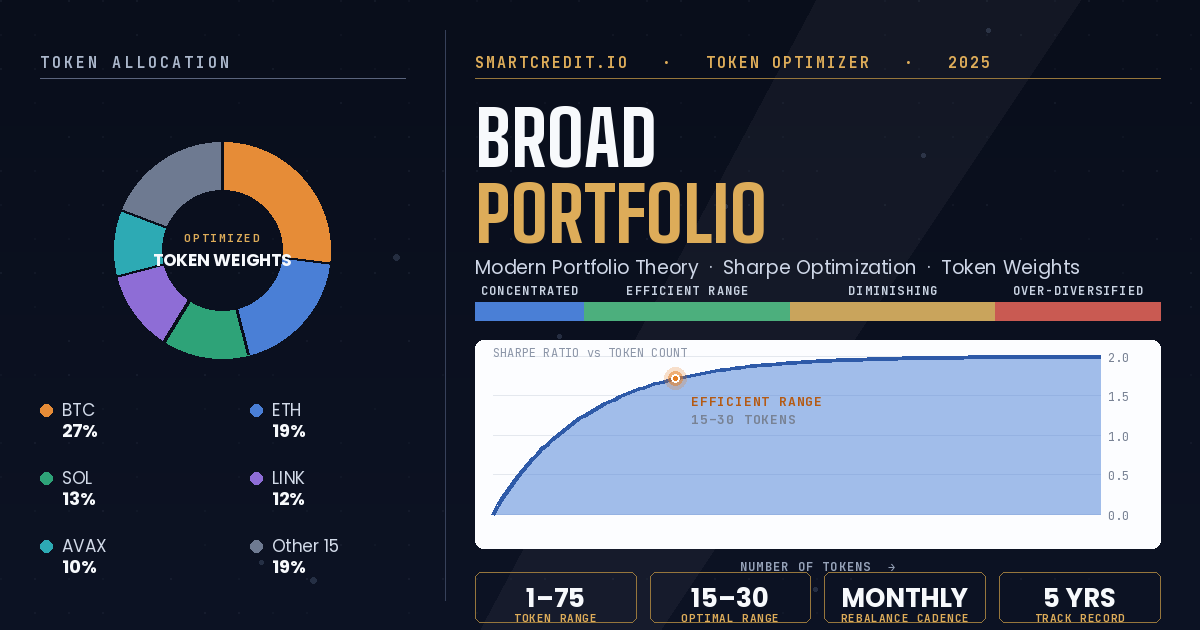
- The efficient range for most portfolios is 15–30 tokens — below that, concentration risk dominates; above it, marginal diversification shrinks.
- Monthly rebalancing captures rebalancing alpha — and the tokens you trim during rebalancing don’t have to sit idle; they can be lent for yield instead.
- No wallet connection is required to run the optimizer and review an allocation.
What Modern Portfolio Theory Actually Does
Modern Portfolio Theory, developed by economist Harry Markowitz in 1952, starts from a simple observation: portfolio risk is not the average of the risks of the assets in it. It is determined by how those assets move relative to each other. Markowitz’s original framework — outlined in his paper “Portfolio Selection” — later earned him the Nobel Memorial Prize in Economic Sciences, and it remains the mathematical foundation for how institutional asset managers build diversified portfolios today.
Two tokens that are highly correlated — that rise and fall together — offer almost no diversification benefit when held together. Two tokens with low or negative correlation genuinely reduce each other’s risk when combined, because losses in one are partially offset by gains in the other.
The Markowitz optimizer uses historical return and correlation data to find the portfolio on the Efficient Frontier: the allocation that delivers the maximum possible return for a given level of risk, or equivalently, the minimum possible risk for a given return target. No other combination of those same assets does better.
In practice, Broad Portfolio targets the maximum Sharpe Ratio portfolio — the point on the Efficient Frontier that gives the best return per unit of total risk. This is the standard institutional target for unconstrained portfolio optimization, and it’s the same logic pension funds and endowments have relied on for decades, now applied at the level of individual crypto tokens.
Your Portfolio Has Idle Weight Somewhere
Whatever the optimizer trims from your allocation doesn’t have to sit at 0%. Put it to work earning yield on SmartCredit.
Explore Lending Rates →Why Correlation Behaves Differently in Crypto Markets
Applying Markowitz’s framework to crypto raises a question that doesn’t come up as sharply in traditional equity markets: how stable is correlation between assets over time? In equities, sector correlations shift gradually across years and economic cycles. In crypto, correlation structure can move meaningfully within a single quarter.
During calm markets, many tokens trade with relatively low correlation to Bitcoin and to each other — driven by project-specific news, sector rotation, and idiosyncratic narratives. During sharp drawdowns, that same set of tokens often becomes highly correlated almost overnight, as liquidations and risk-off behavior push most assets down together regardless of their individual fundamentals. This phenomenon — diversification benefits shrinking exactly when they’re needed most — is well documented in traditional markets too, but it tends to be more pronounced and more frequent in crypto given the market’s younger age, thinner liquidity in mid- and small-cap tokens, and its sensitivity to leveraged positioning.
This has two direct implications for how Broad Portfolio should be used:
- Historical correlation is a snapshot, not a constant. The optimizer’s weights are only as good as the correlation window feeding them. This is precisely why re-running the tool monthly — rather than optimizing once and holding indefinitely — keeps the allocation aligned with current market structure instead of a stale one.
- Diversification reduces risk on average, not in every scenario. A 20-token optimized portfolio will typically behave with lower volatility than a concentrated 2-token portfolio across most market conditions, but during a systemic, market-wide shock, even a well-diversified crypto portfolio can see its assets move together. MPT reduces idiosyncratic, project-specific risk; it does not eliminate systemic market risk.
Neither point is an argument against using the framework — it’s simply a reminder that an optimizer is a tool for improving the odds, not a guarantee. Combined with monthly rebalancing, it still produces a more disciplined and better-reasoned allocation than an instinct-built portfolio with no framework at all.
How Broad Portfolio Works
The tool is available at smartcredit.io/portfolio. The interface is deliberately simple — there is no configuration beyond a single input:
- Enter the number of tokens — type any number between 1 and 75. This tells the optimizer how many assets to include in the final allocation.
- Click Go — the system fetches current market data and runs the Markowitz optimization, selecting the specific tokens and weights that maximize the Sharpe Ratio for that portfolio size.
- Review the output — a table shows each selected token with its optimal weight and individual performance metrics. Portfolio-level summary statistics appear below the table.
- Rebalance monthly — re-run the tool each month to maintain the optimized allocation as prices drift away from target weights.
The optimizer handles asset selection and weighting on its own. You don’t need to know which tokens correlate with which, or model the math yourself — that’s the entire point of automating a Markowitz-style optimization.
Understanding the Output
For each token in the optimized portfolio, the tool displays six data points:
| Column | What It Means |
|---|---|
| Symbol | The token ticker |
| Weight | Percentage of the portfolio to allocate |
| Annual Return | Historical annualized return |
| Annual Volatility | Annualized standard deviation — a measure of price variability |
| Sharpe Ratio | Return per unit of total risk |
| Sortino Ratio | Return per unit of downside risk — more relevant for asymmetric return distributions like crypto |
Portfolio-level summary statistics show the aggregate Sharpe Ratio, Sortino Ratio, expected annual return, and volatility across the full allocation. These summary numbers matter most: they describe how the portfolio behaves as a whole, not just how its individual parts look in isolation.
The page also includes a historical performance simulation comparing how the optimized portfolio would have performed against a benchmark over time, both plotted from an indexed starting point so growth trajectories are directly comparable. This is a backtested simulation — past performance does not guarantee future results — but it gives a concrete reference point for what the strategy has historically produced.
The Sharpe and Volatility Charts
Two line charts show how portfolio-level metrics change as the number of assets increases:
Sharpe Chart — plots Sharpe Ratio against number of assets. The curve typically rises sharply with the first few additions, then flattens as each additional token contributes less marginal diversification. The point where the curve plateaus identifies where adding more tokens stops meaningfully improving risk-adjusted return.
Volatility Chart — plots Annual Volatility against number of assets. Even highly volatile individual tokens reduce portfolio-level volatility when combined with low-correlation assets. Most of the volatility reduction happens within the first 10–20 assets; beyond that, the marginal improvement shrinks noticeably.
These two charts are the most useful starting point for deciding how many tokens to hold: look at where the Sharpe curve flattens and the Volatility curve levels off before settling on a token count. The efficient range for most portfolios is 15 to 30 tokens. Below 10, concentration risk dominates. Above 40 to 50, transaction costs at each monthly rebalance begin eroding the marginal diversification gain.
Rebalancing Alpha
The Markowitz optimizer produces a target allocation at a single point in time. Prices move continuously, and as they do, actual portfolio weights drift away from that optimized target. A token that outperforms its target weight becomes an overweight position; one that underperforms becomes underweight.
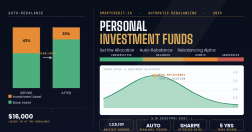
Monthly rebalancing corrects this drift — and in the process generates what practitioners call rebalancing alpha: the systematic return from selling what has grown above its target weight and buying what has fallen below it. This is disciplined profit-taking and buying dips at the portfolio level, executed mechanically rather than emotionally.
The process itself is straightforward:
- At the start of each month, re-run Broad Portfolio with the same token count.
- Compare the new recommended weights to your current holdings.
- Adjust positions to match the updated allocation.
Monthly is the right cadence for most portfolios. More frequent rebalancing increases transaction costs without a proportional improvement in outcomes. Less frequent rebalancing allows drift to accumulate until the portfolio’s actual risk profile diverges meaningfully from the optimized target.
A Worked Example: Rebalancing a 20-Token Portfolio
Consider a $50,000 portfolio optimized across 20 tokens. After a strong month for large-cap layer-1s, three positions have grown well past their target weights and the monthly rebalance calls for trimming them back down:
| Position | Target Weight | Drifted Weight | Amount to Trim |
|---|---|---|---|
| Token A | 6% | 9.5% | ~$1,750 |
| Token B | 5% | 7.8% | ~$1,400 |
| Token C | 4% | 6.2% | ~$1,100 |
| Total trimmed | — | — | ~$4,250 |
The optimizer’s job ends once it tells you to trim $4,250 back into underweight positions. But that rebalancing usually isn’t instant — proceeds sit as cash or stablecoins for hours or days while you execute the rest of the reallocation, and some investors intentionally hold a portion back as dry powder. At 0% yield, that $4,250 earns nothing while it waits.
Lent out on SmartCredit at a representative 10% APY instead, the same $4,250 held for an average of two weeks between rebalances would generate roughly $16 in that window alone — and compounded across twelve monthly rebalances a year on a portfolio that consistently trims a similar amount, that’s on the order of $190–$200 annually from capital that would otherwise have earned nothing. It’s a small number relative to the portfolio, but it’s a systematic, close-to-zero-effort improvement to the rebalancing process itself — the trimmed capital earns something instead of nothing during the gap between rebalances.
Don’t Let Trimmed Positions Sit at 0%
Between rebalances, lend the capital you’ve trimmed and let it earn yield instead of idling in a wallet.
Start Lending on SmartCredit →Broad Portfolio vs Categories Based Portfolio
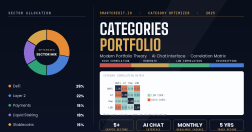
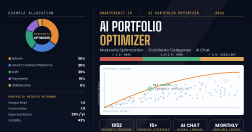
SmartCredit.io also offers Categories based Portfolio, which applies the same Markowitz framework at the sector level through an AI chat interface. The two tools are complementary rather than competing:
| Broad Portfolio | Categories Based Portfolio | |
|---|---|---|
| Interface | Form (enter token count) | AI chat |
| Optimization unit | Individual tokens | Crypto sectors (DeFi, Layer 2, etc.) |
| Output | Token weights, per-token metrics, charts, simulation | Sector weights, risk metrics, correlation matrix |
| Best for | Getting a direct token-weight list for N assets | Exploring sector-level strategy, interest-bearing portfolios |
A natural workflow is to use Categories based Portfolio first to set macro sector targets, then use Broad Portfolio to select and weight specific tokens within each sector. The two levels of optimization — sector and token — address different aspects of the same underlying problem: turning a large, noisy universe of assets into a defensible, mathematically grounded allocation.
What to Keep in Mind
Backtested results. The historical simulation uses past data. Crypto markets are young enough that the token universe and its correlation structure change significantly over time. A correlation that was low during one market cycle may be much higher in the next. Results from one period may not generalize to another, which is why re-running the optimizer monthly — rather than setting an allocation once and forgetting it — is important.
Token availability. The optimizer selects from the universe of currently available tokens, and the composition of that universe affects results. Re-running the tool periodically ensures the selection reflects the current market rather than a snapshot from months ago. Market data providers such as CoinGecko illustrate how quickly that universe — and its liquidity profile — shifts even over a single quarter, as new tokens list, older ones lose liquidity, and market capitalization rankings reshuffle.
Transaction costs. For larger portfolios rebalancing across 20–30 positions, swap fees and slippage add up. Factor these into net return expectations, particularly at smaller portfolio sizes where costs represent a larger percentage of capital. If costs are a concern, a slightly lower rebalancing frequency — every six weeks rather than monthly — is a reasonable compromise. For a deeper look at realizing gains efficiently without repeatedly triggering taxable disposals, see how to take profit in crypto without selling.
Concentration versus conviction. An optimizer has no opinion about a token beyond its historical statistical profile. If you hold a high-conviction position you don’t want the optimizer to trim below a certain floor, you may prefer to size that position outside the optimized set and run Broad Portfolio on the remaining capital. Rather than selling part of that conviction position to fund an addition elsewhere in the portfolio, it’s often more efficient to borrow against it and deploy the borrowed capital into the optimized allocation — keeping the original position, and its potential upside, fully intact.
Want to Fund a New Allocation Without Selling?
Borrow against an existing position on SmartCredit and put the proceeds toward your optimized portfolio — no forced disposal required.
See Borrowing Terms →Getting Started
Broad Portfolio is available at smartcredit.io. No wallet connection is required — you can run the optimizer and review allocations before committing any capital, which makes it a reasonable first step even if you’re simply trying to understand how your current holdings compare to a mathematically optimized alternative.
Start with a token count of 20. Review the Sharpe and Volatility charts, then adjust the number up or down based on where the curves flatten for the current market. If you already hold a large, high-conviction position you don’t want the optimizer touching, consider running the tool on your remaining capital only, and treat the conviction position as a separate line item — one that can still be put to work through lending or used as collateral, without folding it into the optimized set.
Re-run the tool each month to maintain the optimized allocation, and treat every rebalance as a chance to put trimmed capital to work rather than letting it sit idle between adjustments. Over a full year, that habit compounds into a meaningfully more efficient use of capital than simply holding cash or stablecoins between rebalances.
The tool does the math. The investor provides the capital — and the discipline to rebalance consistently each month.
Frequently Asked Questions
What is Broad Portfolio?
Broad Portfolio is a free tool on SmartCredit.io that applies Modern Portfolio Theory to individual crypto tokens. You enter a desired token count between 1 and 75, and the tool returns the specific tokens and weights that maximize the portfolio’s Sharpe Ratio based on historical return and correlation data.
How many tokens should I include in my portfolio?
For most portfolios, the efficient range is 15 to 30 tokens. Fewer than 10 leaves concentration risk dominating the portfolio’s behavior. More than 40–50 tends to add transaction costs at each rebalance without a proportional gain in diversification. The Sharpe and Volatility charts on the Broad Portfolio page show exactly where this trade-off flattens for the current market.
How often should I rebalance?
Monthly is the recommended cadence for most portfolio sizes. It’s frequent enough to capture rebalancing alpha and keep the portfolio close to its optimized target, without generating excessive transaction costs. Portfolios with higher swap costs relative to size may reasonably stretch this to every six weeks.
Can I lend the tokens Broad Portfolio recommends?
Yes. Broad Portfolio tells you what to hold and in what weight; it doesn’t require those tokens to sit idle. Many of the assets that appear in optimized allocations are also available to lend on SmartCredit, so a token contributing to your portfolio’s Sharpe Ratio can simultaneously be earning yield rather than sitting at 0%.
Can I borrow against a portfolio built with Broad Portfolio?
You can use eligible holdings from your optimized portfolio as collateral to borrow on SmartCredit, which is useful if you want to add a new position, cover the trimmed portion of a rebalance, or access liquidity without disposing of an existing token. As with any collateralized loan, keep an eye on your collateral ratio to manage liquidation risk if the market moves against your position.
In practice: if a rebalance calls for adding to an underweight token but your only available capital is tied up in a position you don’t want to trim, borrowing against that position is usually the more capital-efficient path compared with selling it outright.
Does Broad Portfolio account for taxes when rebalancing?
No — the optimizer’s output is based purely on risk and return statistics, not tax treatment. Selling appreciated tokens during a rebalance can trigger a taxable event depending on your jurisdiction. Some investors prefer to fund new or underweight positions by borrowing against overweight holdings instead of selling them outright, which can defer that taxable disposal.
Is Broad Portfolio only for large portfolios?
No. The tool works for any portfolio size, though transaction costs matter proportionally more for smaller portfolios rebalancing across a large number of tokens. If your capital is limited, a lower token count (closer to 10–15) reduces the number of positions you need to adjust at each rebalance.
What data does the optimizer use?
The tool pulls current market data at the time you run it and calculates historical annualized return, volatility, and correlation across the available token universe. Because this universe and its correlation structure shift over time, results reflect the market conditions at the moment the optimization runs — which is exactly why monthly re-runs, rather than a one-time calculation, keep the allocation aligned with current conditions.
Do I need a SmartCredit account to use Broad Portfolio?
No wallet connection or account is required to run the optimizer and review a proposed allocation. An account becomes relevant only if you choose to act on the output through SmartCredit’s own lending or borrowing products.
Build a Portfolio the Math Actually Supports
Run Broad Portfolio for free, then put every position — held, trimmed, or borrowed against — to work on SmartCredit.
Try Broad Portfolio Now →