Bull markets reward the prepared. When crypto prices are rising, the traders who capture the most upside are not those who simply hold — they are those who deploy additional capital against their existing holdings to amplify their gains. The problem? Variable-rate DeFi borrowing makes this unpredictable and dangerous. Fixed-rate crypto loans change the equation entirely.
This guide explains exactly how to use fixed-term, fixed-interest-rate crypto loans to execute bullish market strategies in DeFi — with your total borrowing cost locked from day one, so you can model your profit before you ever open a position.
SmartCredit.io
Borrow Stablecoins at a Fixed Rate
Lock your borrowing cost before entering any bullish strategy. Know your exact interest from day one.
Open the Loan Calculator →What Are Bullish Market Trading Strategies in DeFi?
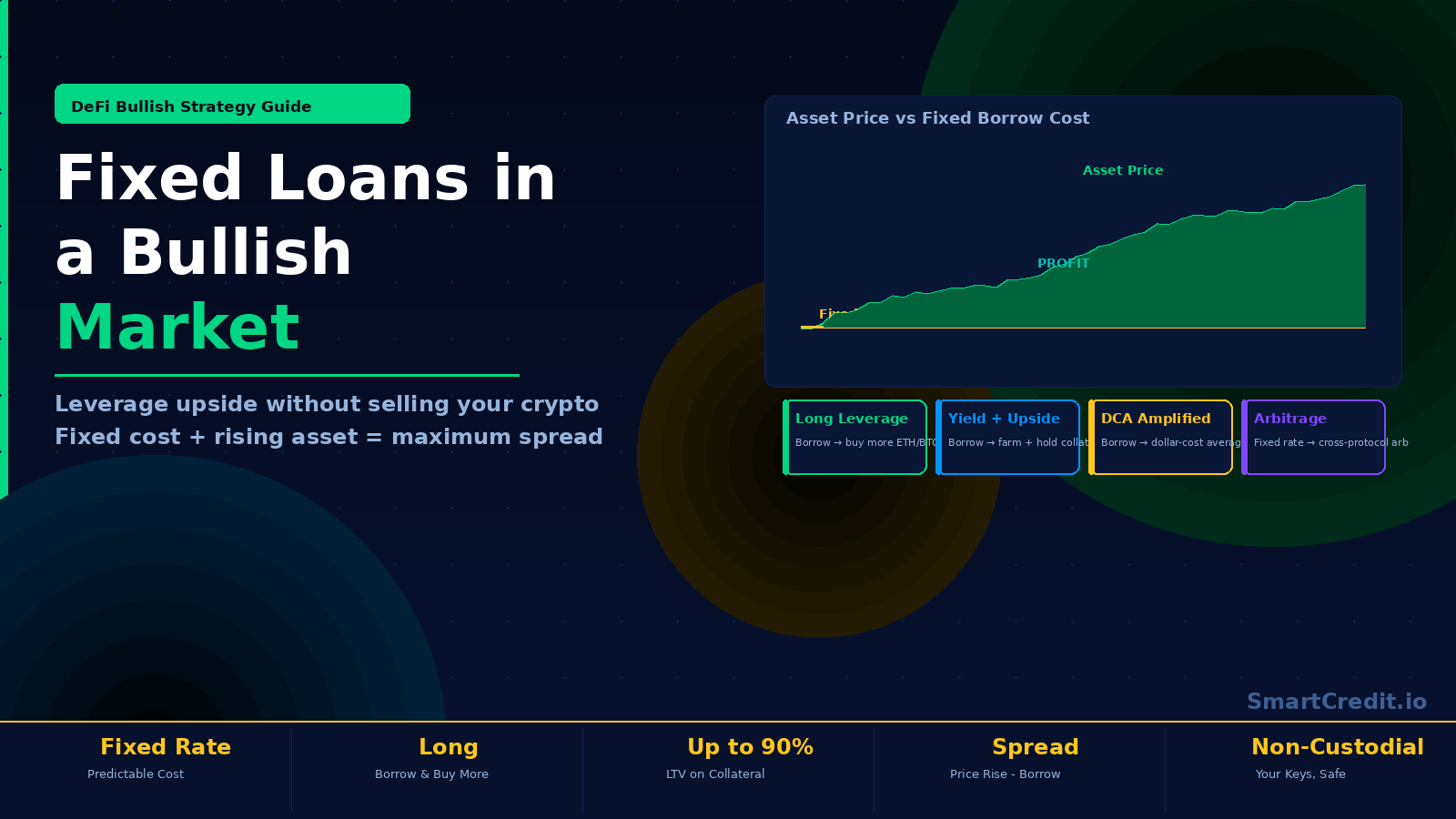
Bullish strategies profit from rising asset prices. The classic DeFi approach: borrow stablecoins against your crypto collateral, use those stablecoins to buy more of the asset you expect to rise, then sell at a higher price, repay the loan, and collect the spread. This is leveraged long exposure — and it works just as effectively in DeFi as on centralised exchanges, with one critical structural advantage: you keep full custody of your assets throughout the entire trade.
On centralised exchanges like Binance or Bitfinex, margin trading requires depositing into the exchange’s custody. If your maintenance margin drops below a threshold, the exchange forcibly liquidates your position — and they control the process entirely. In DeFi, your collateral stays in audited smart contracts. You remain in control.
A standard DeFi bullish strategy using fixed-rate crypto loans works like this:
- Deposit collateral (ETH, WBTC, or other supported assets) into SmartCredit.io.
- Borrow stablecoins (USDC, USDT, or DAI) at a fixed interest rate for a fixed term.
- Buy ETH or your target asset on a DEX (e.g. Uniswap or Curve) at what you judge to be a market entry point.
- Monitor the price using technical indicators — RSI, moving averages — for your exit signal.
- Sell your ETH at a higher price when your exit signal triggers.
- Repay the fixed-rate loan — principal plus the known, pre-locked interest.
- Collect the spread between your buy price and sell price, minus borrowing cost.
The chart below illustrates typical RSI-based entry points for a bullish ETH strategy. When the RSI hits the lower limit on the 4-hour chart, oversold conditions signal a potential long entry:

For a comprehensive framework on how bullish strategies fit within a risk-managed crypto portfolio, see our professional crypto portfolio management guide — specifically the sections on tactical asset allocation and upside capture.
Why Variable-Rate Borrowing Ruins Bull Market Trades
Here is the fundamental problem with using variable-rate money market protocols — Aave, Compound, MakerDAO — for bullish strategies: borrowing rates spike exactly when everyone else is also trying to go long.
Variable rates are set algorithmically based on pool utilisation. When a bull market begins, every trader rushes to borrow stablecoins to buy ETH simultaneously. Utilisation in stablecoin pools spikes. Rates spike with them. A strategy that looked profitable with a 3% APY borrowing cost becomes loss-making at 25% APY — and you had no way to anticipate this at entry.
This is not theoretical. During the bull markets of 2021 and 2024, stablecoin borrowing rates on major variable-rate DeFi protocols regularly surged above 15–30% APY during peak demand periods — precisely when bullish traders needed cheap leverage most. Our 5-year DeFi interest rates comparison documents exactly how destructive these variable rate spikes have been across Aave V2, Aave V3, Compound, and MakerDAO.
You enter a long trade borrowing stablecoins at 4% APY. The bull market accelerates. Every other trader does the same. Pool utilisation hits 90%. Your rate jumps to 28% APY overnight. Your trade is now unprofitable before ETH has even moved enough to cover borrowing costs. Fixed rates eliminate this risk entirely.
What Are Fixed-Term, Fixed-Rate Crypto Loans?
SmartCredit.io is a fixed-term, fixed-interest-rate DeFi lending protocol built on Ethereum. Unlike variable-rate money markets where rates change every block, SmartCredit.io locks both the loan term and the interest rate at origination — for the entire duration of the loan.
Key characteristics of fixed-term crypto loans on SmartCredit.io:
- Fixed loan term — you know exactly when the loan expires. Plan your strategy around a defined timeline.
- Fixed interest rate — locked at origination. No matter what utilisation rates do during a bull run, your cost never changes.
- Predictable total cost — calculate your exact breakeven, profit target, and maximum acceptable loss before opening the trade.
- Non-custodial — your collateral stays in independently audited smart contracts. SmartCredit.io never takes custody.
- Up to 90% LTV — higher than most DeFi protocols, maximising the capital you can deploy per unit of collateral.
- SMARTCREDIT borrow rewards — earn weekly SMARTCREDIT token rewards as a borrower, partially offsetting your interest cost.
This predictable cost structure is what makes SmartCredit.io loans specifically well-suited to bullish strategies with a defined entry and exit. You can model your full P&L before committing a single dollar. Variable-rate borrowing makes this calculation impossible. For more on why fixed rates are structurally superior for planned trading strategies, see our fixed vs fluctuating interest rate guide.
How to Borrow Fixed-Rate Crypto Loans on SmartCredit.io
- Connect your wallet — MetaMask or WalletConnect supported. New to MetaMask? See our complete MetaMask wallet setup guide.
- Open the Loan Calculator — enter your collateral type, desired loan amount, and term length.
- Review your fixed rate — your exact total interest cost for the full term is shown before you commit.
- Submit your loan request and deposit your collateral into the smart contract.
- Receive your stablecoins — matched with lenders from the Fixed Income Fund pool, typically within minutes.
- Execute your bullish strategy — deploy your stablecoins to buy your target asset on a DEX at your chosen entry point.
Supported collateral includes ETH, WBTC, stablecoins, and major DeFi tokens. Loan terms range from short-term to 180 days. The interest rate is determined by loan duration and collateral type — all visible in the calculator before you commit.
SmartCredit.io
Calculate Your Fixed-Rate Loan Before Your Next Trade
Enter your collateral and desired loan amount to see your exact fixed rate, total interest, and net borrowing cost.
Open the Loan Calculator →Full Bullish Strategy Walkthrough with Fixed-Rate Loans
Here is a complete worked example of a bullish ETH strategy using a fixed-rate SmartCredit.io loan:
| Step | Action | Fixed-Rate Advantage |
|---|---|---|
| 1 | Deposit 2 WBTC as collateral | Collateral stays in non-custodial smart contracts |
| 2 | Borrow $20,000 USDC at 5% APY fixed for 90 days | Total interest cost known upfront: ~$250 |
| 3 | Buy 10 ETH on Uniswap at $2,000 each | Entry executed when RSI signals oversold |
| 4 | Wait for ETH to rise to $3,000 | No rate shock during holding period |
| 5 | Sell 10 ETH at $3,000 = $30,000 | $10,000 gross profit |
| 6 | Repay loan: $20,000 + $250 interest | Net profit: ~$9,750 (minus gas) |
The critical difference from a variable-rate loan: if peak bull market conditions drove stablecoin borrowing rates from 5% to 28% APY on a variable protocol, your 90-day interest cost would jump from $250 to ~$1,400 — potentially eliminating most of your profit even if ETH moved exactly as predicted. With a fixed-rate SmartCredit.io loan, your interest cost at step 6 is identical to what you calculated at step 2.
For strategies that go beyond simple long positions — including how to earn yield on your stablecoins while waiting for the right entry signal — see our yield farming with fixed-rate DeFi loans guide. And if you hold ETH and want to amplify your staking returns rather than trade, our leveraged Lido staking guide covers the 2x–5x ETH yield strategy in full detail.
Fixed-Rate Crypto Loans vs Variable-Rate: Side-by-Side
| Factor | Variable-Rate (Aave, Compound) | Fixed-Rate (SmartCredit.io) |
|---|---|---|
| Borrowing rate in bull market | Spikes with utilisation — can 5–10x | Locked at origination, never changes |
| Total borrowing cost | Unknown until position is closed | Calculated exactly before entry |
| P&L modelling at entry | Impossible to model accurately | Full P&L calculable before trade |
| Rate spike risk | Highest exactly during bull runs | Zero — rate is fixed |
| Asset custody | Non-custodial (smart contract) | Non-custodial (audited smart contract) |
| SMARTCREDIT borrow rewards | No | Yes — weekly token rewards |
| Max LTV | Varies, typically 70–80% | Up to 90% |
The Lender Opportunity: Earn Fixed Yield During Bull Runs
Bull markets are not only an opportunity for borrowers. When bullish traders are actively borrowing stablecoins to go long, lenders on SmartCredit.io earn fixed yields on every loan — with zero exposure to the price risk of the borrowed or purchased assets.
As a lender on SmartCredit.io’s Fixed Income Fund, you:
- Set your own investment rules — minimum rate, preferred collateral types, and loan term range
- Earn a fixed APY automatically matched to borrowers’ loan requests
- Receive weekly SMARTCREDIT token lender rewards on top of your fixed interest income
- Maintain full non-custodial control — funds secured in independently audited smart contracts
- Benefit from overcollateralised loans — borrowers post collateral exceeding loan value, protecting your principal
Bull markets historically drive peak borrowing demand for long strategies — meaning higher loan volume hitting the Fixed Income Fund and potentially more matched loans for lenders. To see all nine ways to earn on SmartCredit.io — from simple Fixed Income Fund lending to leveraged staking — read our complete SmartCredit.io earning guide.
SmartCredit.io
Earn Fixed Yield While Bull Market Traders Borrow
Lend stablecoins on SmartCredit.io and earn a fixed APY with no price exposure, whether markets rise or fall.
Start Earning Fixed Yield →Frequently Asked Questions
Can I use fixed-rate crypto loans for bullish strategies in DeFi?
Yes — and fixed-rate loans are specifically better suited to bullish strategies than variable-rate protocols. With a fixed rate locked at origination, you know your exact borrowing cost from entry to exit and can model your full P&L before opening any position.
What stablecoins can I borrow on SmartCredit.io?
SmartCredit.io supports major stablecoins including USDC, USDT, and DAI. Use the loan calculator to see currently available loan pairs, rates, and terms for your specific collateral.
What happens if my collateral drops in value during the loan?
SmartCredit.io monitors collateral ratios throughout the loan term. If the collateral value drops below the liquidation threshold, the protocol liquidates the collateral to repay the lender. Any remaining collateral after liquidation is returned to the borrower. The fixed interest rate is not a liquidation trigger — only collateral ratio movements are.
How does DeFi bullish trading compare to a centralised exchange?
On a CEX, your margin assets are held by the exchange — as demonstrated by the collapse of FTX, Celsius, and other custodial platforms. On SmartCredit.io, your collateral stays in non-custodial, audited smart contracts at all times. You maintain full self-custody throughout the trade lifecycle.
Can I combine a bullish loan strategy with staking?
Yes. A popular combination is to use ETH as collateral, borrow stablecoins for a bullish position, and simultaneously earn staking rewards on the collateralised ETH. SmartCredit.io also offers fixed-rate leveraged Lido staking as a separate product for ETH holders looking to amplify staking returns at 2x–5x.
Summary: Why Fixed-Rate Loans Are the Right Tool for Bull Markets
Bull markets reward those who act decisively with a clear, pre-calculated plan. Fixed-rate, fixed-term crypto loans from SmartCredit.io give you exactly that:
- ✅ Know your exact borrowing cost before entering any long trade
- ✅ No rate spikes destroying your P&L when everyone else is also borrowing
- ✅ Up to 90% LTV — maximise capital deployment per unit of collateral
- ✅ Non-custodial — your collateral in audited smart contracts, not an exchange
- ✅ SMARTCREDIT borrow rewards reduce your effective net borrowing cost
- ✅ Lenders earn fixed yield regardless of what the market does
SmartCredit.io
Ready to Execute a Bullish DeFi Strategy?
Use the loan calculator to see your exact fixed rate for any term, backed by audited non-custodial contracts.
Get a Fixed-Rate Crypto Loan →Disclaimer: This article is for educational purposes only and does not constitute financial advice. Crypto trading and DeFi strategies involve significant risk including potential loss of collateral. Always do your own research before executing any strategy.
📣 Stay connected: Twitter/X | Gitbook Docs | Telegram Community
Managing Risk When You Use Fixed-Rate Crypto Loans in a Bull Market
A fixed rate removes interest rate risk. However, it does not remove price risk. Even in a strong uptrend, ETH can fall 15% in a single session. Therefore, every leveraged long needs a defence plan before you open it.
How Much Collateral Buffer Does a Leveraged Long Need?
SmartCredit.io supports a 0% liquidation fee — remaining collateral returned to you, not to liquidation bots more capital-efficient than Aave or Compound. Nevertheless, running at the minimum leaves no room for a pullback. Disciplined traders hold a buffer well above the floor and treat the extra collateral as insurance. Our guide to the collateral ratio explains how to size that buffer for your risk appetite. Furthermore, our walkthrough on how to avoid crypto loan liquidation sets out the exact steps to follow when prices turn against you.
Can Automation Watch Your Loan While You Sleep?
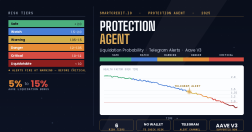
Markets move around the clock, but traders cannot. Consequently, automated monitoring has become a core part of any serious leveraged strategy. The Protection Agent tracks the health of your position and flags risk before it reaches a liquidation threshold. You can read the full product description on the Protection Agent learn page. As a result, you spend less time staring at charts and more time executing your plan.
Fixed-Rate Crypto Loans vs Aave and Compound: Which Suits a Bull Market?
Choosing a lending venue shapes every number in your trade model. The table below compares the three platforms on the features that matter most to bullish borrowers and lenders.
| Feature | SmartCredit.io | Aave | Compound |
|---|---|---|---|
| Rate type | Fixed for the full term | Variable, changes with utilisation | Variable, changes with utilisation |
| Behaviour in a bull run | Cost locked at origination | Rates can spike as demand surges | Rates can spike as demand surges |
| Minimum collateral ratio | Probability-based (5% liq. risk) | Higher requirement | Higher requirement |
| Capital efficiency | 2.5× more efficient | Baseline | Baseline |
| Loan term | Fixed term, known expiry date | Open-ended | Open-ended |
| Lender yield | Up to 18% APY, fixed | Variable | Variable |
| Lender default protection | Loss Provision Fund | Protocol-level mechanisms | Protocol-level mechanisms |
| Leveraged staking | Lido stETH, 2× to 5× | Manual looping required | Manual looping required |
Why Do Fixed Rates Beat Variable Rates in Bullish Conditions?
Variable rates respond to demand, and demand peaks during rallies. Fixed rates ignore that pressure entirely. Our fixed rate vs variable rate DeFi guide covers the mechanics in depth. Meanwhile, the DeFi interest rates comparison shows how wide the gap has been in practice. You can also compare historical DeFi rates yourself before choosing a term.
How Do You Pick the Right Lending Platform?
Rate structure is only one factor. Security, collateral flexibility and transparency also matter. Our ranking of the best crypto lending platforms scores each venue on these criteria. In addition, independent research firms such as Messari publish protocol data that helps you verify claims before you commit capital.
Fixed-Rate Crypto Lending: Earning Up to 18% APY While the Market Rises
Borrowers are only half of the story. Every leveraged long needs a lender on the other side. Therefore, bull markets create strong demand for stablecoin liquidity, and that demand benefits lenders directly.
Why Do Lenders Benefit When Traders Rush to Borrow?
When traders queue to borrow stablecoins, lender opportunities multiply. SmartCredit.io lenders earn up to 18% APY at a fixed rate, so they know their return on day one. Variable-rate lenders may earn more during a spike, but they may also earn far less once the frenzy fades. Fixed yield, by contrast, is easy to plan around. The fixed-term, fixed-rate borrowing and lending page explains how each term is priced.
How Does the Loss Provision Fund Protect Lenders?
Leverage raises the chance that some borrowers default during sharp reversals. The Loss Provision Fund exists to absorb those losses so lenders stay protected. Consequently, lenders can participate in the bull run without carrying the full default burden. For the wider security model, visit the security learn page.
Can You Earn Passive Income Beyond Basic Lending?
Yes, several routes exist. Our guide on how to earn with SmartCredit lists them in order of complexity. Likewise, the DeFi passive income article compares lending, staking and liquidity provision. Ethereum itself provides the settlement layer for all of these activities, and the Ethereum.org DeFi overview is a useful primer for newcomers.
Crypto Loans, Taxes and Portfolio Strategy in a Bullish Market
Profit means little if you ignore what happens afterwards. Smart bull market planning therefore covers tax treatment and portfolio balance as well as entry and exit signals.
Can You Take Profit Without Selling Your Crypto?
Many holders want liquidity but do not want to close long-term positions. Borrowing against collateral offers one alternative. Our article on how to take profit without selling explains the approach step by step. Moreover, the crypto as collateral guide shows which assets work best.
How Do Crypto Loans Interact With Taxes?
Tax rules differ by jurisdiction, and they keep changing. Our overview of crypto loans and taxes outlines the general principles. Chainalysis also publishes global crypto adoption research that shows how regulators are responding. Always consult a qualified tax professional before acting.
How Does Leveraged Lido Staking Fit a Bullish Plan?
If you hold ETH and expect it to rise, staking adds a second return stream. SmartCredit.io offers leveraged Lido staking at 2× to 5× on stETH yield. The staking and rewards page details how rewards accrue. Alternatively, an AI crypto portfolio optimizer can help you balance leveraged ETH exposure against other holdings.
SmartCredit.io
Lock Your Borrowing Cost Before the Next Rally
Join 20,000+ users on SmartCredit.io. Borrow stablecoins at a fixed rate with a with probability-based collateral (5% liquidation probability).
Borrow at a Fixed Rate →More Fixed-Rate Crypto Loan Questions for Bullish Traders
Is a fixed-rate crypto loan safer than a variable-rate loan?
A fixed rate removes interest rate risk, but it does not remove price risk. Your collateral can still lose value, so you need a buffer above the minimum ratio. The benefit is predictability, because your total interest cost is known from day one.
How low can the collateral ratio go on SmartCredit.io?Bullish Market Crypto Loans: A Final Risk Checklist
A fixed rate protects your margin, however it does not protect your collateral. Therefore, pair every bullish trade with a clear liquidation plan. Our guide on how to avoid crypto loan liquidation shows how to size a buffer above the minimum ratio. Furthermore, the Protection Agent for DeFi liquidation monitoring watches your position around the clock. As a result, you get an early warning before a sharp price drop becomes a forced sale.
Rate certainty also changes how you compare platforms. Consequently, read our analysis of fixed rate vs variable rate DeFi before you commit capital. The DeFi interest rates comparison adds five years of data to the argument. Meanwhile, our review of the best crypto lending platforms ranks the main alternatives. For the mechanics, the learning centre explains fixed-term, fixed-rate borrowing and lending in plain language. Likewise, the SmartCredit.io security overview covers audits and non-custodial design.
How Should You Size a Bullish Position With a Fixed-Rate Loan?
Start with the loss you can accept, not the gain you want. Then work backwards to a position size that survives a normal pullback. Use these checks before you borrow:
- Calculate total interest for the full term, so you know your exact breakeven price.
- Keep a collateral buffer well above the 100% minimum ratio.
- Set an exit level for both profit and loss before you open the trade.
- Match the loan term to your trade horizon, with a few days of margin.
In addition, the collateral ratio guide explains how buffers work in practice. Fixed costs make this arithmetic reliable, whereas variable rates turn it into guesswork.
SmartCredit.io
Monitor Your Collateral Around the Clock
The Protection Agent watches your loan health, so a sudden dip never catches you off guard during a bull run.
Activate the Protection Agent →How Do You Calculate Breakeven on a Fixed-Rate Crypto Loan?
Add the total fixed interest for the term to your principal. Then divide that repayment figure by the number of tokens you bought. The result is your breakeven sell price. Because the rate never changes, this number stays accurate until maturity. Remember to include DEX fees and slippage as well. Furthermore, any SMARTCREDIT borrow rewards you earn can lower your effective cost.
Can You Combine a Fixed-Rate Loan With Leveraged Lido Staking?
Yes, SmartCredit.io offers leveraged Lido staking at 2× to 5× on stETH yield. This suits holders who expect ETH to rise and want a second return stream. However, leverage amplifies losses as well as gains. Read the leveraged Lido staking launch guide and the staking and rewards overview before you choose a multiplier.
What Happens When a Fixed-Term Loan Reaches Maturity?
You repay the principal plus the interest agreed at origination, and your collateral is released. Therefore, plan your exit to land before the term ends. If you want to keep exposure, you can sell part of your position to repay and hold the rest. Meanwhile, our guide on how to take profit without selling covers alternative exits.
What Protects Lenders if a Borrower Defaults?
The Loss Provision Fund protects lenders from borrower defaults. Lenders can earn up to 18% APY, and the fund adds a safety layer on top of overcollateralised positions. Our Loss Provision Fund explainer describes how it works. As a result, borrower demand in a bull market also benefits the lenders who supply the liquidity.
SmartCredit.io
See Today’s Fixed Rates Before You Go Long
Compare fixed and variable DeFi borrowing costs side by side, then lock your rate with a with probability-based collateral (5% liquidation probability).
Compare Rates Now →Sources: Ethereum.org – Decentralised Finance (DeFi), Messari – Crypto Research and Market Data, Chainalysis – Blockchain Data and Adoption Research
Related SmartCredit reading: Compare historical DeFi borrowing rates, Cryptocurrency as collateral, Yield farming with fixed-term loans, Crypto loans and taxes