Borrowing USDT or USDC against your crypto holdings lets you unlock liquidity without selling – and without triggering a capital gains tax event. This guide explains exactly how crypto collateral loans work in 2026, which assets qualify, how collateral ratios compare across platforms, and why a fixed-rate loan on SmartCredit.io gives you predictability that variable-rate protocols cannot match.
Last Updated: November 2026
In This Article
- What Is Crypto-Collateralised Stablecoin Borrowing?
- Why Borrow USDT or USDC Instead of Selling?
- Which Crypto Assets Qualify as Collateral?
- Collateral Ratio Comparison: SmartCredit vs Aave vs Compound
- How to Borrow USDT or USDC on SmartCredit.io
- Fixed-Rate vs Variable-Rate Stablecoin Borrowing
- Managing Your Loan and Avoiding Liquidation
- Tax Implications of Borrowing Against Crypto
- Frequently Asked Questions
What Is Crypto-Collateralised Stablecoin Borrowing?
Crypto collateral loans allow you to deposit digital assets – such as ETH, WBTC or stablecoins – as security and receive USDT or USDC in return. The loan is fully secured by your on-chain collateral, so no credit check or bank account is required. Consequently, you retain ownership of your underlying assets throughout the loan term. When you repay the principal plus interest, your collateral is released.
This model differs fundamentally from unsecured lending. Because the collateral secures the loan, lenders face limited counterparty risk. Furthermore, the entire process runs through smart contracts on Ethereum mainnet, meaning no intermediary holds your assets. As a result, borrowers with no credit history can access stablecoin liquidity in minutes rather than weeks.
The two most popular stablecoins for borrowing are USDT (Tether) and USDC (Circle). Both track the US dollar 1:1 and are accepted across hundreds of DeFi protocols, centralised exchanges, and payment platforms. Borrowing either gives you dollar-denominated purchasing power without converting your crypto holdings into fiat.
Understanding how cryptocurrency works as collateral is the foundation of every crypto-backed loan. Meanwhile, the collateral ratio – the relationship between your deposited value and borrowed amount – determines how much you can borrow and how close you are to liquidation.
SmartCredit.io
Borrow USDT or USDC at a Fixed Rate
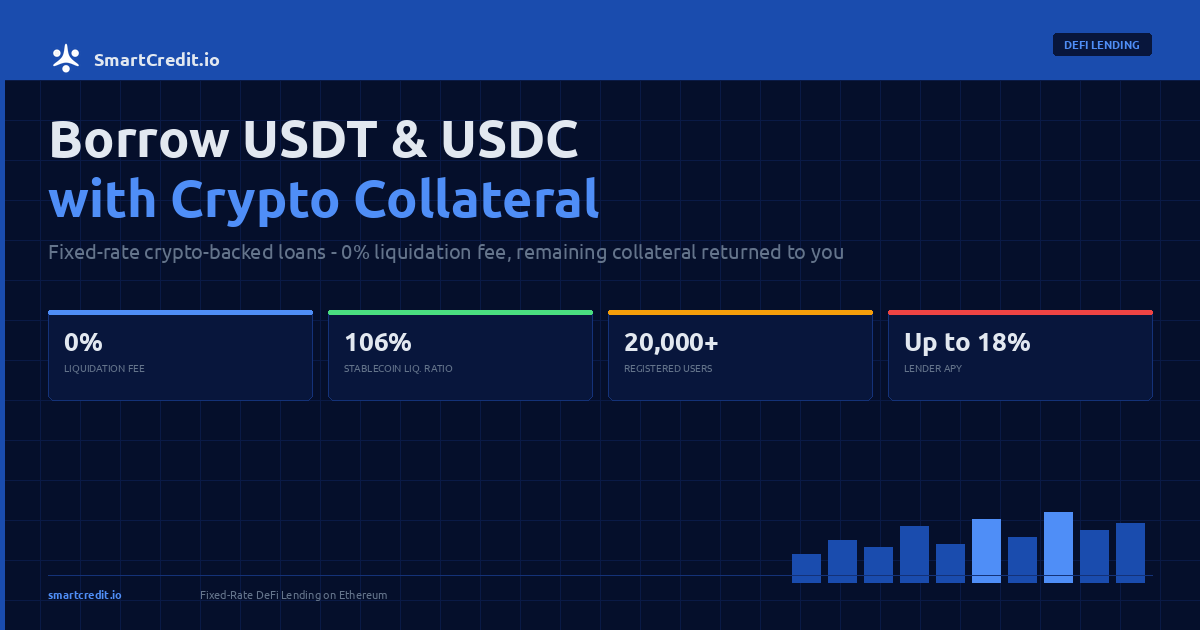
Fixed-term, fixed-rate crypto loans on Ethereum. 0% liquidation fee – remaining collateral returned to you, not to liquidation bots.
Get a loan →Why Borrow USDT or USDC Instead of Selling?
Selling crypto to cover expenses or fund investments is the most common approach – but it comes with two significant costs. First, you lose future upside if the asset appreciates. Second, in most jurisdictions, selling triggers a capital gains tax event. Borrowing against your holdings avoids both problems entirely.
Consider a practical example. If you hold 10 ETH at $3,000 each ($30,000 total) and need $10,000 for a property deposit, selling 3.3 ETH realises that capital gain immediately. However, borrowing $10,000 USDC against 3.5 ETH as collateral keeps all 10 ETH in your portfolio. Furthermore, when ETH appreciates, you benefit from the full position – not just 6.7 ETH.
The tax treatment of crypto loans is an important consideration. In most jurisdictions – including the United States, United Kingdom and European Union – taking a loan against crypto is not a taxable disposal. As a result, you access liquidity without triggering capital gains. Nevertheless, always consult a tax professional for advice specific to your situation, since regulations vary and continue to evolve.
Beyond tax efficiency, crypto collateral loans serve several strategic purposes:
- Leveraged DeFi strategies – borrow stablecoins and redeploy into yield-generating protocols
- Business cash flow – access working capital without liquidating a long-term position
- Arbitrage – borrow USDT to capture price discrepancies across exchanges
- Diversification – shift into different asset classes without selling your crypto base
- Emergency liquidity – access funds quickly without permanently exiting a position
Many borrowers use the strategy described in our guide on taking crypto profits without selling: borrow stablecoins against appreciated holdings, use them for real-world expenses, then repay when convenient – all without triggering a taxable event.
Which Crypto Assets Qualify as Collateral?
Not all crypto assets are accepted as collateral across every DeFi lending platform. Lenders typically require assets with sufficient liquidity, on-chain price feeds, and established market depth. Consequently, the most liquid large-cap assets dominate collateral options in 2026.
ETH (Ethereum) is the most widely accepted collateral across all major DeFi protocols. As the native asset of Ethereum mainnet, it carries the deepest liquidity and the most reliable price oracle support. Meanwhile, WBTC (Wrapped Bitcoin) brings Bitcoin’s store-of-value characteristics into DeFi smart contracts. Both assets are accepted on SmartCredit.io, Aave, and Compound.
Stablecoins as collateral present an interesting use case. Some protocols allow borrowers to deposit USDC as collateral and borrow USDT, or vice versa. However, the capital efficiency gains are limited when both sides of the trade track the same underlying value. As a result, most borrowers use volatile assets like ETH or WBTC as collateral to maximise their stablecoin borrowing power.
stETH (Lido staked ETH) is increasingly popular as collateral. Because it accrues staking rewards automatically, borrowers can use their stETH as collateral while continuing to earn Lido yield – effectively running a leveraged staking position. SmartCredit.io supports leveraged Lido staking at 2x-5x amplification, as detailed in our guide to fixed-rate leveraged Lido staking.
Collateral Eligibility at a Glance
| Asset | SmartCredit.io | Aave | Compound |
|---|---|---|---|
| ETH | ✓ | ✓ | ✓ |
| WBTC | ✓ | ✓ | ✓ |
| stETH | ✓ | ✓ | ✗ |
| USDC | ✓ | ✓ | ✓ |
Collateral Ratio Comparison: SmartCredit vs Aave vs Compound
The collateral ratio – sometimes called the loan-to-value (LTV) ratio – is the single most important factor determining how much USDT or USDC you can borrow against your crypto. A lower required collateral ratio means you can borrow more against the same amount of collateral. Consequently, capital efficiency is a critical differentiator between DeFi lending platforms.
SmartCredit.io calculates collateral differently from every other DeFi lending platform. Rather than applying a hard-coded ratio, the system models the liquidation probability of your specific collateral asset over your specific loan term and proposes the minimum collateral needed to keep that probability at 5%. Shorter loan terms and less volatile assets require less collateral; longer terms and volatile assets require more. By contrast, Aave and Compound apply fixed LTV limits regardless of term – 80% LTV (125% collateral) for ETH on Aave, 75% LTV (133%) on Compound – because they have no loan maturity to calculate against. Our detailed analysis of DeFi collateral ratios explains precisely why probability-based calculation matters for borrowers.
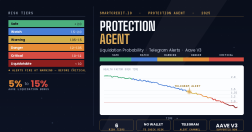
Beyond the ratio itself, the liquidation model is fundamentally different. Aave, Compound and MakerDAO earn 5–10% on every liquidation and run their own liquidation bots to collect that fee. SmartCredit.io earns 0% on liquidations – remaining collateral after a liquidation is returned to the borrower’s credit line, not kept by the protocol. Furthermore, SmartCredit.io’s Positions Monitoring System sends Telegram alerts when liquidation probability rises to 15%, giving borrowers time to act. Aave offers no equivalent monitoring tool – structurally, it cannot, as warning borrowers would reduce liquidation revenue.
| Platform | Collateral Requirement | Liquidation Fee | Rate type |
|---|---|---|---|
| SmartCredit.io | Probability-based (5% liq. risk)* | 0% — collateral returned | Fixed |
| Compound | 133% (fixed) | 5–8% kept by liquidators | Variable |
| Aave | 125% ETH (fixed) | 5–10% kept by liquidators | Variable |
| MakerDAO | 150–175% (fixed) | 13% kept by liquidators | Variable |
*SmartCredit.io collateral is calculated at 5% liquidation probability for the chosen asset and loan term. Liquidation ratios: 106% (stablecoins), 112–114% (ETH/wBTC). Actual initial collateral varies by term length and asset volatility.
Beyond the collateral approach, the rate type matters enormously. Variable-rate platforms like Aave and Compound adjust borrowing costs algorithmically based on pool utilisation. During periods of high demand – such as market rallies when traders seek leverage – rates can spike from 3% to 20%+ within days. By contrast, SmartCredit.io locks your borrowing rate at loan inception. You can compare how rates have moved historically using our historical DeFi rates comparison tool.
How to Borrow USDT or USDC on SmartCredit.io
Borrowing stablecoins on SmartCredit.io follows a straightforward process. The platform runs on Ethereum mainnet, so you will need an Ethereum-compatible wallet (MetaMask, Ledger or WalletConnect-compatible) and your collateral assets held on mainnet. The entire process completes in a single transaction after you approve the terms.
Step 1 – Connect your wallet
Navigate to smartcredit.io/borrow and connect your Ethereum wallet. MetaMask, Ledger Live and any WalletConnect-compatible wallet are supported. SmartCredit.io has served 20,000+ registered users since launch, and the onboarding process requires no KYC verification for most loan sizes.
Step 2 – Choose your collateral asset and amount
Select the asset you wish to use as collateral – ETH, WBTC, stETH or USDC. Enter the collateral amount. The interface immediately calculates your maximum borrowable USDT or USDC based on the probability-based collateral ratio for your asset and loan term. The system proposes the minimum collateral that keeps your liquidation probability at 5% – shorter terms and stablecoins require less collateral, longer terms and volatile assets require more. In Simple mode this is set automatically; in Advanced mode you can adjust it after connecting the Telegram Positions Monitoring System.
Step 3 – Select loan term and fixed rate
This is where SmartCredit.io differs most sharply from competitors. You choose both the loan term (the repayment date) and the borrowing rate, which is fixed for the entire duration. No variable-rate surprises, no algorithmic rate adjustments. Our guide to fixed-term, fixed-rate borrowing and lending explains exactly how the matching mechanism works.
Step 4 – Review and confirm
Before confirming, review the loan summary: collateral deposited, USDT or USDC received, fixed interest rate, repayment date and total repayment amount. Once confirmed, the smart contract locks your collateral and releases stablecoins to your wallet in the same transaction. Your security is enforced by audited smart contracts – see the SmartCredit security overview for audit details.
Step 5 – Repay and reclaim collateral
At any point before the loan term expires, you can repay the principal plus accrued interest. The smart contract releases your collateral immediately upon repayment. Early repayment is permitted on most SmartCredit.io loan configurations. If you need to monitor your collateral health in real time, the Protection Agent sends alerts before your ratio approaches the liquidation threshold.
SmartCredit.io
Compare Borrowing Rates Before You Commit
See fixed vs variable rates across DeFi protocols side by side. No registration required.
Compare rates now →Fixed-Rate vs Variable-Rate Stablecoin Borrowing
The distinction between fixed and variable borrowing rates is the most consequential decision a DeFi borrower makes. Variable-rate platforms dominate the market – Aave, Compound and MakerDAO all use algorithmic rates that adjust with utilisation. However, this creates significant planning risk. A borrower who opens a 90-day loan at 4% APR may find themselves paying 18% APR by week three if market conditions shift.
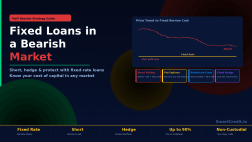
Fixed-rate borrowing eliminates this uncertainty entirely. When you borrow USDT or USDC on SmartCredit.io, the interest rate is locked at the moment the loan is created. Consequently, your total repayment cost is known on day one. This is especially valuable for borrowers with specific cash flow requirements – such as funding a business expense or deploying capital into a yield strategy with a known return.
Our analysis of fixed interest rates vs fluctuating rates in DeFi shows that variable rates have historically been cheaper on average – but with far greater volatility. The DeFi interest rates comparison between fixed and variable approaches shows that the risk-adjusted cost of fixed-rate borrowing is often competitive once rate spikes are factored in.
Variable-rate risk: a concrete example
During the DeFi surge of late 2021, Aave USDC borrowing rates spiked from under 3% to over 40% APR within 72 hours as demand overwhelmed available liquidity. Borrowers with open loans saw their daily interest cost multiply overnight. By contrast, a fixed-rate borrower on SmartCredit.io faced no change whatsoever. Furthermore, the Loss Provision Fund – which protects lenders from borrower defaults – means SmartCredit.io can offer fixed rates without the platform absorbing excessive risk.
Read more about how the Loss Provision Fund works and why it enables the fixed-rate model to function sustainably at scale. Additionally, the how to earn on SmartCredit.io guide explains the lender side of the same equation.
Managing Your Loan and Avoiding Liquidation
Liquidation is the forced sale of your collateral when its value falls below the liquidation threshold. For ETH collateral on SmartCredit.io, that threshold is 113% – meaning if your collateral-to-loan ratio drops to 113%, the loan is liquidated. Unlike Aave or Compound, which keep 5–10% of collateral as a liquidation fee, SmartCredit.io earns nothing on liquidations. Any collateral remaining after the loan is repaid goes back to your credit line, not to the protocol. Understanding and managing this risk is therefore essential for anyone borrowing stablecoins against volatile collateral.
Several practical strategies reduce liquidation risk substantially. Our comprehensive guide on how to avoid crypto loan liquidation covers these in detail, but the core principles are:
- Maintain a buffer above the minimum ratio – borrowing 70-80% of your maximum gives a meaningful cushion
- Use the Protection Agent – SmartCredit.io’s automated monitoring tool alerts you when your ratio falls below a custom threshold
- Diversify collateral assets – using multiple assets reduces single-asset liquidation risk
- Monitor macro conditions – broad market drawdowns affect all collateral assets simultaneously
- Keep repayment funds accessible – maintaining liquid reserves allows rapid repayment if needed
The Protection Agent integrates directly with your SmartCredit.io position. It monitors collateral health in real time and sends alerts via email or webhook before you approach the liquidation threshold. As a result, you have time to top up collateral or partially repay the loan rather than facing a forced liquidation event.
Tax Implications of Borrowing Against Crypto
One of the strongest arguments for borrowing USDT or USDC rather than selling crypto is the tax treatment. In most major jurisdictions, taking a loan against your crypto is not a taxable event. You are not selling, exchanging or disposing of an asset – you are using it as security for a debt. Consequently, no capital gains liability arises at the point of borrowing.
However, several nuances apply. In the United States, the IRS has not issued specific guidance on crypto-backed loans, but the general treatment under existing rules suggests borrowing is not taxable. By contrast, liquidation events – where collateral is forcibly sold – may be treated as a disposal and therefore taxable. Our detailed guide to crypto loans and taxes covers the full picture across multiple jurisdictions. Furthermore, the SmartCredit.io regulatory overview explains the platform’s approach to compliance.
It is worth noting that interest paid on crypto-backed loans may be deductible in some jurisdictions if the proceeds are used for business or investment purposes. This further improves the tax efficiency of the strategy relative to selling. Nevertheless, tax law varies significantly by country and continues to evolve – always seek advice from a qualified tax professional before making decisions based on anticipated tax treatment.
External resources such as Chainalysis and Messari publish annual crypto tax guidance reports that are useful reference points alongside official guidance from Ethereum.org on DeFi fundamentals. For TVL and market data referenced in this article, see DefiLlama.
SmartCredit.io
Borrow Without Triggering a Tax Event
Use ETH or WBTC as collateral. Receive USDT or USDC instantly at a locked rate. Keep your crypto, skip the tax bill.
Start borrowing →Frequently Asked Questions
Can I borrow USDT with crypto as collateral?
Yes. SmartCredit.io allows you to deposit ETH, WBTC, stETH or USDC as collateral and borrow USDT at a fixed rate on Ethereum mainnet. The collateral requirement is calculated at a 5% liquidation probability for your specific asset and loan term – not a hard-coded ratio. No credit check or KYC is required for most loan sizes, and the entire process completes on-chain in a single transaction.
How much USDC can I borrow against my ETH?
The amount you can borrow depends on your chosen collateral asset and loan term. SmartCredit.io calculates the minimum collateral for a 5% liquidation probability – for shorter terms and stablecoins, the ratio is tighter (from 106% liquidation threshold for stablecoins); for longer terms and volatile assets like ETH (113% liquidation threshold), the initial required collateral is higher. In Simple mode the system sets this automatically. In Advanced mode – available after connecting the Telegram Positions Monitoring System – you can adjust the ratio for greater capital efficiency.
Is borrowing USDT against crypto a taxable event?
In most jurisdictions, borrowing against crypto is not a taxable disposal. You are using the asset as collateral, not selling or exchanging it. Consequently, no capital gains tax event arises at the point of borrowing. However, if your collateral is liquidated, that may be treated as a disposal in some jurisdictions. Always consult a tax professional for jurisdiction-specific advice.
What is the difference between borrowing USDT and USDC?
USDT (Tether) and USDC (Circle) both track the US dollar and serve the same functional purpose for most borrowers. USDC is considered more transparent, with regular third-party attestations of its dollar reserves. USDT has deeper liquidity on many centralised exchanges. In practice, both are widely accepted across DeFi protocols, and the choice often comes down to which you plan to use or redeploy after borrowing.
SmartCredit.io vs Aave: which is better for borrowing stablecoins?
SmartCredit.io offers three advantages Aave cannot match. First, fixed borrowing rates locked at loan creation – Aave’s variable rates can spike from 3% to 40%+ during high-demand periods. Second, 0% liquidation fee: when a SmartCredit.io loan is liquidated, remaining collateral is returned to the borrower’s credit line. Aave keeps 5–10% as a liquidation penalty. Third, the Positions Monitoring System sends Telegram alerts when your liquidation probability reaches 15% – Aave offers no equivalent tool. Aave has a broader collateral range and deeper liquidity for large positions; SmartCredit.io is the better choice for borrowers who need cost predictability and fair liquidation treatment.
What happens if my collateral value drops?
If your collateral falls below the minimum ratio, your position may be liquidated – the protocol sells your collateral to repay the loan. To avoid this, maintain a healthy buffer above the minimum ratio and use the SmartCredit.io Protection Agent, which monitors your position in real time and alerts you before you approach the liquidation threshold. Early repayment or topping up collateral can prevent liquidation.
Can I borrow against Litecoin or Solana on SmartCredit.io?
SmartCredit.io operates on Ethereum mainnet and currently supports Ethereum-native assets as collateral: ETH, WBTC, stETH and select ERC-20 tokens. Litecoin and Solana are not natively supported, as they operate on separate blockchains. However, wrapped versions of these assets – if available as audited ERC-20 tokens – may be added in future. Check the SmartCredit.io roadmap for the latest collateral asset additions.
SmartCredit.io
Ready to Borrow USDT or USDC?
Fixed rate. Fixed term. 0% liquidation fee. 20,000+ users on Ethereum mainnet.
Get started →Sources: Ethereum.org – DeFi Overview | DefiLlama – Protocol TVL Data | Messari – Crypto Research | Chainalysis – Crypto Tax Guidance
Related SmartCredit reading: Using Cryptocurrency as Collateral | DeFi Collateral Ratio Guide | Crypto Loans and Taxes | How to Avoid Liquidation | Compare Historical DeFi Rates | Collateral ratios explained