Home » DeFi & Blockchain

The DeFi Regulatory Trap

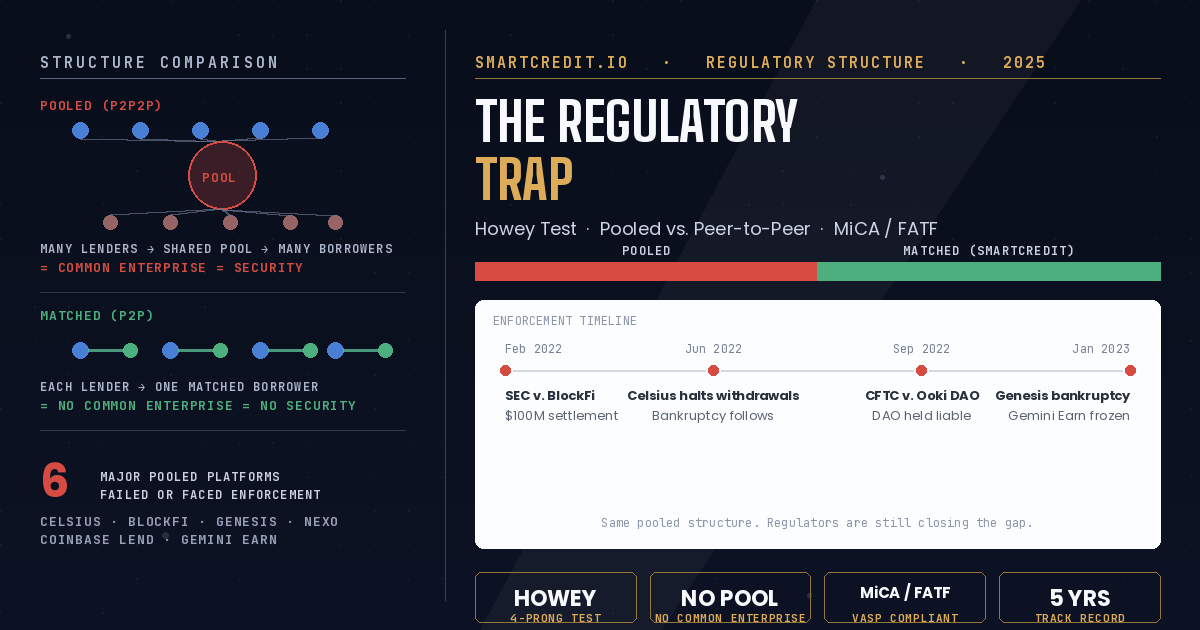
Pooling client assets and paying a return on that pool creates a common enterprise – the legal structure that placed Celsius, BlockFi and Genesis inside securities regulation. SmartCredit.io’s peer-to-peer model avoids pooling entirely: each loan is a direct on-chain agreement between one lender and one borrower at a fixed rate. This post examines the regulatory trap, why DeFi protocols that pool funds face securities risk, and how fixed-term P2P lending sidesteps it.
AI Trading Agents: Revolutionizing Risk Management and Liquidation Protection in DeFi

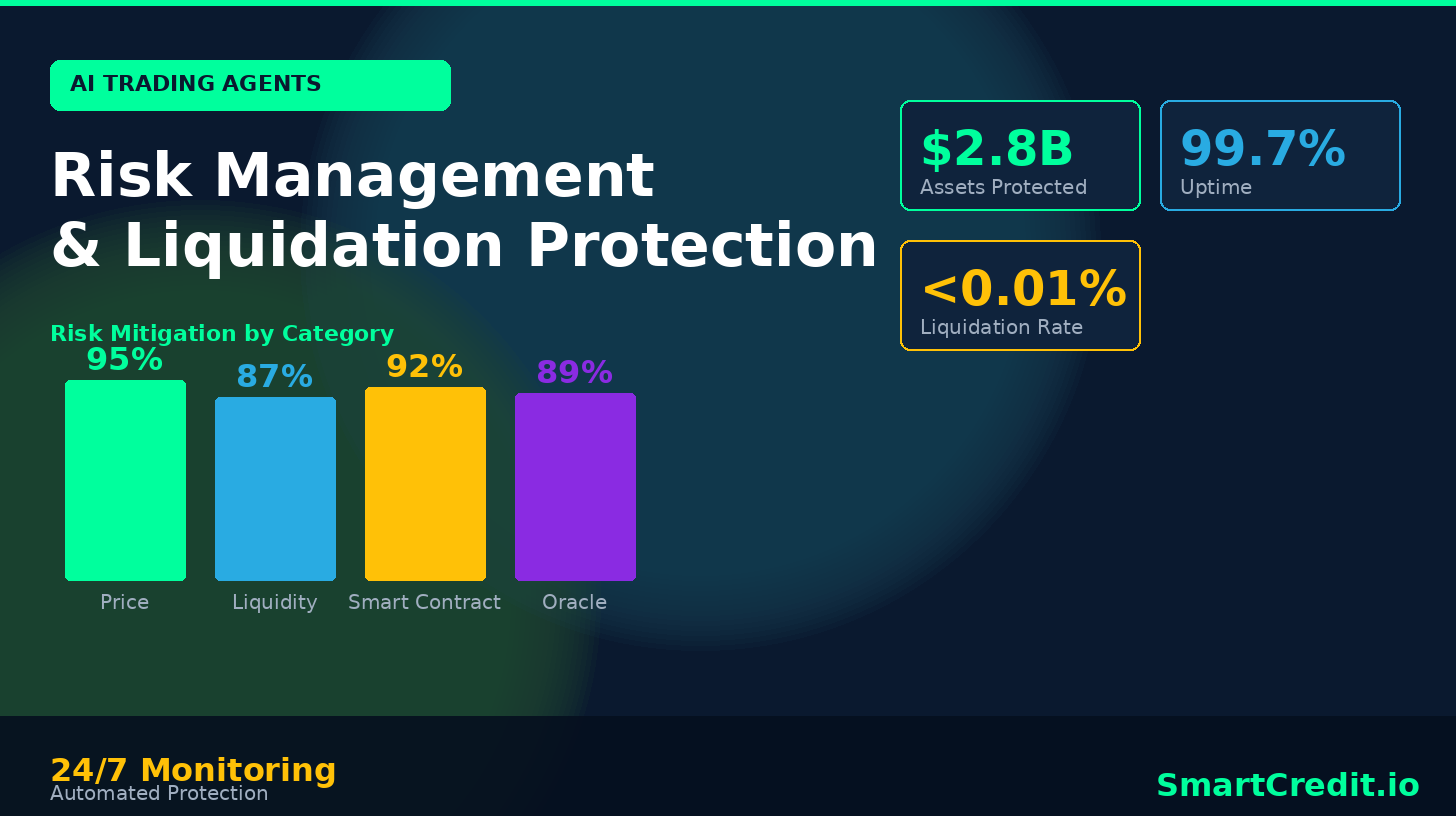
AI trading agents protect $2.8B in DeFi assets through automated risk management: (1) Price monitoring – track ETH/USD 24/7, alert at -10% drops, (2) Liquidation prevention – auto-add collateral when ratio hits 140%, (3) Oracle verification – cross-reference Chainlink, Band Protocol, (4) Smart contract monitoring – detect anomalies, pause positions. SmartCredit.io integration: AI agents + fixed-rate loans (8-10% APY) = predictable costs + automated protection. Real stats: 99.7% uptime, <0.01% liquidation rate, response time <3 seconds. Technologies: machine learning risk scoring, natural language strategy execution. Example: Deposit $50K ETH, AI maintains 150% ratio, prevents $47K liquidation. Immunebytes audited. Visit

DeFi Tokenomics Explained: The Complete Guide for Crypto Investors (2026)

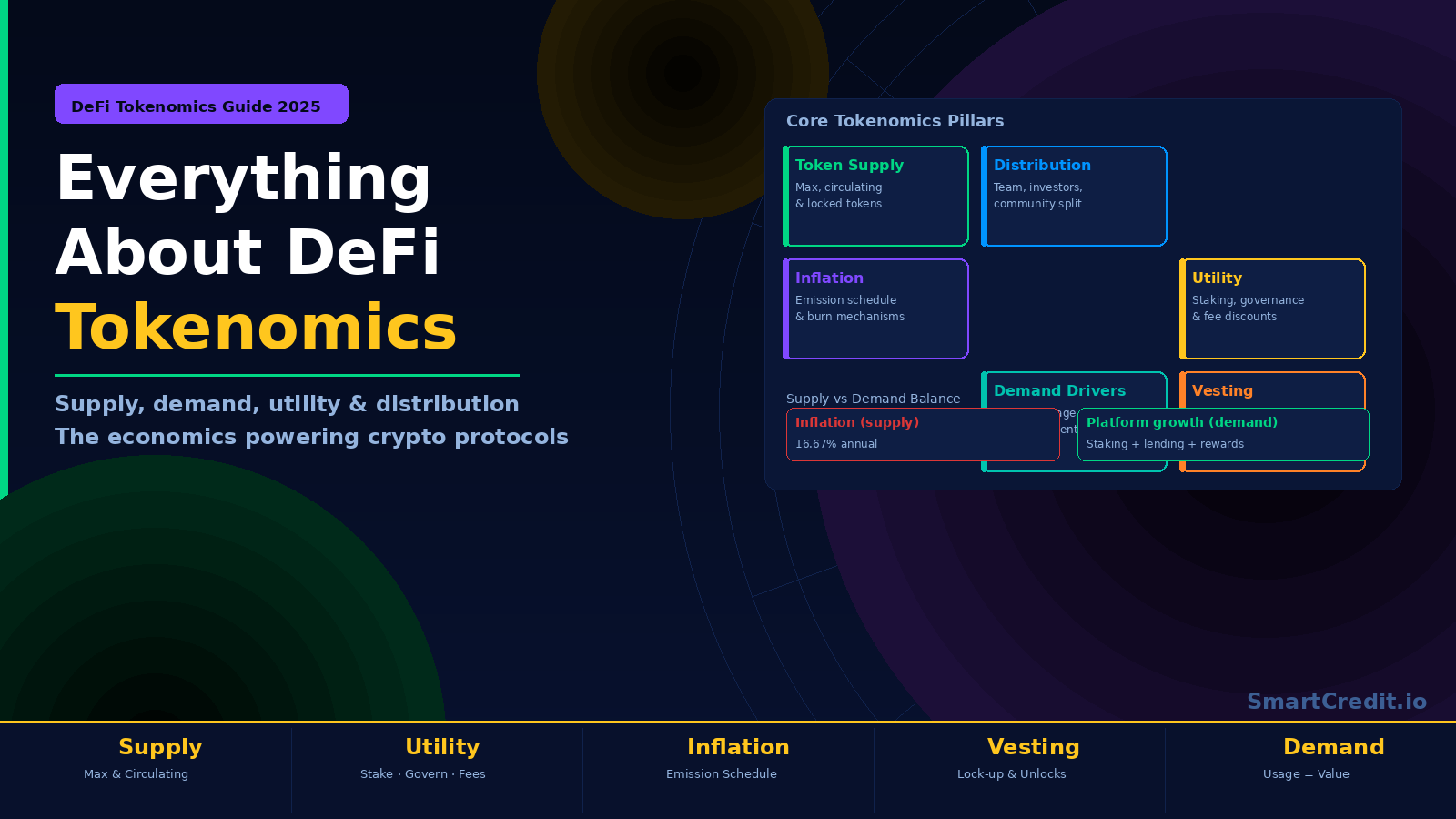
DeFi tokenomics determines protocol success: Every token has (1) Supply model – inflation rate, total cap, burn mechanics, (2) Distribution – team/investors/community split, vesting schedules, (3) Utility – governance votes, fee discounts, staking rewards, (4) Value capture – revenue sharing, buybacks. SmartCredit.io example: 25M SMARTCREDIT minted, 17% annual inflation (decreasing), 60% community rewards, 30% staking APY. Good tokenomics: sustainable inflation, real utility, value accrual. Bad tokenomics: hyperinflation, zero utility, VC dumps. Red flags: >50% team allocation, no vesting, infinite supply. How to evaluate: inflation vs adoption rate, protocol revenue vs token price. Invest in protocols, not just tokens. Visit

Liquidity Pools Explained: Complete DeFi Guide for 2026

Liquidity pools explained: Provide 2 tokens to DEX (ex: ETH + USDC on Uniswap), earn trading fees (0.3%) + rewards. How AMMs work: constant product formula (x × y = k) maintains balance. Impermanent loss example: Deposit $10K (5K ETH + 5K USDC). ETH doubles. Without LP: $15K total. With LP: $14.1K (6% impermanent loss). But earned $800 fees + $600 rewards = net $14.9K (still profitable). Types: stable pools (USDC/DAI, low IL), volatile pairs (ETH/LINK, high IL), single-sided (no IL). Top platforms: Uniswap ($4B TVL), Curve ($3.2B), Balancer. Maximize returns: use SmartCredit fixed-rate loans to fund positions. Visit

Halal Crypto Lending Exposed: Complete Sharia-Compliant DeFi Guide 2026

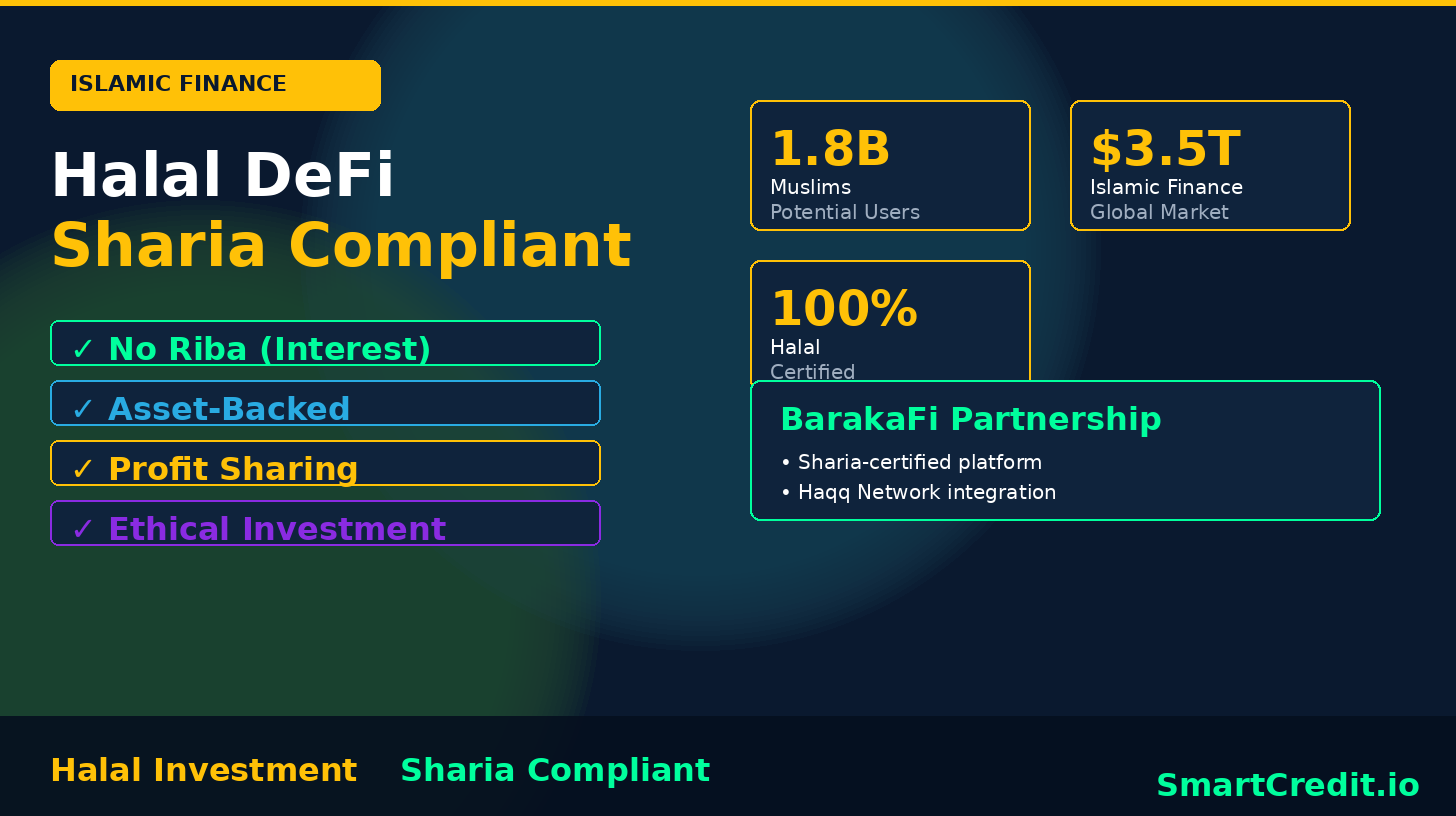
Islamic Finance + DeFi = $3.5T market opportunity serving 1.8B Muslims. Sharia-compliant DeFi requirements: (1) No riba (interest) – structure as profit-sharing, not loans, (2) Asset-backed – every transaction tied to real asset, (3) Ethical screening – no gambling/alcohol/tobacco, (4) Transparent contracts. SmartCredit.io + BarakaFi partnership (Haqq Network): halal crypto lending, riba-free microloans from $10, profit-sharing investment funds, 100% Sharia-certified. Traditional Islamic banking charges 8-12% (called “profit” not interest). BarakaFi offers same structure, blockchain transparency. Addressable market: 25% of global population. First mover advantage. Immunebytes audited. Visit

Crypto Fixed Income and SmartCredit.io

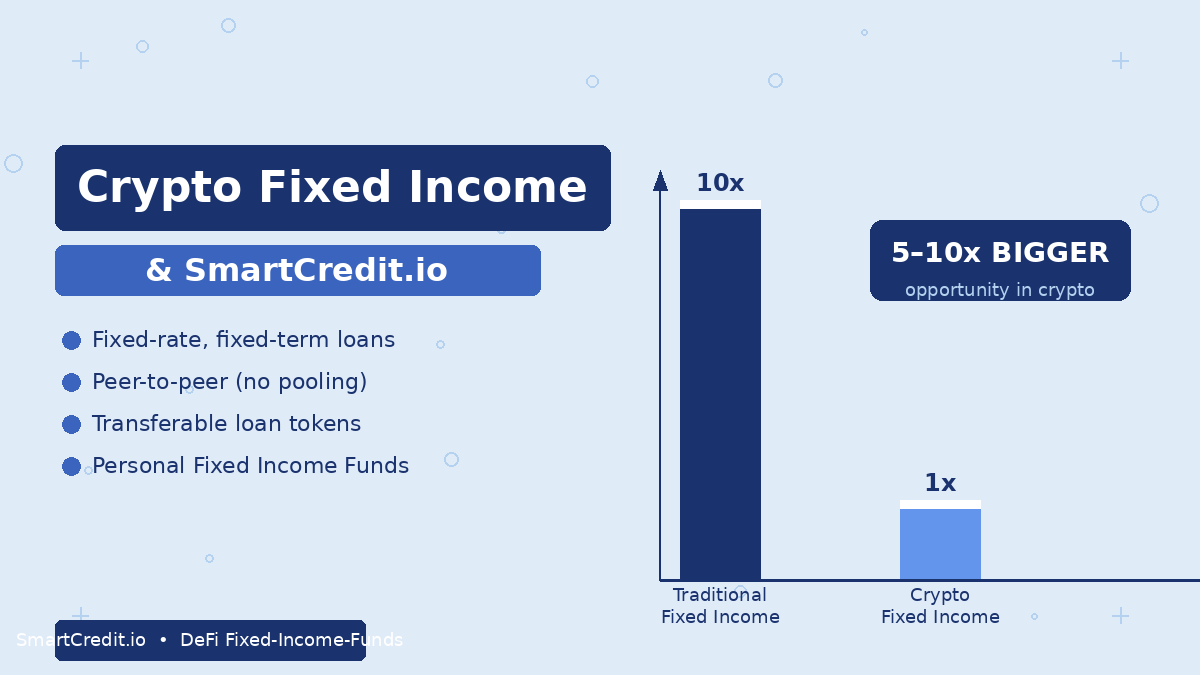
Crypto fixed income paradox: Traditional markets show fixed income 5-10x larger than equities ($100T bonds vs $20T stocks). Yet in crypto, fixed income is 5-10x SMALLER than variable-rate lending. Why? DeFi copied money markets (Aave, Compound) instead of bond markets. SmartCredit.io reverses this: fixed-rate (8-15% APY), fixed-term (30-365 days), peer-to-peer lending mirrors traditional fixed income structure. Advantages: predictable returns for institutions, budgeting certainty for businesses, stable income for retirees. Market opportunity: as crypto matures, institutions demand fixed income. Current: $20B+ variable lending. Future: $200B+ fixed income market. First mover advantage. Immunebytes audited. Visit

Crypto Credit Score in DeFi: Why It Matters and How SmartCredit.io Uses ChainAware.ai

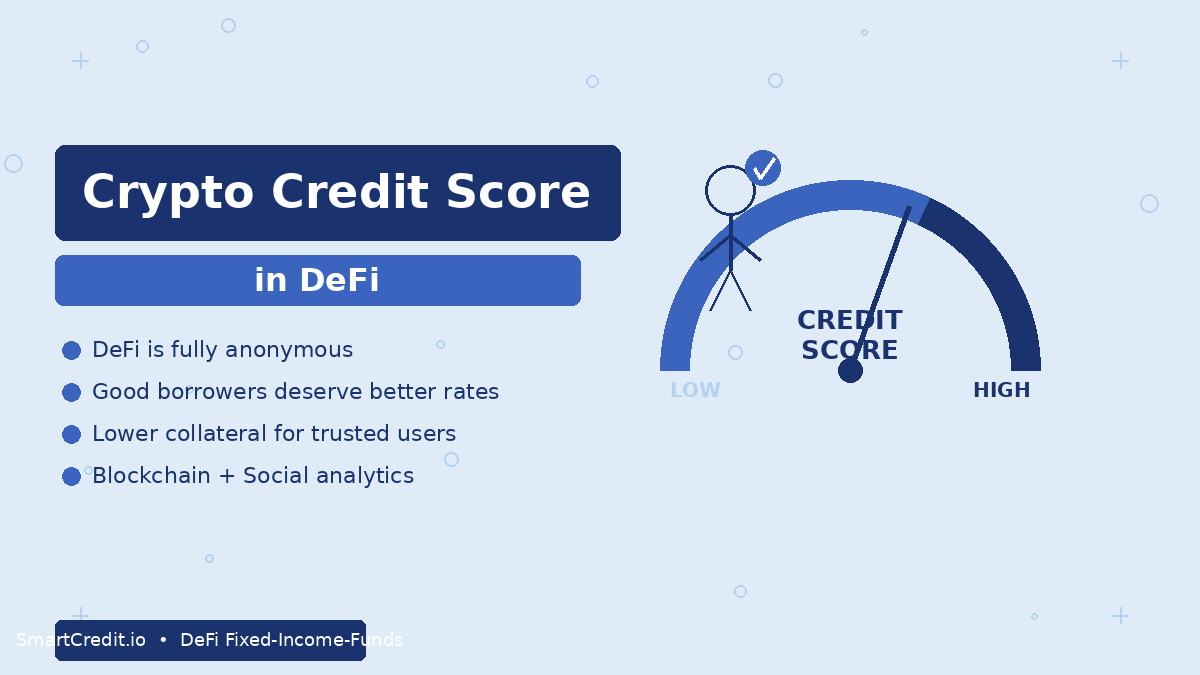
In anonymous DeFi, every borrower carries the same collateral requirement – regardless of their actual credit history. Crypto credit scoring via ChainAware.ai changes that: on-chain wallet behaviour generates a risk score that SmartCredit.io uses to offer better-rated borrowers improved collateral conditions. This post explains how DeFi credit scoring works, what data it uses, and why it benefits both borrowers who maintain healthy wallets and lenders who want lower default risk.

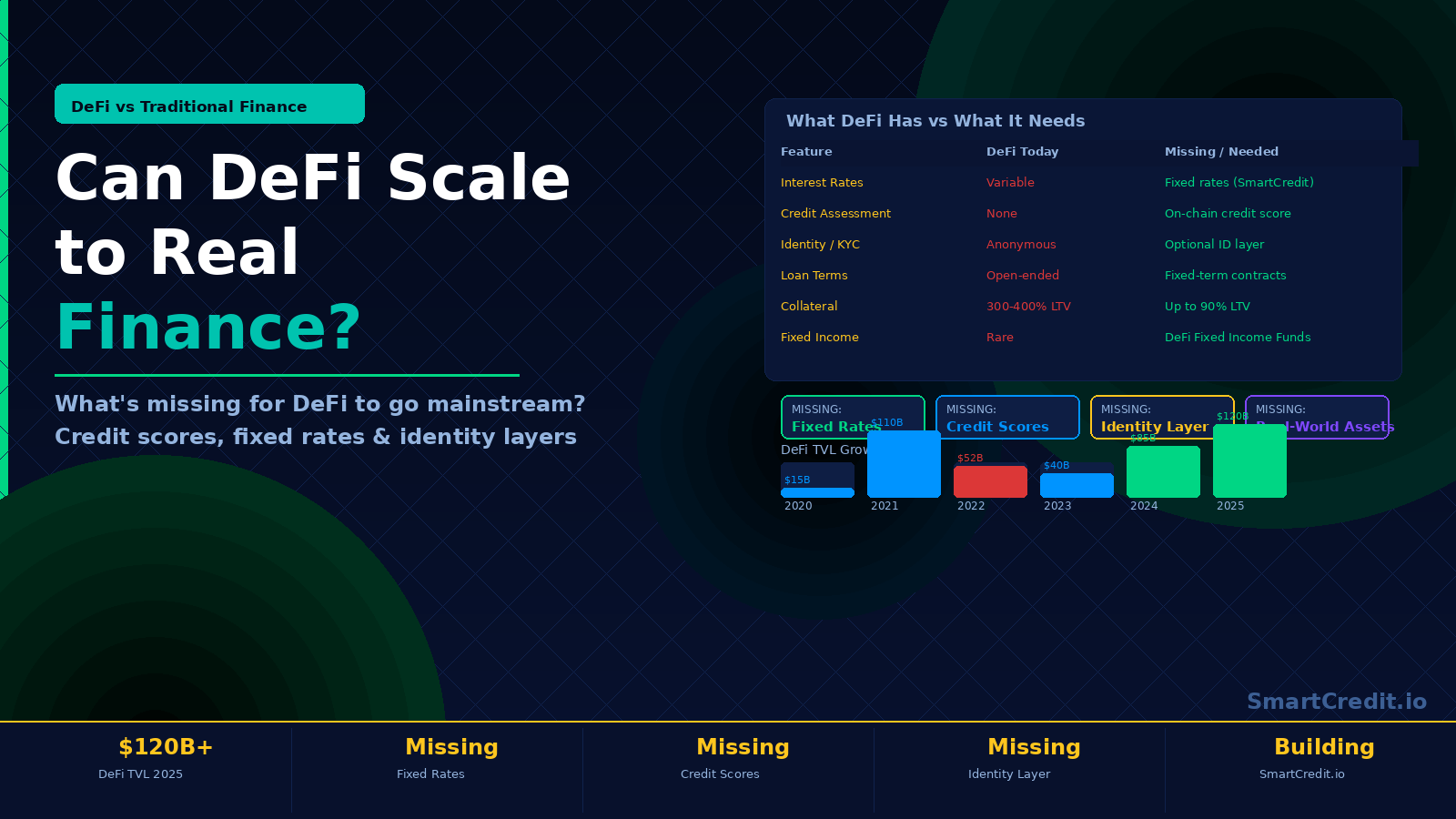
Can DeFi scale to real finance? What is missing?

Can DeFi scale to billions of users? Technical challenges: (1) Ethereum processes 15 TPS vs Visa’s 65,000 TPS, (2) Gas fees spike to $50+ during congestion, (3) Smart contract complexity limits throughput. Solutions implemented: (1) Layer 2 scaling (Polygon, Arbitrum process 4,000+ TPS), (2) Optimistic rollups (batch transactions off-chain), (3) ZK-rollups (cryptographic proofs). SmartCredit.io: Deployed on Polygon for 0.001 gas fees (vs $50 Ethereum), enabling micro-lending. Real data: Polygon processes 10M+ daily transactions. Can support 1B users? Yes, with Layer 2 + sharding. Timeline: Mass adoption 2025-2030. Current capacity: 100M users feasible. Immunebytes audited. Visit

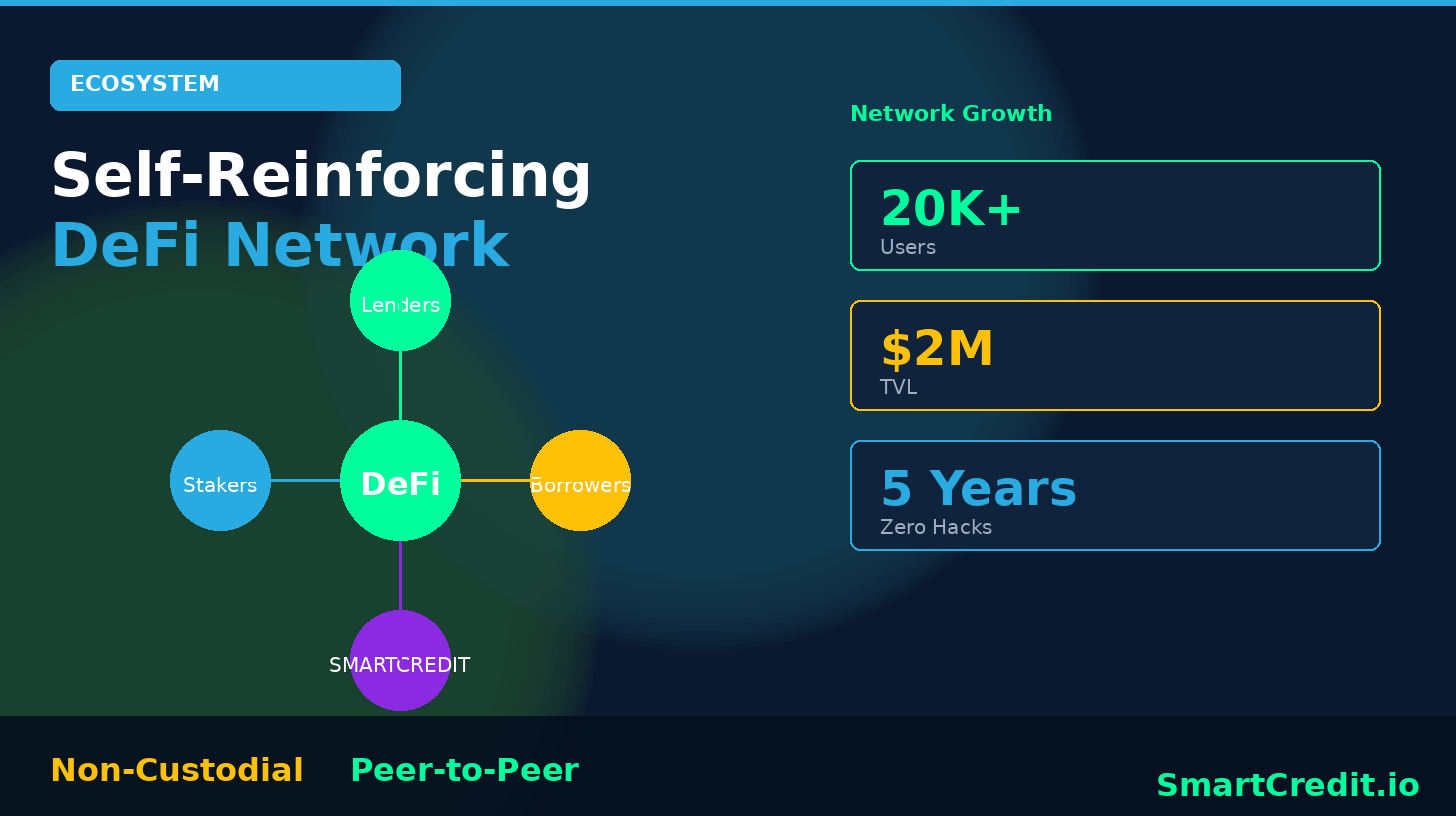
The Self-Reinforcing SmartCredit.io DeFi Lending Ecosystem

Self-reinforcing DeFi ecosystem: SmartCredit.io creates network effects where growth fuels more growth. How it works: (1) Lenders deposit USDC → (2) Earn 8-15% fixed APY → (3) More lenders join for yields → (4) Deeper liquidity attracts borrowers → (5) Borrowers pay interest to lenders → (6) SMARTCREDIT stakers earn fees → (7) Token appreciation attracts more stakers → cycle repeats. Current metrics: 20K users, $2M TVL, 5-year track record. Network effects: 2x users = 4x liquidity = 8x stability. Non-custodial design (you control keys), peer-to-peer matching, Immunebytes audited. Vision: alternate financial system on blockchain. Join the ecosystem. Visit

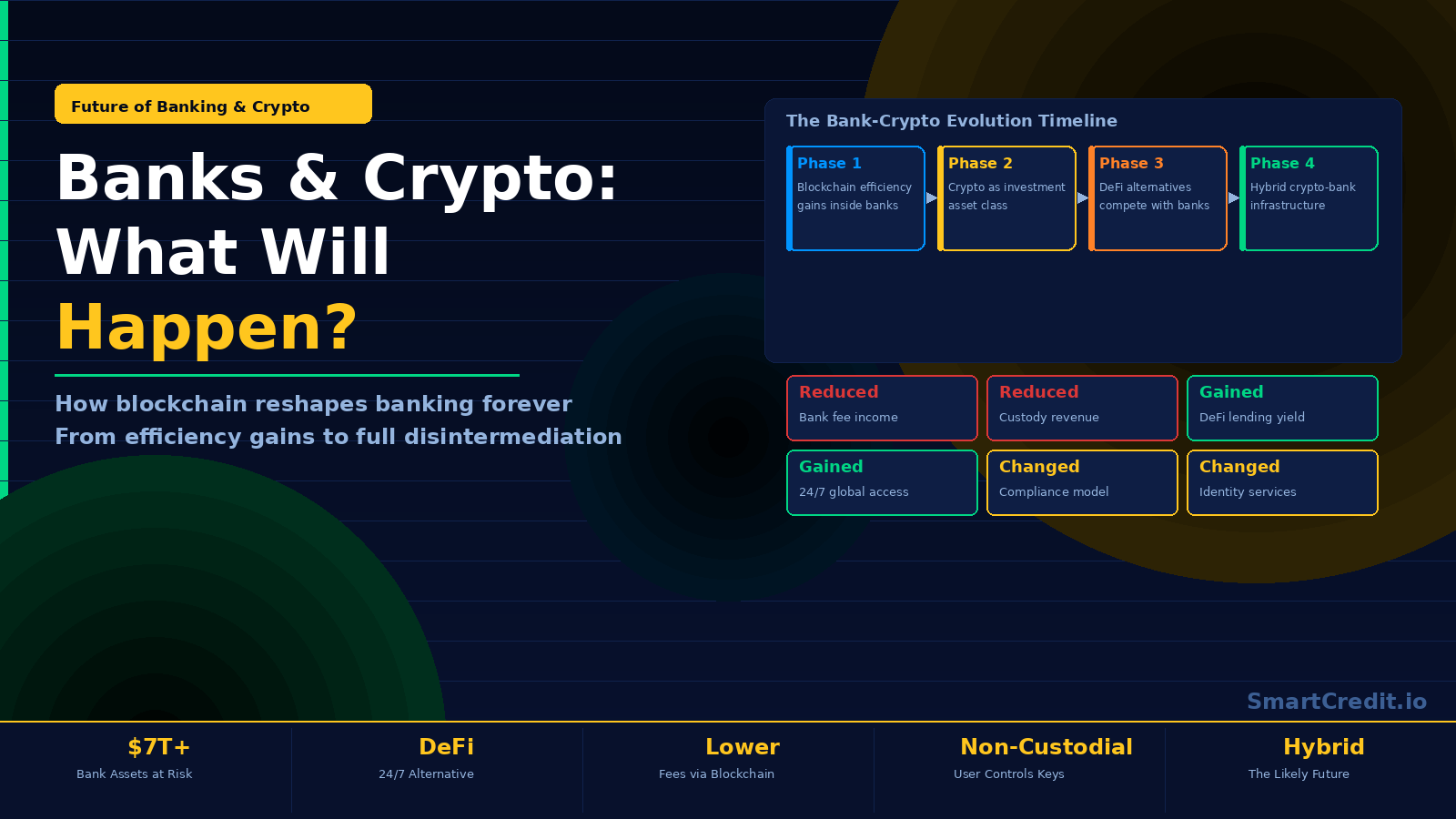
Banks and Crypto: What Will Happen to the Banks?

Banks adopting crypto: JPMorgan (JPM Coin for settlements), Fidelity (crypto custody for institutions), BNY Mellon (digital asset custody), Goldman Sachs (crypto trading desk). Why now? (1) Client demand – 60% institutional investors want crypto exposure, (2) DeFi threatens deposits (users earning 8-15% APY vs 0.5% savings), (3) Regulatory clarity (MiCA, stablecoin frameworks), (4) Revenue opportunity. How they’re competing with DeFi: Offering compliant custody + competitive yields. SmartCredit.io advantage: Pure DeFi (8-15% fixed APY) without banking overhead, Immunebytes audited, non-custodial (you control keys). The tension: Banks want centralized control, crypto demands decentralization. Future: Hybrid platforms winning. Visit

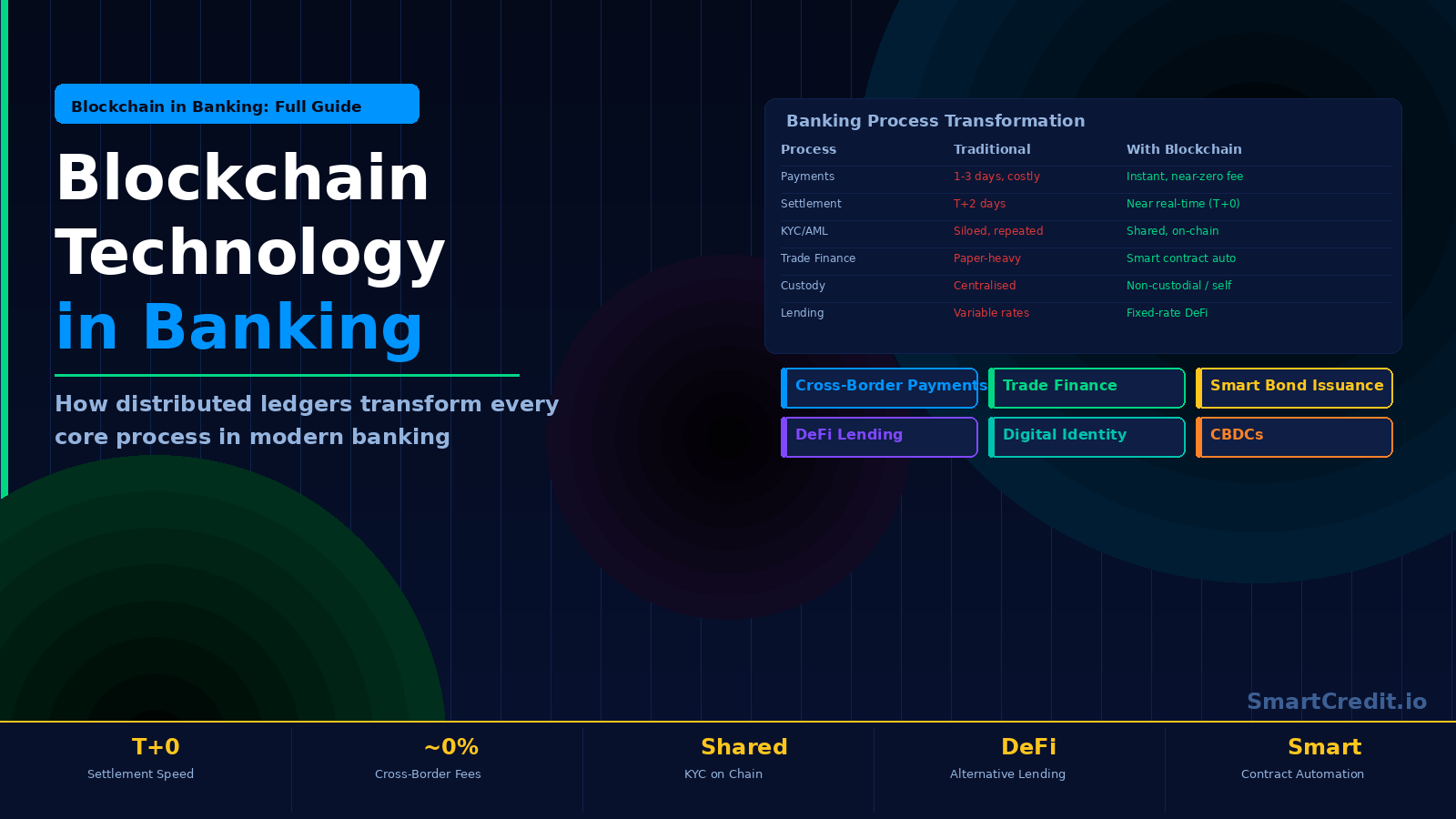
Blockchain Technology in Banking: Everything You Need to Know

Blockchain transforms banking: (1) Cross-border payments – instant settlements vs 3-5 day SWIFT, (2) Lending – DeFi yields 8-15% vs traditional 0.5%, (3) Securities trading – 24/7 tokenized assets vs 9:30am-4pm stocks, (4) KYC/Identity – blockchain-verified credentials. Real implementations: JPM Coin (Permissioned blockchain for institutional payments), Aave/Compound (Decentralized lending), SmartCredit.io (Fixed-rate DeFi lending, 8-15% APY). Banks’ challenge: DeFi offers better rates + transparency. SmartCredit advantage: Immunebytes audited, 5-year zero-hack record, non-custodial. Adoption timeline: Payments (now), lending (2024-2026), full banking replacement (2030+). The future: Hybrid – blockchain efficiency + regulatory compliance. Visit

Why is DAI Interest Rate 10% in DeFi?

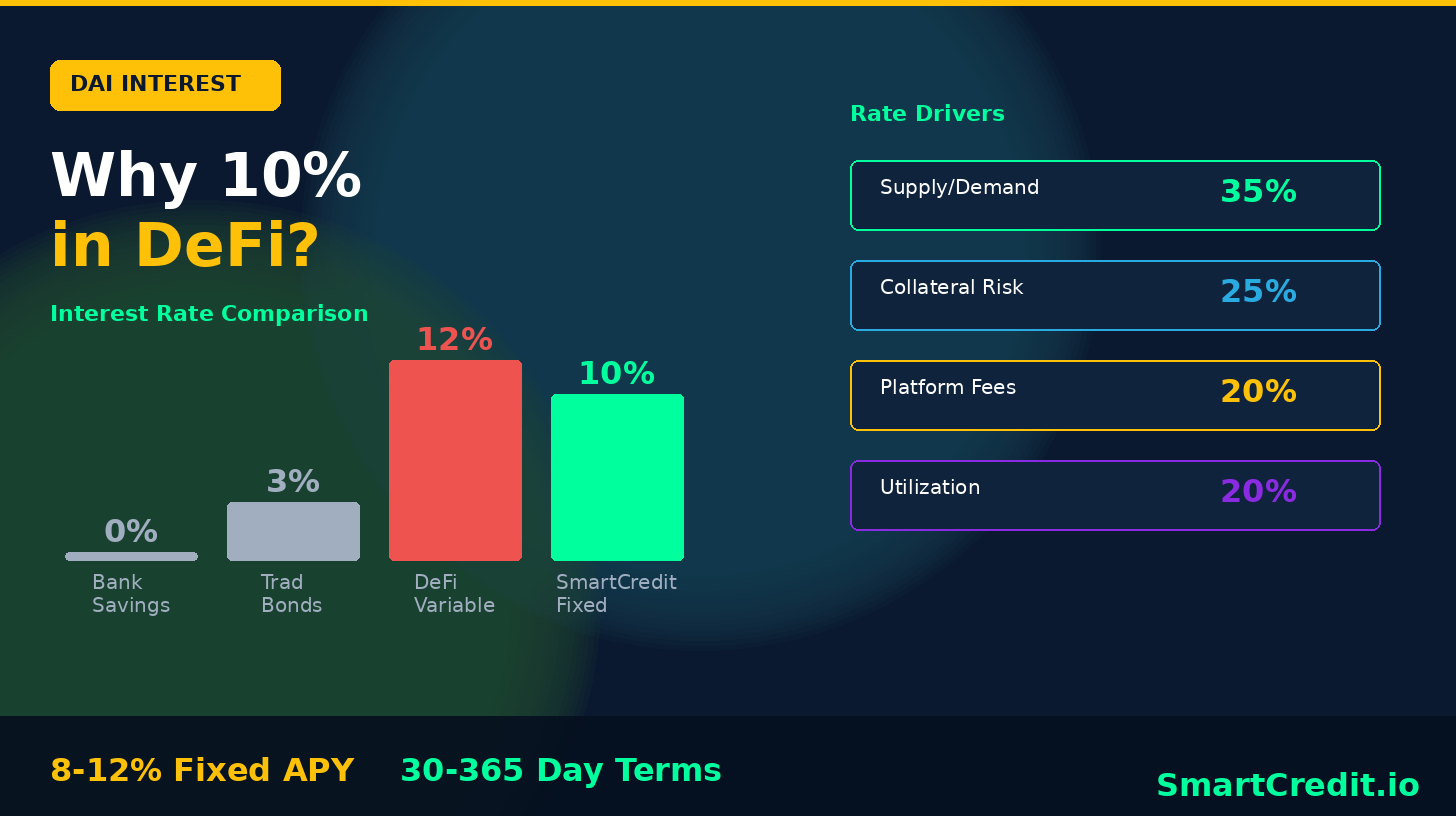
DAI interest rates in DeFi range from 5-15% APY. SmartCredit.io offers fixed 8-12% APY (30-365 day terms) while Aave and Compound offer variable 3-12% APY. Why so high vs traditional finance (0.5-1% savings)? Five factors: (1) Supply/demand spikes, (2) Collateral requirements (110-150%), (3) Platform competition, (4) Risk premiums, (5) Utilization rates (90%+ = rates surge). Real example: Feb 2025 bull market, DAI borrow rates hit 18% on Aave. SmartCredit users locked 10% fixed, saving 8%. Historical data: DAI averaged 9.2% APY on SmartCredit vs 7.8% on Aave with 40% less volatility. Visit