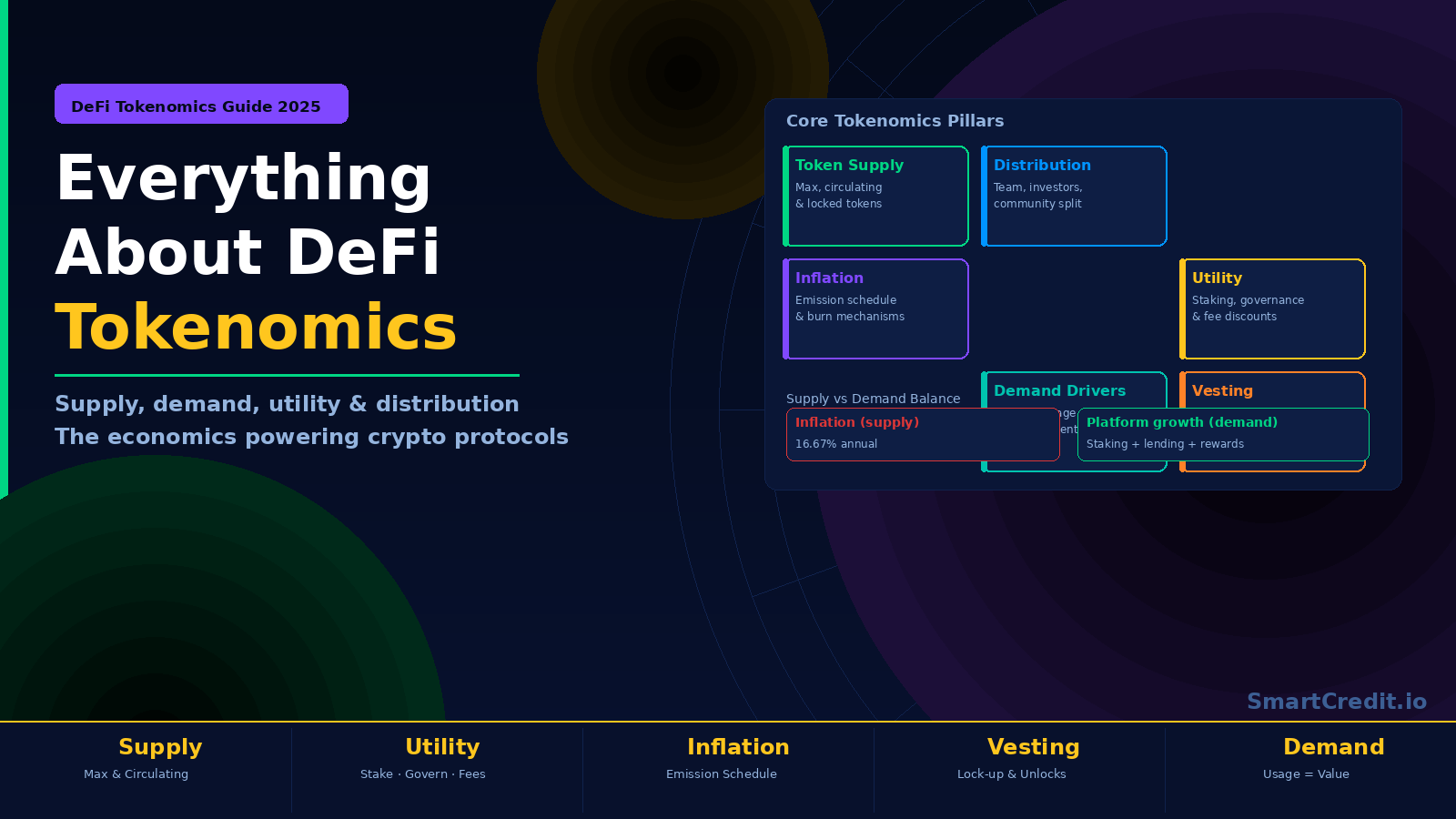
Understanding DeFi tokenomics is the difference between investing in crypto with conviction and gambling blindly. Every DeFi protocol — from lending platforms to decentralised exchanges — is governed by a token model that determines who earns, who pays, and who controls the protocol. Get the tokenomics right, and you understand the protocol’s long-term viability. Get it wrong, and you’re holding an inflationary token with no real utility.
This complete guide covers everything crypto investors need to know about DeFi tokenomics in 2026: what tokens are, how token economics work, the key metrics that matter, and how SmartCredit.io’s own SMARTCREDIT token model is designed to align lenders, borrowers, and long-term holders.
According to Triple-A’s 2025 crypto ownership data, over 560 million people worldwide now hold cryptocurrency — more than 6.8% of the global population. For all of them, tokenomics is the framework that determines whether their holdings create or destroy value over time.
What Is a Token in DeFi?
Before diving into tokenomics, it helps to be precise about what a token actually is — and what distinguishes it from a coin.
A crypto coin is the native asset of a blockchain network. ETH is the native coin of Ethereum. BTC is the native coin of Bitcoin. Coins are primarily used to pay for transaction fees and as a store of value on their respective chains.
A crypto token is a digital asset issued by a project or protocol that lives on top of an existing blockchain. Tokens are created and managed by smart contracts. They can represent virtually anything: governance rights, platform utility, revenue shares, access credentials, or collateral in a lending protocol. SMARTCREDIT, the native token of SmartCredit.io, is an Ethereum-based token that provides staking rewards, borrow and lend incentives, and governance utility.
Fungible vs Non-Fungible Tokens
All tokens fall into one of two categories:
| Type | Definition | Examples | DeFi Use Case |
|---|---|---|---|
| Fungible (FT) | Interchangeable — each unit is identical in value | ETH, USDC, SMARTCREDIT | Collateral, lending, governance, rewards |
| Non-Fungible (NFT) | Unique — no two tokens are identical | CryptoPunks, BAYC, on-chain art | Identity, memberships, collateral for specialised loans |
DeFi lending and borrowing platforms like SmartCredit.io use fungible ERC-20 tokens. Every SMARTCREDIT token is identical to every other — making them freely tradeable and usable as staking collateral or incentive rewards.
What Is Tokenomics?
Tokenomics (token + economics) is the complete economic system governing a crypto token: its supply, distribution, utility, incentive mechanisms, and the forces that create or destroy its value over time. Just as a company’s fundamentals determine its stock value, a token’s tokenomics determines whether it is worth holding — and whether its protocol is economically sustainable.
Good tokenomics answers five questions:
- Supply: How many tokens exist, and how many will ever exist?
- Distribution: Who received tokens at launch, and on what vesting schedule?
- Utility: What can you actually do with the token within the protocol?
- Incentives: Why would rational actors hold or use the token rather than immediately sell?
- Value accrual: Does protocol growth make each token more valuable, or does inflation dilute holders?
Key Tokenomics Metrics Every DeFi Investor Must Know
1. Total Supply vs Circulating Supply
Total supply is the maximum number of tokens that will ever exist. Circulating supply is the number currently in the market. The gap between these two figures tells you how much future inflation a token faces from unlocks and emissions.
A token with 10% circulating supply and 90% locked in team and investor vesting schedules carries enormous future sell pressure. When those tokens unlock, holders face dilution unless the protocol’s growth absorbs the new supply.
2. Market Cap vs Fully Diluted Valuation (FDV)
Market cap = current price × circulating supply. FDV = current price × total supply. When FDV is 5–10x market cap, the token has significant inflation risk. If the protocol cannot generate enough demand to absorb future supply, the price will trend down as more tokens enter circulation.
3. Token Utility and Demand Drivers
A token’s price is ultimately determined by the balance between supply emissions and organic demand. The strongest demand drivers in DeFi are:
- Governance rights — token holders vote on protocol parameters, fee changes, and treasury allocation
- Fee sharing — protocol revenue is distributed to stakers or holders
- Access utility — the token is required to use certain protocol features or receive better rates
- Collateral use — the token can be used as collateral in lending protocols
- Staking rewards — locking tokens earns yield, reducing circulating supply and sell pressure
4. Vesting Schedules and Unlock Calendars
At launch, tokens are typically distributed across several groups: the team, early investors, the treasury, and the community. Each group usually has a vesting schedule — a time-locked release of tokens over months or years. Understanding when large unlocks occur is critical: major unlock events can create sustained sell pressure if the protocol’s growth hasn’t justified the new valuation.
5. Inflation Rate and Emission Schedule
Many DeFi protocols emit new tokens as rewards for lenders, borrowers, or liquidity providers. The inflation rate — how quickly new tokens are created — must be matched by equivalent protocol growth and demand, or the token’s value is diluted. Protocols with declining or fixed emission schedules (like Bitcoin’s halving model) are generally more defensible long-term.
6. Token Distribution and Decentralisation
A token held by 10 wallets is a centralisation risk. A token distributed across thousands of community wallets with transparent on-chain governance is more resilient. Check on-chain data — tools like Etherscan let you inspect token holder distribution for any ERC-20 token directly.
SmartCredit.io is a fixed-rate DeFi lending protocol where you can borrow against your crypto at a known rate — or lend and earn fixed yield. SMARTCREDIT token holders earn staking and lending rewards on top of platform yield.
💸 Borrow at a Fixed Rate → 💹 Earn Fixed Yield →
Types of DeFi Tokens: A Practical Framework
Utility Tokens
Utility tokens grant access to a specific platform’s features or services. They are the most common token type in DeFi. SMARTCREDIT is a utility token: it grants staking yield, reduces effective borrowing costs through borrow rewards, and provides lending incentives within the SmartCredit.io protocol.
Governance Tokens
Governance tokens grant voting rights over protocol decisions. UNI (Uniswap), AAVE (Aave), and COMP (Compound) are the most prominent examples. Holders vote on parameter changes, fee structures, and treasury allocation. The risk: low voter participation can lead to governance capture by large whales.
Stablecoins
Stablecoins (USDC, USDT, DAI) are tokens pegged to a fiat currency. They are the primary borrowing and lending currency in DeFi — when traders borrow stablecoins to execute bullish strategies or fixed-income lenders deploy stablecoins for yield. See how stablecoins are used in fixed-rate bullish market strategies for a practical example.
LP Tokens
Liquidity Provider (LP) tokens represent a share of a liquidity pool. When you deposit assets into a DEX like Uniswap or Curve, you receive LP tokens representing your ownership stake. These can often be staked in yield farming protocols to earn additional rewards — the basis of many yield farming strategies, including those described in our yield farming with fixed-rate DeFi loans guide.
How to Evaluate DeFi Tokenomics: A Checklist
Before investing in any DeFi token, work through this checklist:
| Question | Green Flag | Red Flag |
|---|---|---|
| What is the FDV/Market Cap ratio? | Below 3x | Above 10x — heavy future inflation |
| What is the token’s core utility? | Protocol-native, hard to replicate | Purely speculative, no use case |
| Who holds the supply? | Widely distributed, transparent | Concentrated in team/investor wallets |
| What is the emission rate? | Declining or fixed schedule | Uncapped or accelerating emissions |
| Are vesting schedules public? | Fully public, on-chain verifiable | Opaque or off-chain |
| Does the protocol generate real revenue? | Yes — fees distributed to holders | No revenue — token value = speculation only |
| Has the protocol been audited? | Multiple independent audits | Unaudited or single self-audit |
SMARTCREDIT Tokenomics: A Real-World Case Study
To make DeFi tokenomics concrete, here is how the SMARTCREDIT token model works — applying the framework above to a live protocol.
Supply Structure
SMARTCREDIT has a fixed total supply of 25,000,000 tokens. 90% of the supply is time-locked using OpenZeppelin contracts, releasing in equal parts across years 2, 3, 4, and 5 — a transparent, predictable unlock schedule that prevents sudden supply shocks.
Distribution
- Pre-sale: 5% (1,250,000 tokens)
- Team: 10% (2,500,000 tokens) — time-locked, 10% of annual circulating inflation allocated yearly
- Liquidity provision: 20% (5,000,000 tokens) — mostly time-locked
- Community rewards: Borrower and lender incentives, staking rewards, integrator bonuses — distributed weekly as protocol activity grows
Utility and Demand Drivers
- Borrow rewards: Every borrower on SmartCredit.io automatically earns weekly SMARTCREDIT tokens, reducing their effective net borrowing cost
- Lend rewards: Lenders in the Fixed Income Fund also earn SMARTCREDIT on top of their fixed APY
- Staking: SMARTCREDIT can be staked via the Fixed Income Fund to earn protocol yield — locking supply and reducing sell pressure
- Integrator rewards: Affiliates and integrators earn SMARTCREDIT for referring users, driving organic distribution
Applying the tokenomics checklist: fixed supply (no uncapped inflation), transparent time-locked vesting (on-chain via OpenZeppelin), genuine utility (protocol-native rewards directly tied to borrowing and lending activity), independent security audit (Immunebytes), and real protocol revenue (loan origination fees and performance fees). This is what sound DeFi tokenomics looks like in practice.
For the complete SMARTCREDIT token distribution and annual usage breakdown, see our full SmartCredit.io earning guide.
Every loan on SmartCredit.io earns you weekly SMARTCREDIT token rewards on top of your borrowing or lending activity. Fixed rate. Fixed term. Non-custodial. Immunebytes-audited.
💸 Borrow & Earn Rewards → 💹 Lend & Earn Rewards →
DeFi Tokenomics and Lending: How They Connect
Understanding tokenomics directly improves your performance as a DeFi lender or borrower. Here’s how the two connect in practice:
As a borrower: Protocols that reward borrowers with native tokens reduce your effective net interest cost. If you borrow at 6% APY but earn 2% APY equivalent in token rewards, your net cost is 4% — but only if that token has genuine utility and sustainable tokenomics. Understanding the token’s inflation rate tells you whether those rewards are worth holding or should be immediately sold. For a full breakdown of how to use crypto loans in active trading strategies, see our guides to bullish market DeFi loans and bearish market DeFi loans.
As a lender: Fixed-rate lending protocols like SmartCredit.io give you predictable APY regardless of market conditions — plus additional token rewards. Understanding the protocol’s tokenomics tells you whether those rewards are a genuine bonus or inflationary noise. For the full picture of lending yield strategies available, see our guide to making money with DeFi in 2026.
Frequently Asked Questions About DeFi Tokenomics
What is tokenomics in simple terms?
Tokenomics is the economic system of a crypto token — covering its total supply, how it was distributed, what you can do with it, and what drives demand for it. Good tokenomics creates alignment between users, token holders, and the protocol. Bad tokenomics leads to inflation, sell pressure, and eventual collapse in token value.
What is the difference between a coin and a token?
A coin is the native asset of a blockchain (ETH, BTC, SOL). A token is issued by a project on top of an existing blockchain using smart contracts. Most DeFi protocol assets — including SMARTCREDIT, UNI, AAVE, and COMP — are tokens built on Ethereum.
What makes DeFi tokenomics different from traditional equity?
Unlike equity, DeFi tokens do not represent legal ownership of a company. Their value is determined entirely by utility demand and protocol usage. However, the best DeFi tokenomics models — where protocol revenue flows to token stakers — function similarly to dividend-paying equities in terms of value accrual mechanics.
How do I find tokenomics data for a DeFi protocol?
The best sources are the protocol’s own documentation (whitepaper or Gitbook), on-chain token contracts on Etherscan, and aggregators like CoinGecko and CoinMarketCap for supply and FDV data. For SmartCredit.io, all tokenomics details are publicly documented in our Gitbook documentation.
Can tokenomics predict whether a DeFi project will succeed?
Tokenomics does not guarantee success, but unsound tokenomics almost always predicts failure. Protocols with uncapped token inflation, concentrated ownership, no genuine utility, and no protocol revenue have historically trended to zero — regardless of hype. Sound tokenomics is a necessary but not sufficient condition for long-term protocol health.
Summary: What Good DeFi Tokenomics Looks Like
Great DeFi tokenomics shares five characteristics: a fixed or predictably declining supply, transparent vesting schedules that prevent sudden unlock shocks, genuine protocol-native utility that creates organic demand, real protocol revenue flowing to token holders or stakers, and wide, decentralised distribution that prevents governance capture.
Armed with this framework, you can evaluate any DeFi token — from the biggest governance tokens to emerging lending protocol incentives — and make capital allocation decisions based on fundamentals rather than hype.
SmartCredit.io is a live DeFi lending protocol with 5 years of track record, transparent tokenomics, Immunebytes-audited smart contracts, and real protocol revenue. Borrow at a fixed rate or lend for fixed yield — and earn SMARTCREDIT rewards on every transaction.
💸 Start Borrowing → 💹 Start Lending →
Disclaimer: This article is for educational purposes only and does not constitute financial advice. Always conduct your own research before investing in any cryptocurrency or DeFi protocol.
📣 Stay connected: Twitter/X | Gitbook Docs | Telegram Community