

How are loan requests matched?
SmartCredit.io automatically matches borrower loan requests with lender Fixed Income Funds by loan term, asset type, and collateral availability. The matching engine cannot access client assets - it only triggers smart contract interactions.
Last updated:
Key Takeaways
- SmartCredit.io acts as a matching engine between borrowers’ credit lines and lenders’ Fixed Income Funds (FIFs).
- Matching is based on loan term, borrowed asset, and the FIF bucket configuration chosen by the lender.
- The matching engine cannot access or move client assets - it only triggers smart contract events.
- Interest payments accumulated in FIFs are continuously re-matched with new loan requests.
- The system is currently run centrally; decentralized matching is on the roadmap.
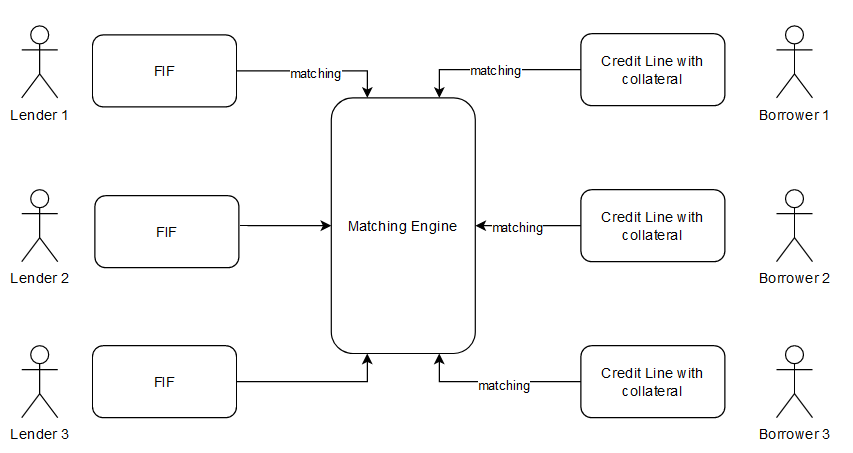
There are three components in the system:
- Borrowers define their collateralized loan requests with credit lines.
- Lenders define their fixed-income funds (FIF) and deposit the assets.
- SmartCredit.io is a matching engine, which matches borrowers’ loan requests with lenders’ fixed-income funds.
The matching engine is run centrally (in the future, decentrally). The matching engine cannot access client assets, but can only trigger the matching of the borrowers’ credit lines and the lenders’ fixed-income funds.
How Matching Works
When a borrower submits a loan request, the matching engine searches for a compatible FIF bucket:
- Asset match - the borrowed asset (e.g., USDC) must match the FIF’s lending asset.
- Term match - the loan term falls within the FIF bucket range (e.g., a 45-day loan matches Bucket 2: 31-90 days).
- Collateral check - the borrower must have sufficient collateral posted in their credit line.
- Funding - the engine triggers the smart contract to transfer funds from the matching FIF to the borrower’s credit line.
Interest payments flow back into the lender’s FIF as loans repay, and those accumulated funds are then continuously re-matched with new loan requests.
Further info
- Credit Lines - how borrowers set up collateralized borrowing accounts
- Fixed Income Funds - how lenders define their lending strategy
- SmartCredit.io: https://SmartCredit.io
- Twitter: https://twitter.com/Smartcredit_io
- Telegram: https://t.me/SmartCredit_Community
- Blog: https://SmartCredit.io/blog
- Learn: https://SmartCredit.io/learn