Every DeFi borrower faces the same fundamental question: fixed or variable interest rate? It sounds simple. But the answer has cost countless DeFi traders thousands of dollars in unexpected borrowing costs — and it explains why SmartCredit.io was built from the ground up around a fixed-rate, fixed-term model that traditional finance has used for centuries.
This guide breaks down exactly how fixed and variable DeFi interest rates work, why variable rates are structurally dangerous for planned strategies, what the traditional fixed income market tells us about where DeFi is heading, and how to lock a fixed rate on your next crypto loan today.
SmartCredit.io offers fixed-term, fixed-interest-rate crypto loans. Your rate is locked at origination for the full loan term — no utilisation spikes, no rate surprises, no forced position changes mid-strategy.
🔒 Open the Loan Calculator →
How Variable-Rate DeFi Lending Works Today
The dominant DeFi lending model — used by Aave, Compound, and MakerDAO — is based on the money-market-fund concept. It works like this:
- Lenders deposit assets into a shared liquidity pool and receive pool shares (interest-bearing tokens like aTokens or cTokens).
- Borrowers draw from this pool against overcollateralised positions.
- Interest rates are set algorithmically based on pool utilisation — the ratio of borrowed funds to total deposited funds.
- When utilisation rises, the rate rises. When utilisation falls, the rate falls. This happens at every block.
The result: both the interest rate and the loan term are variable. Borrowers have no loan maturity date — they can hold indefinitely as long as they maintain their collateral ratio. But they also have no certainty about what they will pay in interest over any given period.
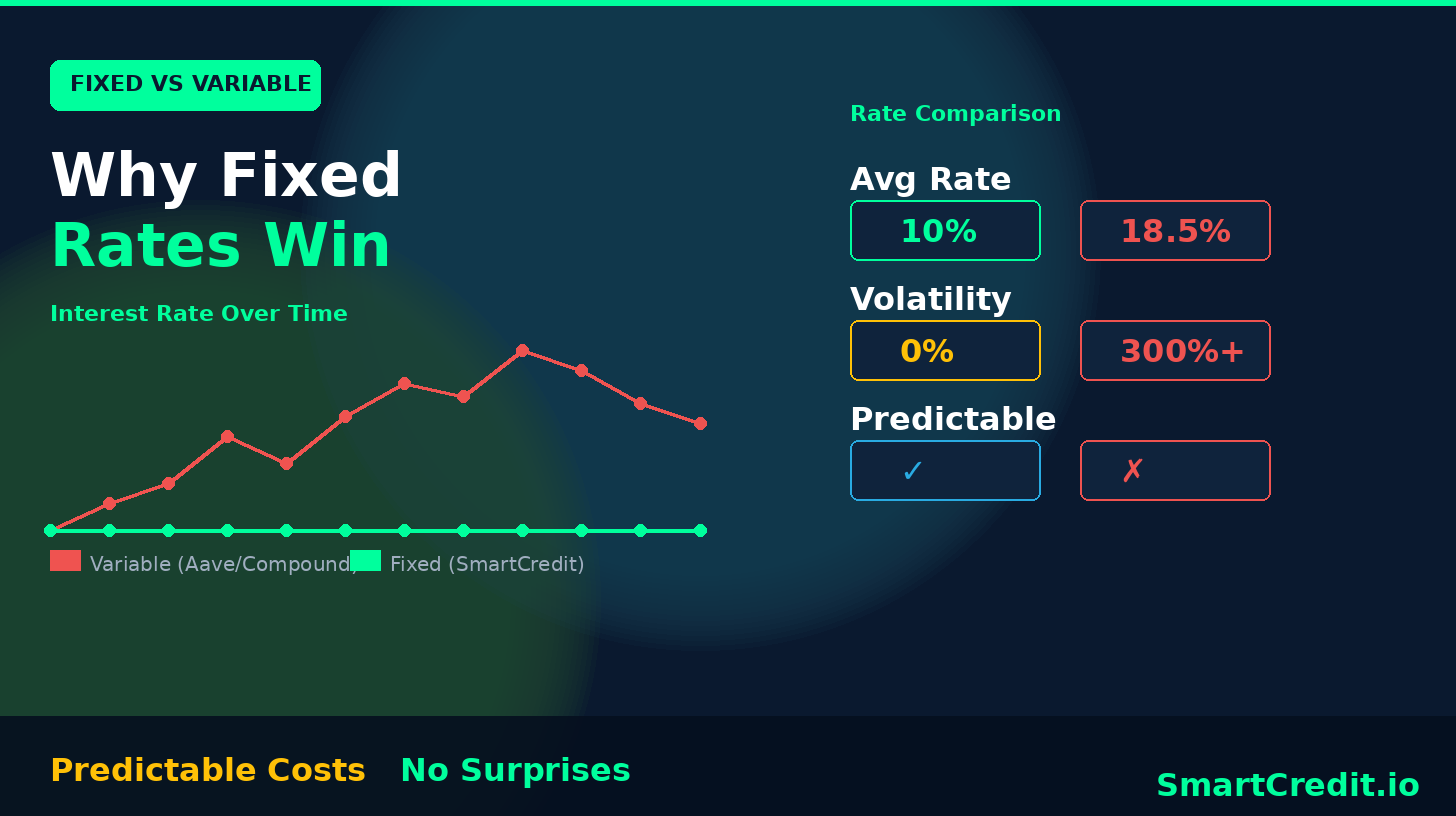
The mechanism creates a self-reinforcing rate feedback loop. When the market expects ETH to rise, traders rush to borrow DAI to buy ETH. DAI pool utilisation spikes. DAI borrowing rates spike. Traders who entered the position at 3% APY now face 25% APY — with no warning and no exit other than closing the position at a loss. Our 5-year DeFi interest rates comparison documents exactly this pattern across Aave V2, Aave V3, Compound V2, and MakerDAO — with daily rate data going back to 2019.
The Three Defining Features of Variable-Rate DeFi Lending
| Feature | Variable-Rate Protocols (Aave, Compound) | Impact on Borrower |
|---|---|---|
| Interest rate | Fluctuates every block based on utilisation | Cannot model P&L at entry |
| Loan maturity | Open-ended — no fixed term | No defined exit timeline |
| Collateral requirement | High — typically 70–80% LTV maximum | Capital inefficiency |
| Rate shock risk | Highest during market volatility | Strategy can become unprofitable mid-trade |
| Planning horizon | None — rates change every block | Impossible to calculate exact borrowing cost in advance |
How the Traditional Fixed Income Market Works
Traditional finance has two parallel lending markets:
- Money-market funds — short-duration, variable-rate instruments. Flexible, but unpredictable in cost. Used for short-term liquidity management.
- Fixed-income funds — fixed-rate, fixed-term instruments. Bonds, term deposits, fixed-rate mortgages. Used for planning, hedging, and stable income.
The ratio between these two markets is telling: the global fixed income market is approximately $130 trillion — roughly 10 times the size of the global money market fund sector. This 1:10 ratio is not arbitrary. It reflects a fundamental truth about how businesses, governments, and individuals actually want to borrow and lend: with known costs and known timelines.
In traditional finance, four combinations of rate and term are theoretically possible:
| Rate Type | Term Type | Primary Market | Example |
|---|---|---|---|
| Variable rate | Variable term | Money markets | Aave, Compound (current DeFi) |
| Fixed rate | Fixed term | Fixed income (10x larger) | Bonds, mortgages, SmartCredit.io |
| Fixed rate | Variable term | Derivatives only | Interest rate swaps |
| Variable rate | Fixed term | Derivatives only | Floating rate notes |
Note on the derivatives combinations: interest rate derivatives can convert variable-term loans into fixed-term, or fixed-rate loans into variable. But derivatives always sit on top of a primary spot market. Without the underlying spot market providing price discovery, derivatives arbitrage breaks down. This means DeFi fixed income cannot be solved purely through rate-swapping derivatives — it requires a native fixed-rate, fixed-term lending protocol as the foundation.
Why DeFi Urgently Needs Fixed-Rate, Fixed-Term Loans
DeFi started where it had to — with variable-rate, variable-term money market protocols. They were simpler to build and easier to bootstrap liquidity. But the same evolution that happened in traditional finance is now happening in DeFi: demand for fixed-rate products is growing precisely because variable-rate products have demonstrated their limitations.
The evidence is clear in the rate data. During the bull markets of 2021 and 2024, DAI and USDC borrowing rates on Aave and Compound regularly surged above 20–40% APY during peak demand. During the bear market of 2022, rates collapsed to near zero — destroying lender returns. Neither borrowers nor lenders could plan anything with confidence. For the complete five-year dataset, see our DeFi interest rates comparison.
The Borrower’s Case for Fixed Rates
For borrowers, fixed-rate loans deliver three structural advantages over variable-rate protocols:
- Predictable total cost — you know exactly what you will pay in interest before opening a position. Full P&L modelling is possible at entry.
- Lower collateral requirements — when a lender knows the loan term and rate, they can accept a lower collateral ratio. SmartCredit.io supports up to 90% LTV, versus 70–80% on variable-rate protocols. This means borrowers can deploy significantly more capital per unit of collateral.
- Strategy immunity to rate shocks — a bullish or bearish DeFi strategy executed with a fixed-rate loan cannot be disrupted by a mid-position rate spike. The cost is locked from day one.
To see exactly how these advantages play out in practice for both long and short strategies, see our guides to crypto loans in a bullish market and crypto loans in a bearish market.
SmartCredit.io fixed-rate loans give borrowers the capital efficiency and cost certainty that variable-rate protocols cannot. Choose your term, see your exact rate, lock it in.
💸 Calculate My Fixed-Rate Loan →
The Lender’s Case for Fixed Rates
For lenders, fixed-rate products are even more compelling. Variable-rate protocols offer yield that looks attractive in bull markets but collapses in bear markets — often at exactly the moment lenders want income most. Fixed-rate lending on SmartCredit.io delivers:
- Predictable APY — the yield you see when you create a Fixed Income Fund is the yield you receive for the full loan term, regardless of market conditions.
- No pool exposure — SmartCredit.io matches lenders directly with specific borrowers, not into a shared pool. Your capital is not diluted by other lenders entering or exiting.
- Weekly SMARTCREDIT rewards — on top of the fixed APY, lenders earn weekly SMARTCREDIT token rewards that add an additional return layer.
- Overcollateralised protection — every loan is backed by borrower collateral exceeding the loan value, protecting principal.
For a full breakdown of all yield strategies available on SmartCredit.io — from simple Fixed Income Fund lending to leveraged staking — see our complete SmartCredit.io earning guide.
SmartCredit.io Fixed Income Funds pay a known APY for the full loan term. Set your investment rules, earn fixed yield on every matched loan, and collect weekly SMARTCREDIT token rewards on top.
💹 Open a Fixed Income Fund →
Fixed Rate vs Variable Rate: Complete Side-by-Side Comparison
| Factor | Variable Rate (Aave, Compound) | Fixed Rate (SmartCredit.io) |
|---|---|---|
| Interest rate | Changes every block | Locked at origination for full term |
| Loan term | Open-ended, no maturity | Fixed — defined at origination |
| Borrowing cost predictability | None | Exact cost known before entry |
| Rate shock risk | High — worst during market stress | Zero |
| Max LTV for borrowers | 70–80% | Up to 90% |
| Lender yield predictability | Varies with utilisation | Fixed for full term |
| Capital efficiency | Lower — high collateral requirements | Higher — up to 90% LTV |
| P&L modelling at entry | Impossible | Fully calculable |
| Best suited for | Short-term liquidity, no defined horizon | Planned strategies with defined hold period |
| Token rewards | Protocol-specific (varies) | Weekly SMARTCREDIT rewards for both sides |
The DeFi Fixed Income Gap — and Why It’s Closing
Traditional finance’s fixed income market is roughly 10 times the size of its money market sector. DeFi today is the inverse: almost all DeFi lending TVL sits in variable-rate money market protocols, with fixed-rate protocols representing a small but rapidly growing share.
This gap is closing for the same reason it closed in traditional finance: borrowers and lenders with real financial goals demand cost certainty. A treasury managing cash flow cannot accept a borrowing rate that might triple overnight. A fixed-income investor cannot accept a yield that collapses to near zero in a bear market. These are not edge cases — they are the majority of capital in traditional finance, and they are increasingly the majority of DeFi users as the space matures beyond pure speculation.
SmartCredit.io was founded on this thesis: that the DeFi fixed income market will ultimately replicate the 10:1 ratio of traditional fixed income — and that building the native fixed-rate, fixed-term infrastructure now positions both the protocol and its users to benefit from that structural shift. Understanding this shift is also key context for evaluating DeFi tokenomics — protocols with genuine fixed-rate utility have structurally stronger token demand than pure speculation-driven variable-rate platforms.
Frequently Asked Questions
What is the difference between a fixed and variable interest rate in DeFi?
A variable interest rate in DeFi changes every block based on pool utilisation — it can be 3% APY today and 30% APY tomorrow. A fixed interest rate is locked at loan origination and does not change for the full loan term, regardless of market conditions or pool utilisation. SmartCredit.io uses fixed rates; Aave and Compound use variable rates as their primary model.
Why are fixed-rate DeFi loans more capital efficient?
When a lender knows the exact loan term, they can model their risk more precisely and accept a lower collateral requirement from the borrower. This is why SmartCredit.io supports up to 90% LTV — versus 70–80% on variable-rate protocols where the open-ended term forces lenders to demand more collateral as a buffer against uncertainty.
Can I switch from a variable to a fixed rate on an existing DeFi loan?
Not directly within the same protocol. To move from variable to fixed, you would repay your variable-rate loan and open a new fixed-rate loan on SmartCredit.io. Many borrowers do exactly this when entering a period of expected market volatility, to eliminate the risk of rate spikes mid-strategy.
Is fixed-rate DeFi lending safe?
SmartCredit.io’s fixed-rate lending protocol has been independently audited by Immunebytes, a leading Web3 security firm. All loans are overcollateralised — borrowers post collateral exceeding the loan value. The non-custodial architecture means user funds remain in audited smart contracts throughout the loan term, not under platform custody.
What is a DeFi Fixed Income Fund?
A DeFi Fixed Income Fund on SmartCredit.io is a lender-configured investment rule set that automatically matches your deposited assets with borrowers’ loan requests based on your defined criteria — minimum rate, accepted collateral types, and term length. You earn a fixed APY on every matched loan, plus weekly SMARTCREDIT token rewards, without actively managing each individual loan.
Summary: Fixed Rates Are the Future of DeFi Lending
Variable-rate DeFi lending was the necessary starting point. But the trajectory of financial markets is clear: where scale and planning matter, fixed income dominates. The 10:1 ratio of fixed income to money markets in traditional finance is not a coincidence — it reflects the fundamental demand of borrowers and lenders for cost certainty and defined timelines.
DeFi is replicating this evolution. Fixed-rate protocols are growing. The borrowers and lenders who move early — locking fixed rates before the broader market reprices the value of rate certainty — will benefit most from this structural shift.
Join 50,000+ users on the leading fixed-rate DeFi lending protocol. Borrow at a locked rate or lend for fixed yield — with Immunebytes-audited smart contracts and a 5-year track record.
🔒 Borrow at a Fixed Rate → 💹 Earn Fixed Yield →
Disclaimer: This article is for educational purposes only and does not constitute financial advice. DeFi lending involves risk including potential loss of collateral. Always conduct your own research.
📣 Stay connected: Twitter/X | Gitbook Docs | Telegram Community