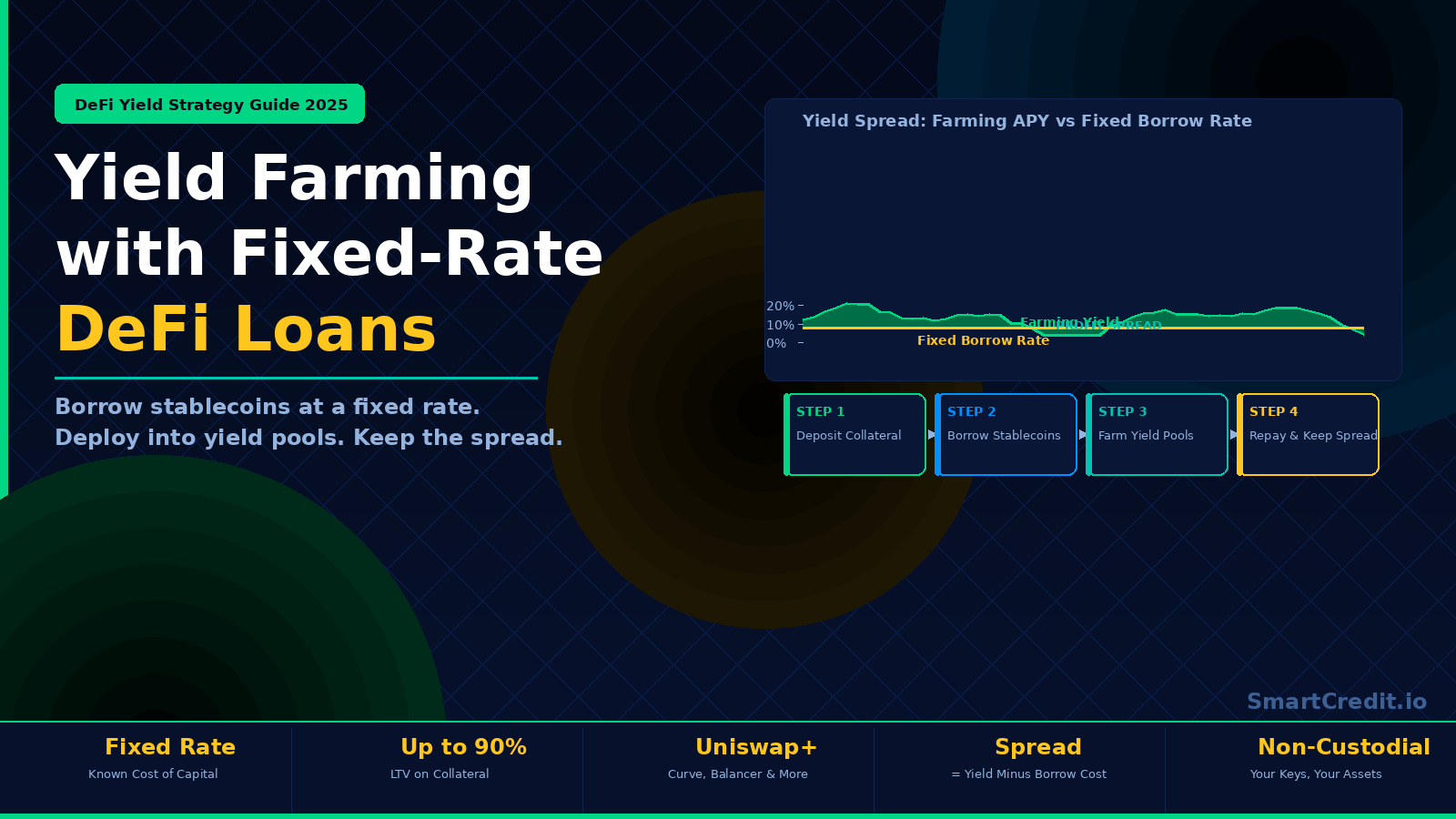
Yield farming earns you income from crypto you already own. Fixed-rate DeFi loans let you borrow at a predictable, locked cost. Combine the two — and you have one of DeFi’s most powerful strategies: borrow stablecoins at a fixed rate, deploy them into yield-generating pools, and pocket the difference between what you earn and what you pay.
This is yield farming with fixed-rate loans: a strategy where your borrowing cost is known in advance, your collateral stays intact, and your profit is the spread between farming yield and interest rate. No rate shock. No surprises mid-strategy. Just math that works — if you use the right lending platform.
This guide covers everything: what yield farming is, how to borrow stablecoins against your existing crypto at a fixed rate, which pools to target, and exactly how to calculate your net profit before you commit a single dollar.
Borrow stablecoins against your ETH, BTC, or altcoin collateral at a fixed rate on SmartCredit.io. Deploy into yield pools. Keep the spread as profit.
Calculate Your Loan →
What Is Yield Farming? A 2025 Primer
Yield farming is the practice of deploying crypto assets into DeFi protocols — primarily decentralized exchanges (DEXs) and liquidity pools — to earn income without selling your underlying holdings. Instead of letting your stablecoins or tokens sit idle in a wallet, you provide them as liquidity to protocols like Uniswap, Curve, or Balancer and earn a share of the trading fees those protocols generate.
There are two primary categories of yield farming:
DEX liquidity provision. Decentralized exchanges like Uniswap, Curve, and Balancer rely on liquidity providers (LPs) rather than traditional order books. LPs deposit token pairs into pools, and traders swap against those pools, paying a fee that is distributed back to the LPs proportionally. Uniswap V3 charges 0.05–1% per trade depending on the pool tier. Curve charges 0.04% on stablecoin swaps. These fees accumulate continuously and grow with trading volume.
Incentivised liquidity mining. Many protocols supplement trading fee income with additional token rewards distributed to liquidity providers. Curve distributes CRV governance tokens on top of trading fees, boosting effective APY significantly for stakers. Balancer distributes BAL tokens. These reward programs increase headline yield numbers but introduce exposure to the protocol’s native token price.
The key distinction for our strategy: stablecoin yield farming (e.g. Curve’s 3pool, Uniswap USDC/USDT pairs) carries essentially zero impermanent loss risk because both assets in the pair hold the same $1 peg. This makes stablecoin pools the ideal deployment target when farming with borrowed capital — you know your principal is stable while your farming yield accrues.
For a broader view of DeFi income strategies beyond yield farming, see our comprehensive guide: How to Make Money with DeFi in 2025: 9 Proven Strategies.
The Core Problem: Variable Borrow Rates Destroy Yield Farming Margins
Most DeFi borrowers fund their yield farming using variable-rate protocols — Aave, Compound, or MakerDAO. This creates a structural problem that most strategies ignore until it is too late.
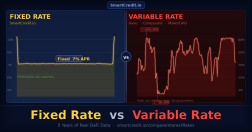
When you borrow against your ETH on Aave to fund a yield farming position, your borrowing cost is not fixed. It is recalculated algorithmically at every block based on pool utilisation. During normal market conditions this might sit at 4–6% APR. During a bull market, when demand for stablecoin loans surges, that same rate can spike to 30–60% APR within days — sometimes within hours.
Your yield farming position, meanwhile, is returning 8–18% APY. The moment your borrowing cost exceeds your farming yield, your “profit” becomes a loss. And because variable rates can triple overnight, there is no warning window. You wake up underwater.
This is not a hypothetical risk. Our DeFi Interest Rates Comparison covers five years of live daily rate data across Aave, Compound, and MakerDAO, showing that variable rates for USDC and DAI have reached 80%+ APR during market stress periods — precisely when you are least able to exit a farming position cleanly.
The solution is conceptually simple: borrow at a fixed rate. If your borrow cost is locked at 6% APR for 90 days, and your Curve stablecoin pool is returning 10–18% APY, your spread is locked in from day one. The strategy works regardless of what happens to Aave’s variable rate during that period.
How Fixed-Rate Loans Transform the Yield Farming Equation
SmartCredit.io is a peer-to-peer DeFi lending protocol built on Ethereum that offers fixed-term, fixed-interest-rate loans. The rate you agree to at origination is the rate you pay for the entire term — whether you borrow for 30 days or 180 days. No governance votes can change it. No utilisation spike can move it. It is contractually locked.
Here is why this changes the yield farming calculus entirely:
| Factor | Variable Rate (Aave/Compound) | Fixed Rate (SmartCredit.io) |
|---|---|---|
| Borrow cost known in advance | ✗ No | ✓ Yes |
| Spread calculable before entry | ✗ No | ✓ Yes |
| Risk of rate spike mid-strategy | ✗ High | ✓ None |
| Exit timing controlled by you | ~ Flexible but rate-driven | ✓ Fixed maturity date |
| Strategy profitability predictable | ✗ No | ✓ Yes |
The fixed rate is not just a convenience. It is the foundation that makes yield farming a calculable, plannable strategy rather than a gamble on whether your borrowing cost stays below your farming yield.
Enter your collateral, loan term, and amount. SmartCredit.io shows you the exact fixed rate instantly — so you can compare it against current farming yields and verify your strategy is profitable before committing.
Open the Loan Calculator →
The Yield Farming + Fixed Loan Strategy: Step by Step
The mechanics of this strategy are straightforward. Here is the complete flow from collateral deposit to profit realisation:
Step 1: Assess Your Collateral and Calculate Borrow Capacity
SmartCredit.io supports a wide range of collateral assets including ETH, wETH, wBTC, LINK, UNI, MKR, USDC, USDT, DAI, and other major ERC-20 tokens. Use the on-platform loan calculator to input your collateral amount, choose your preferred loan term (30 to 180+ days), and see the exact fixed interest rate and maximum borrowable amount instantly.
SmartCredit.io offers Loan-to-Value (LTV) ratios up to 90% on supported assets — 2 to 2.5× more borrowing power than standard DeFi protocols. This matters enormously for yield farming: more borrowed capital deployed into a farming pool means proportionally larger absolute returns. For a deep dive into why LTV ratio matters more than most DeFi users realise, see our guide on low collateral ratios and DeFi borrowing power.
Step 2: Submit the Loan Request and Receive Stablecoins
Once you have confirmed the fixed rate and loan term, submit your loan request and deposit your collateral into the smart contract. SmartCredit.io’s peer-to-peer matching engine connects your request with a lender whose Fixed Income Fund parameters match your loan. Once matched, stablecoins (USDC, DAI, or USDT) are delivered directly to your wallet.
The entire process takes minutes. There is no KYC, no credit check, and no custody of your collateral by SmartCredit.io — your assets are locked in a non-custodial smart contract that only releases on loan repayment or, in a default scenario, liquidation.
Step 3: Deploy Stablecoins into Yield Farming Pools
With stablecoins in your wallet, you now deploy into your chosen yield farming protocol. The most relevant pools for this strategy in 2025:
Curve Finance stablecoin pools. Curve is purpose-built for stablecoin swaps and offers some of the most capital-efficient yields available. The 3pool (DAI/USDC/USDT) and other stablecoin pairs generate trading fee income plus CRV token rewards. Because all assets in stablecoin Curve pools maintain the same $1 peg, impermanent loss is essentially zero. Effective APY ranges from 4–18% depending on CRV staking and lock periods.
Uniswap V3 concentrated liquidity. Uniswap V3’s concentrated liquidity model allows LPs to provide liquidity within specific price ranges, dramatically increasing fee capture efficiency compared to V2. A USDC/USDT position set within a tight range around $1 can earn significantly higher fees per dollar of capital than a standard AMM position.
Balancer stable pools. Balancer offers weighted and stable pool structures with BAL token incentives layered on top of trading fee income. Multi-asset stable pools with three or four stablecoins can offer yields comparable to Curve with similar minimal impermanent loss.
Yearn Finance vaults. For a fully automated approach, Yearn Finance automatically rotates stablecoin deposits across the highest-yielding protocols, rebalancing continuously to maximise return. This is ideal for yield farmers who want passive deployment without active pool management.
Step 4: Monitor the Spread and Manage the Position
Once deployed, your primary monitoring task is straightforward: ensure that your farming yield remains above your fixed borrow cost. Because the borrow cost is fixed, the only variable you need to track is the farming APY, which fluctuates with trading volume and protocol incentive changes.
Set up SmartCredit.io’s Telegram Positions Monitoring System (via Profile → Settings) to receive real-time notifications on your loan position, including collateral ratio alerts if your collateral value declines. This removes the need for constant manual monitoring.
Step 5: Redeem, Repay, and Keep the Spread
At loan maturity, withdraw your stablecoin position from the farming pool, repay the principal and fixed interest to SmartCredit.io, and retrieve your collateral. The difference between total farming yield earned and total interest paid is your net profit.
Collateral: 5 ETH (value: $15,000) | LTV: 67% | Loan: $10,000 USDC
Fixed borrow rate: 7% APR | 90-day interest cost: $175
Curve 3pool APY: 12% | 90-day farming yield on $10,000: $300
Net profit: $300 − $175 = $125 on $10,000 deployed (1.25% in 90 days)
Annualised net: ~5% on deployed capital. Collateral (ETH) retained in full. No ETH sold.
The example above uses conservative yield figures. With higher-incentive pools or CRV staking rewards, farming yields of 15–25% are achievable in active market conditions — widening the spread and multiplying the net return proportionally.
Input your collateral and preferred loan term. See your exact fixed rate, maximum loan amount, and interest cost — then compare to current Curve or Uniswap pool yields to verify your spread is positive before you borrow.
Try the Loan Calculator →
Why This Strategy Works: The Financial Logic
This strategy is a classic carry trade applied to DeFi — one of the oldest and most proven structures in institutional finance. A carry trade borrows at a lower cost and deploys into a higher-yielding asset, capturing the spread. The profitability depends entirely on two things: the size of the spread, and the stability of both the borrow cost and the yield.
With a variable-rate loan, the borrow cost is unstable — which makes the carry trade unreliable and potentially catastrophic during rate spikes. With a fixed-rate loan from SmartCredit.io, the borrow cost is fully stable for the loan term, making the carry trade as predictable as any structured financial product.
The strategy also preserves your long position on your collateral asset. If you hold ETH as collateral and ETH appreciates during the loan term, you benefit from that appreciation in full at loan maturity when you reclaim your collateral. You have not sold your ETH to fund the yield farming position — you have monetised it temporarily at a fixed cost while keeping full price upside.
This is precisely the logic behind crypto-backed borrowing as a tax-efficient liquidity strategy: since borrowing against crypto is not a taxable event (no sale occurs), you access stablecoin liquidity without triggering capital gains. Our comprehensive Crypto Loans and Taxes 2025 guide covers the full IRS and international tax treatment of crypto-backed loans in detail.
Risk Management: What Can Go Wrong and How to Mitigate It
No yield strategy is risk-free. Here are the primary risks of the yield farming + fixed loan approach and how to manage each:
Risk 1: Farming Yield Falls Below Borrow Cost
If the farming pool’s APY drops below your fixed borrow rate during the loan term, your spread turns negative. Mitigation: choose pools with historically stable or increasing yields (Curve stablecoin pools have shown resilience across market cycles). Start with conservative yield estimates — if the strategy only works at peak APY, the risk-adjusted return may not be worth it. Calculate your break-even yield before entry.
Risk 2: Collateral Value Drops Triggering Liquidation
If your ETH or altcoin collateral falls in value below the liquidation threshold, SmartCredit.io will liquidate sufficient collateral to repay the loan. Mitigation: maintain a significant buffer above the minimum collateral ratio at all times. Start with a lower LTV than the maximum — use 50–60% LTV rather than 90% to create a larger cushion. Monitor your collateral ratio via the Telegram alert system. SmartCredit.io’s multi-dimensional risk management gives you more room than pool-based protocols because the liquidation mechanics include a loss provision fund that protects both parties during flash crashes.
For a complete guide to collateral management and liquidation protection, see our article on using crypto as collateral for loans.
Risk 3: Smart Contract Risk in the Farming Protocol
Every DeFi protocol — Curve, Uniswap, Balancer — carries smart contract risk. A protocol exploit could drain liquidity pools. Mitigation: use only audited, battle-tested protocols with long track records. Diversify across two or three pools rather than concentrating all borrowed capital in a single protocol. Curve Finance, for example, has operated since 2020 with no major exploits and over $5 billion in TVL, making it one of the most battle-tested stablecoin protocols in DeFi.
According to DeFiLlama’s DEX tracker, the most established stablecoin-focused DEXs by TVL are consistently Curve, Uniswap, and Balancer — platforms with years of security audit history and multi-billion-dollar liquidity depth. These are the appropriate targets for a conservative fixed-rate farming strategy.
Risk 4: Impermanent Loss (Non-Stablecoin Pools)
If you farm in pools containing volatile assets (e.g. ETH/USDC), impermanent loss can erode or eliminate your yield income. Mitigation: for borrowed capital, stick exclusively to stablecoin-to-stablecoin pools. The Curve 3pool (DAI/USDC/USDT) is the benchmark safe choice — all three assets maintain the same dollar peg, so impermanent loss is negligible.
Advanced Variations: Stacking Additional Yield Layers
The basic strategy earns the spread between farming yield and borrow cost. There are two ways to amplify this:
Stack SMARTCREDIT Bonus Rewards on Your Loan
Every SmartCredit.io borrower automatically earns weekly SMARTCREDIT bonus rewards on their open loan position — worth 10–50% APY in additional token income. These rewards can be staked immediately for 40–80% APY in SMARTCREDIT staking returns. Layering this on top of your farming yield means your strategy earns on three tracks simultaneously: farming yield, borrow rewards, and staking on those rewards.
Our full guide on all earning strategies available on SmartCredit.io explains exactly how to stack these income layers for maximum capital efficiency.
Leveraged Lido Staking as an Alternative to DEX Farming
For ETH holders specifically, SmartCredit.io offers a direct alternative to DEX yield farming: Fixed Rate Leveraged Lido Staking, which multiplies your ETH staking yield by 2–5× using fixed-rate borrowed ETH in an automated loop strategy. This eliminates the DEX interaction layer entirely and delivers amplified staking yield from a single automated position. It applies the same fixed-rate carry trade logic but in a more structured, single-asset format.
Selecting the Right Farming Pools: A 2025 Reference
Not all yield farming pools are equal for this strategy. Here is a quick-reference breakdown by risk level and expected return:
| Protocol | Pool Type | Typical APY Range | IL Risk | Suitable for Borrowed Capital |
|---|---|---|---|---|
| Curve 3pool | DAI/USDC/USDT | 4–12% | Negligible | ✓ Ideal |
| Curve crvUSD pools | crvUSD stablecoin pairs | 6–18% | Very Low | ✓ Good |
| Uniswap V3 USDC/USDT | Stablecoin pair, 0.01% fee | 5–15% | Negligible | ✓ Good |
| Balancer Stable pools | 3–4 stablecoin | 4–14% | Very Low | ~ Consider |
| Yearn USDC/DAI vaults | Auto-optimised stablecoin | 5–16% | Negligible | ✓ Good |
| Uniswap V3 ETH/USDC | Volatile pair | 8–25% | High | ✗ Avoid |
Current live pool yields can be tracked on DeFiLlama’s yield dashboard, which aggregates APY data across every major DeFi protocol in real time. Always verify current yields before committing to a strategy — pool APYs fluctuate with trading volume and protocol incentives.
How SmartCredit.io Enables This Strategy Better Than Any Pool-Based Protocol
The yield farming + fixed loan carry trade is not new. What is new is having a lending platform that makes it genuinely executable: where the borrow cost is truly fixed, the LTV is competitive, the collateral range is broad, and the matching is fast.
SmartCredit.io’s peer-to-peer architecture — lenders and borrowers matched directly rather than through a pool — is what enables fixed rates in the first place. Pool-based protocols must use algorithmic variable rates because they serve an undifferentiated pool of capital; there is no mechanism to negotiate a fixed rate with a pool. SmartCredit.io’s direct matching means lenders can offer fixed terms and fixed rates to specific borrowers, creating the contract structure that makes this strategy calculable.
The credit scoring system adds another layer of advantage: borrowers who complete the optional credit scoring process qualify for lower interest rates, directly widening the farming spread. Combined with up to 90% LTV, gas-free subsequent borrowing transactions, and weekly SMARTCREDIT bonus rewards on open loan positions, SmartCredit.io is purpose-built for exactly this type of structured DeFi yield strategy.
If you are exploring how this fits into a broader crypto portfolio approach, our Crypto Portfolio Management guide covers professional allocation frameworks that incorporate DeFi yield strategies alongside traditional crypto holdings.
Frequently Asked Questions
What is yield farming with fixed-rate loans?
It is a carry trade strategy where you borrow stablecoins at a fixed interest rate using your crypto as collateral, deploy those stablecoins into yield-generating DeFi pools (such as Curve or Uniswap), and earn the spread between the farming APY and your fixed borrow cost as net profit. The fixed rate ensures that your borrowing cost cannot change mid-strategy, making the profit calculable before entry.
Why is a fixed rate essential for this strategy?
A variable borrow rate can spike above the farming yield at any point — turning a profitable strategy into a loss without warning. Five years of DeFi rate data show that variable rates on Aave and Compound have reached 80%+ APR during market stress periods. A fixed rate eliminates this risk entirely by locking your cost of capital for the full loan term.
Which yield farming pools work best with this strategy?
Stablecoin-to-stablecoin pools — such as Curve’s 3pool (DAI/USDC/USDT) and Uniswap V3 USDC/USDT pairs — are ideal because they carry negligible impermanent loss risk. Volatile pairs like ETH/USDC introduce impermanent loss that can offset farming yield and should be avoided when farming with borrowed capital.
What happens if my collateral value drops during the loan?
If your collateral falls below SmartCredit.io’s liquidation threshold, the platform will liquidate sufficient collateral to repay the loan. To protect against this, maintain a significant buffer above the minimum ratio — use 50–60% LTV rather than the maximum 90%, and enable Telegram alerts to monitor your collateral ratio in real time.
Can I earn SMARTCREDIT rewards on top of farming yield?
Yes. Every SmartCredit.io borrower automatically earns weekly SMARTCREDIT bonus rewards (10–50% APY) on their open loan balance. These can be staked for an additional 40–80% APY in staking rewards. Stacking these on top of farming yield creates a three-layer income structure from a single loan position.
What is the minimum loan size for this strategy?
There is no hard minimum on SmartCredit.io, but the strategy becomes most economically meaningful at loan sizes of $1,000 or more, where the absolute spread income meaningfully exceeds any minor gas costs associated with deploying into farming pools.
🚀 Ready to Put Your Crypto to Work in Yield Farming?
Borrow stablecoins at a fixed rate against your ETH or BTC. Deploy into Curve, Uniswap, or Yearn. Keep the spread. Retrieve your collateral at maturity.
Disclaimer: This article is for educational purposes only and does not constitute financial or investment advice. Yield farming, DeFi lending, and crypto-backed borrowing carry significant risks including smart contract risk, liquidation risk, and asset price volatility. Always conduct your own research and assess your personal risk tolerance before implementing any DeFi strategy.